Best CO2 Monitors for Classrooms and Offices (2026)
Best CO2 monitors for classrooms and offices in 2026. Track ventilation levels and know exactly when to open windows.

Table of Contents
- Our Top Picks
- Aranet4 HOME — Best Overall for Classrooms
- Airthings View Plus — Best for Multi-Room Office Monitoring
- SwitchBot CO2 Detector — Best Budget Option
- Qingping Air Monitor Gen 2 — Best CO2 + PM2.5 Combo
- Classroom Deployment Guide
- Single Classroom Setup
- School-Wide Deployment
- Office Meeting Room Setup
- Why CO2 Monitoring Matters for Productivity
- Next Steps
TL;DR
The best CO2 monitor for classrooms and offices is the Aranet4 HOME — its NDIR sensor is highly accurate, the e-ink display is readable from across a room, and the 2-year battery life means no cables or outlets needed. For offices that want cloud monitoring across multiple rooms, the Airthings View Plus offers WiFi dashboards and smart home integration. Budget buyers should look at the SwitchBot CO2 Detector at $60 with Matter smart home support.
Full Comparison
| # | Product | Best For | Rating | Price | |
|---|---|---|---|---|---|
| 1 | Aranet4 HOME Top Pick Aranet | Best Overall for Classrooms | 4.9 | $$ | Check Price |
| 2 | Airthings View Plus Airthings | Best for Multi-Room Office Monitoring | 4.8 | $$$ | Check Price |
| 3 | SwitchBot CO2 Detector SwitchBot | Best Budget NDIR CO2 Monitor | 4.3 | $ | Check Price |
| 4 | Qingping Air Monitor Gen 2 Qingping | Best CO2 + PM2.5 Combo | 4.5 | $$ | Check Price |
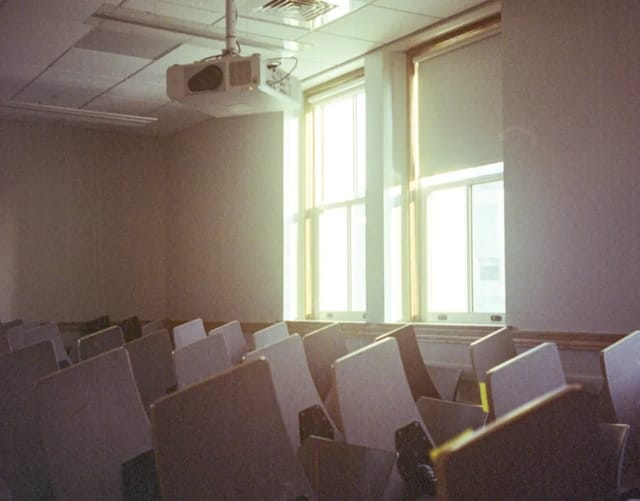
A single hour in a closed classroom with 25 students can push CO2 past 2,500 ppm — more than triple the level where cognitive performance starts declining. Most teachers and office managers have no idea this is happening because CO2 is invisible and odorless.
A CO2 monitor solves this by giving you a clear, real-time number. When it climbs past 800 ppm, open windows. When it drops, close them. This data-driven ventilation approach improves focus, reduces illness transmission, and saves energy compared to fixed ventilation schedules.
Our Top Picks
Aranet4 HOME — Best Overall for Classrooms
Rating: 4.9/5 | Price: ~$200
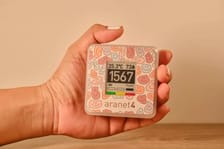
The Aranet4 HOME is the most-recommended CO2 monitor in education for good reason. Its NDIR sensor is accurate to ±30 ppm — among the best in any consumer device. The e-ink display is large, always-on, and readable from across a classroom without backlighting.
For classrooms specifically, the 2-year battery life on 2 AA batteries is critical. No outlet needed, no cables to manage, no charging. Mount it on a wall with adhesive strips and forget about it until you swap batteries in 2 years.
The Bluetooth app syncs data to your phone for history graphs, so teachers and facilities managers can track CO2 patterns across the day and week. Some schools configure an Aranet4 in every classroom and use the app to monitor all of them from the office.
Best for: Individual classrooms, portable use between rooms, teachers who want a simple visual indicator.
Limitations: No WiFi — Bluetooth sync requires proximity. No cloud dashboard for remote monitoring.
Airthings View Plus — Best for Multi-Room Office Monitoring
Rating: 4.8/5 | Price: ~$300
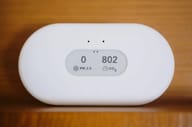
For offices and schools that want centralized monitoring across multiple rooms, the Airthings View Plus is the premium choice. WiFi connectivity pushes data to a cloud dashboard where you can track every room from one screen.
Beyond CO2, the View Plus also monitors PM2.5, VOCs, temperature, humidity, radon, and air pressure. For office environments where comfort complaints about temperature and stuffiness are common, having all this data in one dashboard is powerful for facilities management.
IFTTT and SmartThings integration means you can create automations — for example, turning on supplemental ventilation fans when CO2 exceeds 1,000 ppm.
Best for: Offices and schools deploying multiple monitors with centralized management. Facilities managers who want a dashboard.
Limitations: Premium price, especially for deploying many units. Battery life is shorter than the Aranet4 (about 1 year with WiFi). Overkill for a single classroom.
SwitchBot CO2 Detector — Best Budget Option
Rating: 4.3/5 | Price: ~$60
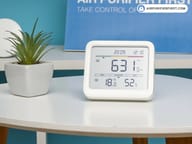
At $60, the SwitchBot CO2 Detector brings true NDIR CO2 sensing to classrooms and offices that cannot justify $200+ per room. It also measures temperature and humidity.
The color display shows CO2 with green/yellow/red indicators that anyone can understand at a glance. Matter smart home support means it works with Apple Home, Google Home, and Amazon Alexa without proprietary hub requirements.
For schools deploying monitors in every classroom on a budget, the SwitchBot makes it financially possible. At $60 per unit, you can outfit 5 classrooms for the price of one Aranet4.
Best for: Budget-conscious deployments, smart home integration, offices that want affordable CO2 awareness in every meeting room.
Limitations: Display is smaller than the Aranet4 — harder to read from across a room. Requires USB-C power (no battery option). NDIR accuracy is adequate but not as tight as the Aranet4.
Qingping Air Monitor Gen 2 — Best CO2 + PM2.5 Combo
Rating: 4.5/5 | Price: ~$120
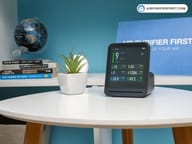
The Qingping Air Monitor Gen 2 measures CO2 with an NDIR sensor alongside PM2.5, PM10, temperature, and humidity. The compact touchscreen display shows all readings clearly.
For offices near construction sites or busy roads, or schools concerned about both ventilation and particulate matter, the Qingping covers both at a reasonable price. WiFi connectivity enables remote monitoring through the app.
Best for: Offices and classrooms that want CO2 and PM2.5 monitoring in one device at a mid-range price.
Limitations: Not as accurate for CO2 as the Aranet4. Requires USB-C power. Less portable than battery-powered options.
Classroom Deployment Guide
Single Classroom Setup
- Mount one Aranet4 HOME or SwitchBot CO2 Detector on the wall at seated breathing height (3-4 feet), away from windows and doors
- Set a classroom rule: open windows when the display turns yellow (typically 800-1,000 ppm)
- Close windows when readings drop back to green (below 800 ppm)
- This simple protocol keeps CO2 low while minimizing heat or cooling loss
School-Wide Deployment
- Deploy one monitor per occupied classroom — SwitchBot at $60/unit makes this affordable
- For centralized monitoring, use Airthings View Plus units connected to the cloud dashboard
- Establish school-wide ventilation thresholds (e.g., 800 ppm = open windows, 1,200 ppm = mechanical ventilation)
- Review weekly CO2 data to identify rooms with chronic ventilation problems
- Prioritize HVAC improvements based on data rather than complaints
Office Meeting Room Setup
Meeting rooms with 6-10 people often hit 1,500+ ppm within 30 minutes. Place a monitor in every meeting room and common area. Set a visible reminder: "If the CO2 display shows yellow, open the door or shorten the meeting."
Why CO2 Monitoring Matters for Productivity
Research from Harvard's T.H. Chan School of Public Health found that cognitive function scores were 61% higher in green building conditions (low CO2 + low VOCs) compared to conventional buildings. Specifically:
- At 600 ppm CO2, cognitive scores were at baseline
- At 1,000 ppm, scores dropped 15%
- At 2,500 ppm, scores dropped 50%
For a classroom or office, the difference between 600 and 1,500 ppm CO2 is the difference between sharp thinking and mental fog. A $60-200 monitor makes this invisible problem visible.
Next Steps
- For more CO2 monitor options, see our comprehensive best CO2 monitors for home roundup
- Learn what CO2 levels mean for health and productivity in What Is a Good CO2 Level Indoors?
- Compare the top two premium monitors in our Aranet4 vs Airthings View Plus head-to-head
- Understand how to test your full air quality in How to Test Air Quality at Home