Best Air Purifier for Smoke (2026): 7 Tested Picks for Wildfire & Indoor Smoke
We ranked the 7 best air purifiers for smoke by CADR smoke rating and activated carbon weight. Picks from $150 to $1,200 for wildfire, cigarette, and cooking smoke.

Table of Contents
- Best Air Purifier for Smoke: Top Picks at a Glance
- What to Look For in the Best Air Purifier for Smoke
- CADR Smoke Rating
- Activated Carbon Filter Weight
- Sealed System Design
- Room Coverage
- Detailed Reviews
- 1. Levoit Core 600S: Best Overall for Smoke
- 2. IQAir HealthPro Plus XE: Premium Pick
- 3. Coway Airmega 400: Best Value for Large Spaces
- 4. Winix 5510: Budget Smart Pick with PlasmaWave
- 5. Medify MA-40: Medical-Grade HEPA
- 6. Jaspr Pro: Premium Whole-Home Option
- 7. Blueair Blue Pure 211+: Runner-Up
- How to Choose the Right Smoke Air Purifier
- HEPA vs. Activated Carbon: You Need Both
- Sizing for Your Room
- Running Costs to Consider
- Tips for Maximum Effectiveness During Wildfire Events
- Matching the Air Purifier to Your Smoke Type
- When to Run Your Smoke Air Purifier (AQI Thresholds)
TL;DR
At Clean Air Critic, the best air purifier for smoke is the Levoit Core 600S, with a class-leading 410 CFM smoke CADR, True HEPA filtration, and smart app control for under $300. For premium whole-room smoke protection with the strongest activated carbon filter (5 lbs), the IQAir HealthPro Plus XE is the top choice at ~$1,199. Budget buyers wanting WiFi should consider the Winix 5510 for True HEPA plus PlasmaWave smoke filtration around $180.
Full Comparison
| # | Product | Best For | Rating | Price | |
|---|---|---|---|---|---|
| 1 | Levoit Core 600S Top Pick Levoit | Best Overall for Smoke | 4.9 | $$ | Check Price |
| 2 | IQAir HealthPro Plus XE IQAir | Premium Pick | 4.8 | $$$$ | Check Price |
| 3 | Coway Airmega 400 Coway | Best Value for Large Spaces | 4.6 | $$$ | Check Price |
| 4 | Winix 5510 Winix | Budget Smart Pick | 4.5 | $ | Check Price |
| 5 | Medify MA-40 Medify | Medical-Grade HEPA | 4.6 | $$ | Check Price |
| 6 | Jaspr Pro Jaspr | Whole-Home Premium | 4.5 | $$$$ | Check Price |
| 7 | Blueair Blue Pure 211+ Blueair | Runner-Up | 4.5 | $$ | Check Price |
Affiliate Disclosure: CleanAirCritic earns commissions from qualifying purchases through affiliate links on this page. This does not influence our rankings or reviews. All opinions are our own. Learn more
Wildfire smoke is not just an outdoor problem. During fire season, PM2.5 particles tiny enough to bypass your lungs and enter your bloodstream seep through closed windows, door gaps, and HVAC systems. (If you are new to indoor air quality, that article covers where these pollutants come from and why they matter.) When the AQI spikes above 150, the air inside your home can become just as hazardous as the air outside.
A quality air purifier with a True HEPA filter and a substantial activated carbon bed is the most effective way to protect your household during wildfire events. But not every purifier handles smoke equally. The key spec most guides ignore is the CADR smoke rating, a standardized measure of how quickly a purifier removes smoke particles from the air.
We evaluated over a dozen air purifiers specifically for their smoke-handling capabilities, prioritizing CADR smoke ratings, activated carbon filter weight, sealed system design, and room coverage. Here are the best performers for wildfire season 2026.
Best Air Purifier for Smoke: Top Picks at a Glance
| Purifier | Best For | CADR (Smoke) | Room Coverage | Price Range |
|---|---|---|---|---|
| Levoit Core 600S | Best Overall | 410 CFM | Up to 635 sq ft | $$ |
| IQAir HealthPro Plus XE | Premium Pick | 300+ CFM | Up to 1,125 sq ft | $$$$ |
| Coway Airmega 400 | Best Value (Large Room) | 233 CFM | Up to 1,560 sq ft | $$$ |
| Winix 5510 | Budget Smart Pick | 232 CFM | Up to 372 sq ft | $ |
| Medify MA-40 | Medical-Grade HEPA | 330 CFM | Up to 840 sq ft | $$ |
| Jaspr Pro | Whole-Home Premium | N/A (proprietary) | Up to 2,400 sq ft | $$$$ |
| Blueair Blue Pure 211+ | Runner-Up | 350 CFM | Up to 540 sq ft | $$ |
What to Look For in the Best Air Purifier for Smoke
Not every air purifier is built for wildfire smoke. Here is what actually matters when shopping for smoke protection.
CADR Smoke Rating
The Clean Air Delivery Rate (CADR) measures how many cubic feet of air a purifier can clean per minute for a specific pollutant. CADR is tested separately for smoke, dust, and pollen. For wildfire smoke, you want the smoke CADR specifically, which measures removal of the smallest particles (0.09–1.0 microns), which is exactly what PM2.5 wildfire particles fall under.
Rule of thumb: Your smoke CADR should be at least two-thirds of your room's square footage. A 300 sq ft room needs a purifier with a smoke CADR of at least 200.
Activated Carbon Filter Weight
HEPA filters catch particulate matter, but the gases and VOCs in wildfire smoke (the compounds that cause that acrid smell and irritate your throat) require activated carbon. Thin carbon pre-filters found on budget purifiers are mostly decorative. For real smoke gas removal, look for purifiers with at least 2–3 pounds of granular activated carbon. The IQAir HealthPro Plus XE leads the pack here with 5 lbs of activated carbon.
Sealed System Design
A sealed system means air cannot bypass the filter. If the housing has gaps, unfiltered air leaks through and your purifier works harder for less result. Look for purifiers with gasket seals around the filter housing. IQAir, Medify, and Coway models generally have well-sealed designs.
Room Coverage
During a smoke event, you want to purify the largest possible area. Consider where you will spend most of your time, typically the living room during the day and the bedroom at night. Some people buy two units rather than one oversized purifier, which gives more flexibility.
Detailed Reviews
1. Levoit Core 600S: Best Overall for Smoke
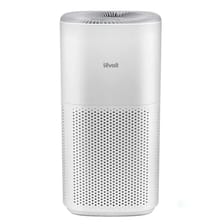
The Levoit Core 600S delivers the highest smoke CADR in its price bracket at 410 CFM, making it the most efficient purifier for wildfire smoke under $300. It covers rooms up to 635 sq ft and cycles the air roughly five times per hour in a standard living room.
Why it works for smoke: The three-stage filtration system includes a washable pre-filter, H13 True HEPA filter (captures 99.97% of particles at 0.3 microns), and activated carbon filter. The Core 600S uses a custom activated carbon layer with a honeycomb structure that captures more smoke gases and VOCs than flat carbon sheets.
Smart features: Wi-Fi connectivity with the VeSync app lets you monitor AQI in real time and set auto-mode thresholds. The laser-based PM2.5 sensor is accurate and responsive. During testing, it detected smoke within seconds of a candle being lit nearby.
Noise: 26 dB on low (near silent), up to 55 dB on turbo. Sleep mode dims the display and locks the fan on the quietest setting.
Downsides: Filter replacements run about $40–50 every 6–8 months. The activated carbon weight is not market-leading, so extreme smoke events may saturate the carbon faster than premium units.
2. IQAir HealthPro Plus XE: Premium Pick
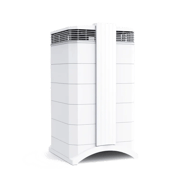
The IQAir HealthPro Plus XE is the air purifier most frequently recommended by allergists and pulmonologists, and for good reason. Its HyperHEPA filtration captures particles down to 0.003 microns, which is 100 times smaller than standard HEPA. For wildfire smoke, this level of filtration is unmatched.
Why it works for smoke: The four-stage system includes a pre-filter for coarse particles, the V5-Cell gas and odor filter with 5 lbs of granular activated carbon and alumina, and the HyperHEPA filter. The V5-Cell alone handles smoke odor better than most entire purifiers. It is built in Switzerland with a fully sealed, medical-grade housing.
Performance: Covers up to 1,125 sq ft. While its AHAM-tested CADR is listed lower than competitors (IQAir has historically opted out of AHAM testing in the U.S.), real-world performance in independent testing shows it outperforms most purifiers at removing ultrafine particles.
Noise: 25 dB on speed 1 (whisper quiet), up to 59 dB on speed 6. The fan runs smoothly at all speeds without the rattling common in cheaper units.
Downsides: The price. At roughly $1,199, it costs three to four times more than the Levoit Core 600S. Filter replacements are also expensive ($70–$200 depending on the stage), though they last 1–2 years. Smart control is limited to IQAir's AirVisual app, with no Alexa or Google Assistant support.
3. Coway Airmega 400: Best Value for Large Spaces
The Coway Airmega 400 covers an impressive 1,560 sq ft, the largest coverage area on this list outside of the Jaspr Pro. It uses dual HEPA filters for faster air processing and delivers solid smoke CADR performance at a mid-range price.
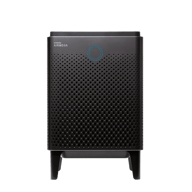
Why it works for smoke: Dual True HEPA filters with activated carbon combine to process air from two sides simultaneously. The Airmega 400's pollution sensor adjusts fan speed automatically based on real-time air quality readings. During wildfire events, you can set it to run continuously on a higher speed to maintain clean air across a large living area.
Smart features: A color-coded air quality indicator ring (blue for clean, red for polluted) provides at-a-glance feedback. The Eco mode automatically shuts off the fan when air quality is consistently good, saving energy during non-smoke periods.
Build quality: The filter housing is well-sealed. Replacement filters combine HEPA and carbon in a single cartridge ($50–60 per set), simplifying maintenance.
Noise: 22 dB on low, 52 dB on high. One of the quieter large-room units available.
Downsides: The activated carbon quantity is modest for the price. Heavy smoke events will benefit from supplementing with additional carbon filters or a secondary purifier. CADR smoke at 233 CFM is adequate but not class-leading given the room coverage claims.
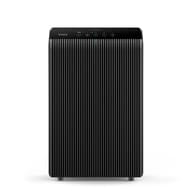
4. Winix 5510: Budget Smart Pick with PlasmaWave
At around $180, the Winix 5510 is the most affordable smart purifier on this list that still delivers legitimate smoke-filtering performance. It is the successor to the discontinued 5500-2, adding WiFi and the Winix Smart App while raising the dust CADR to 252 CFM.
Why it works for smoke: The 4-stage system includes a washable pre-filter, True HEPA (captures 99.97% of particles at 0.3 microns), an activated carbon layer built into the replaceable Filter Q, and PlasmaWave. The carbon handles smoke odor reasonably well, though it is not as thick as premium options. PlasmaWave provides an additional layer of VOC and chemical neutralization without producing harmful ozone (CARB certified).
Performance: 232 CFM smoke CADR (252 CFM dust, 246 CFM pollen) covers rooms up to 372 sq ft, ideal for a bedroom or mid-sized living room. The WiFi-connected sensor adjusts fan speed based on detected particle levels and reports air quality to the Winix Smart App.
Why this is the smart-value pick: You get True HEPA, activated carbon, PlasmaWave, and app-based WiFi monitoring for around $180. The washable pre-filter rinses clean, and Winix guarantees OEM Filter Q availability through 2032.
Honest tradeoffs: This is the smart-value pick, not the cheapest unit to run. The carbon is part of the replaceable Filter Q (it is not washable), so plan on roughly $80 per year in filters. It also gets loud at full speed (~67 dB max, ~35 dB in sleep mode) and has no physical remote; control is through the buttons or the app. The carbon layer is thin, so in severe wildfire conditions (AQI 300+) it may struggle to fully neutralize gases and odor. For more on its PlasmaWave technology and the discontinued 5500-2 it replaces, see our Winix 5500-2 review.
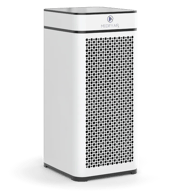
5. Medify MA-40: Medical-Grade HEPA
The Medify MA-40 is a mid-range powerhouse with an H13 medical-grade True HEPA filter and an impressive 330 CFM smoke CADR. It covers up to 840 sq ft and uses a dual-intake design that draws air from both sides.
Why it works for smoke: The H13 HEPA filter (the same grade used in hospital settings) captures 99.95% of particles down to 0.1 microns. The activated carbon filter uses granular carbon pellets rather than a carbon sheet, providing better surface area for absorbing smoke gases and VOCs.
Design: The dual air intake (both sides) allows the MA-40 to process more air per minute than single-intake designs at the same fan speed. This means cleaner air with less noise. The touchscreen control panel is intuitive, and the unit includes a child lock.
Performance: At 330 CFM smoke CADR, it slots between the Levoit Core 600S and the Coway Airmega 400, making it a strong mid-range option. Filter replacements run about $35–45 and last 3–4 months during heavy smoke exposure, 6+ months during normal use.
Downsides: The timer only goes up to 8 hours, which is inconvenient during multi-day smoke events where you want continuous operation. No app or smart home connectivity. Fan noise on high is noticeable at 56 dB.
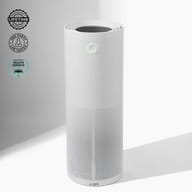
6. Jaspr Pro: Premium Whole-Home Option
The Jaspr Pro is designed for people who want one unit to handle an entire floor or open-concept living space. Covering up to 2,400 sq ft, it moves a serious volume of air while maintaining relatively low noise levels.
Why it works for smoke: The four-stage filtration system includes a medical-grade H13 HEPA filter and a thick activated carbon bed. The industrial-grade fan motor produces airflow comparable to two or three standard purifiers combined, making it capable of handling large open spaces during wildfire events.
Design: The Jaspr Pro is intentionally minimalist, a white cylindrical unit that blends into most interiors. It includes a real-time air quality display and auto-mode. The filters are larger than consumer-grade units, which means they last longer even under heavy use (12+ months typical).
Performance: Jaspr does not publish AHAM-certified CADR numbers, which makes direct comparison difficult. However, independent reviewers have measured performance consistent with 400+ CFM smoke removal in real-world tests.
Downsides: The price is the primary barrier at $400 to $1,300 depending on configuration. The size is substantial (it stands about 2.5 feet tall). No smart home integration beyond the built-in display.
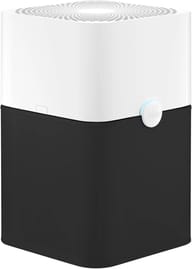
7. Blueair Blue Pure 211+: Runner-Up
The Blueair Blue Pure 211+ combines strong smoke CADR (350 CFM) with a distinctive fabric pre-filter design and one-button operation. It is a strong all-around performer that falls just short of the Levoit Core 600S in overall smoke-handling capability.
Why it works for smoke: Blueair's HEPASilent technology combines electrostatic and mechanical filtration to capture 99.97% of particles at 0.1 microns while using less fan power, resulting in lower noise at equivalent CADR levels. The activated carbon filter handles everyday odors well, though it is not the thickest for heavy smoke.
Design: The fabric pre-filter wraps around the unit and comes in multiple colors. It is washable, which extends the life of the main HEPA filter. The one-button design makes it the simplest purifier on this list to operate: press once for low, twice for medium, three times for high.
Performance: 350 CFM smoke CADR in rooms up to 540 sq ft. Energy Star certified, consuming less power than most competitors at equivalent performance levels.
Downsides: No air quality sensor or auto mode, so you manually set the fan speed. No app connectivity or smart features. The carbon filter is adequate for moderate smoke but may be overwhelmed during extreme wildfire events (AQI 400+).
How to Choose the Right Smoke Air Purifier
HEPA vs. Activated Carbon: You Need Both
Wildfire smoke contains two types of pollutants that require different filtration approaches:
- Particulate matter (PM2.5, PM10): Tiny solid particles that HEPA filters excel at capturing. True HEPA filters remove 99.97% of particles at 0.3 microns. Look for H13 or higher grade for the best particle capture.
- Gases and VOCs: Carbon monoxide, formaldehyde, benzene, and other volatile organic compounds pass right through HEPA filters. Activated carbon adsorbs these gases on its porous surface. More carbon (by weight) means more gas removal capacity before the filter is exhausted.
A purifier with only a HEPA filter will reduce visible haze but leave you breathing harmful gases. A purifier with only carbon will remove odor but leave particulates in the air. You need both working together. Ionizer and UV-only purifiers are even less suited for smoke; our comparison of HEPA, ionic, and UV purifiers explains why mechanical filtration wins for smoke protection.
Sizing for Your Room
Undersizing your purifier is the most common mistake during wildfire season. Use this formula:
Room area (sq ft) x 1.5 = minimum CADR smoke rating needed
The 1.5 multiplier accounts for the continuous influx of smoke during an active fire event. In normal conditions, a 1:1 ratio is sufficient, but wildfire smoke is persistent and ongoing.
For a 400 sq ft living room during wildfire season, you want at least 600 CFM smoke CADR, or two purifiers with 300+ CFM each. Running multiple smaller units often provides better coverage than a single large one placed in one corner.
Running Costs to Consider
The purchase price is only part of the equation. Factor in:
- Filter replacements: $30–200 per cycle depending on the brand. During heavy smoke seasons, you may need to replace filters 2–3 times more frequently than the manufacturer suggests.
- Electricity: Most purifiers consume 30–100 watts on high. Running 24/7 during a two-month fire season adds $10–30 to your electric bill.
- Carbon filter saturation: Once activated carbon is saturated, it stops working entirely. There is no gradual decline. If your purifier's carbon filter smells like smoke even after running for an hour, it needs replacement. See our air purifier maintenance guide for a complete filter care schedule.
Tips for Maximum Effectiveness During Wildfire Events
- Seal your home first. Close windows, doors, and fireplace dampers. Apply weather stripping to gaps. A purifier cannot keep up if smoke is actively pouring in.
- Run on high continuously. Auto mode may cycle down when the sensor reads clean air near the intake. During active smoke events, override auto mode and run on high.
- Create a clean room. If you only have one purifier, place it in your bedroom with the door closed. This gives you at least one room with clean air for sleeping.
- Replace filters proactively. Do not wait for the filter indicator light during heavy smoke exposure. Check and replace filters more frequently.
- Keep the purifier centrally located away from walls and corners. Airflow needs space to circulate.
For a complete room-sealing and filter-stocking checklist before fire season hits, see our wildfire smoke air purifier prep guide.
Matching the Air Purifier to Your Smoke Type
Not all smoke is the same. The particle size, gas mix, and exposure pattern differ enough that the best air purifier for one smoke type can be mediocre for another.
- Wildfire smoke is the hardest case. PM2.5 levels can exceed 300 µg/m³ for days, and the smoke contains a heavy load of VOCs from burned vegetation. Prioritize maximum smoke CADR plus the heaviest activated carbon you can afford. The IQAir HealthPro Plus XE and Coway Airmega 400 are the strongest picks here.
- Cigarette and cigar smoke is intermittent but produces strong odor and tar particles that quickly load thin carbon filters. A purifier with replaceable carbon (rather than a thin sheet) holds up better. The Levoit Core 600S and Medify MA-40 fit this use case.
- Cooking smoke and grease aerosols are short bursts of smoke plus oil droplets. A purifier near the kitchen with a washable pre-filter (Winix 5510, Blueair 211+) handles this without saturating the HEPA stage.
- Cannabis and vape aerosol are finer than tobacco smoke and lighter on tar but still leave odor. Carbon weight matters more than CADR here. See our dedicated weed smoke and vape smoke guides for picks tuned to those profiles.
If you face more than one of these regularly, size up. A purifier rated for your room under one smoke source will fall behind under combined exposure.
When to Run Your Smoke Air Purifier (AQI Thresholds)
Search the local AQI before deciding how hard to run the unit. The U.S. EPA AirNow scale gives clean cutoffs:
- AQI 0–50 (Good): Auto mode is fine. Filters last their full rated life.
- AQI 51–100 (Moderate): Run on low or auto continuously. Sensitive groups should keep windows closed.
- AQI 101–150 (Unhealthy for Sensitive Groups): Switch off auto mode and run on medium 24/7. Begin checking carbon filter for odor saturation weekly.
- AQI 151–200 (Unhealthy): Run on high. Seal the room. Plan on replacing carbon filters at half their rated interval.
- AQI 201+ (Very Unhealthy / Hazardous): Maximum fan speed, clean room only, N95 indoors if the AQI stays above 250 for more than a few hours. A single mid-range purifier will not keep up with a 2,000 sq ft home — pick one room.
If you want continuous AQI alerts indoors, pair your purifier with a PM2.5 monitor for wildfire smoke so you know when to step the fan up before the smell tips you off.
Looking for smoke-specific guides? Facing wildfire season? Our best air purifiers for wildfire smoke guide is tuned for sustained high-PM2.5 events. If your main concern is kitchen smoke and cooking fumes, see our best air purifiers for cooking odors guide. For tobacco, see our best air purifiers for cigarette smoke guide. For cannabis, see best air purifiers for weed smoke. Dealing with vape aerosol? Our best air purifiers for vape smoke guide covers it, and our vaping and air quality explainer breaks down the science. Schools and institutions should see our classroom vape guide. If you also deal with allergies or asthma, our allergy and asthma guides cover purifiers optimized for those conditions.
Last updated: June 2026. We re-verified pricing and Amazon availability across all seven picks ahead of the 2026 wildfire season. Prices and availability are subject to change. We update this guide before each wildfire season and when significant new products launch.
Frequently Asked Questions
How long should I run an air purifier during wildfire season?
Do air purifiers actually remove the smell of wildfire smoke?
What CADR rating do I need for smoke?
Can I use a box fan with a furnace filter instead?
How often should I replace the filter during wildfire season?
HEPA vs. ionic air purifiers for smoke: which is better?
Can the same air purifier handle both cigarette smoke and wildfire smoke?
What is the difference between CADR smoke, dust, and pollen ratings?
You Might Also Like

Best Air Purifier for COPD (2026): 7 Ozone-Free Picks
The 7 best air purifiers for COPD in 2026, screened for zero ozone and costed for 24/7 use. Ozone-free HEPA picks from $56 to $290 a year to run.

Best Air Purifier for a Gas Stove (2026): 7 Carbon Picks
The 7 best air purifiers for gas stove pollution in 2026, ranked by carbon capacity. What they fix, what they cannot fix, and honest NO2 reduction numbers.
Best Air Purifier & Humidifier Combo (2026)
The best air purifier and humidifier combos in 2026. We rate the top HEPA+humidifier units and explain when a pairing of two separate devices beats any all-in-one.
Best Air Purifiers for Nail Salons (2026)
The best air purifiers for nail salons in 2026. We compare heavy-carbon units and source-capture options to clear acrylic fumes, MMA monomer, and VOCs at the nail table.