Best Air Purifiers for Weed Smoke (2026)
The 5 best air purifiers for weed smoke in 2026, ranked by carbon weight and odor removal. Picks with thick activated carbon that eliminate cannabis smell.

Table of Contents
- Our Top Picks at a Glance
- Why Weed Smoke Is Harder to Filter Than Regular Smoke
- Terpenes and VOCs
- Fine Particulate Matter
- Resinous Residue
- What to Look For in a Weed Smoke Air Purifier
- Activated Carbon Filter Weight
- Smoke CADR Rating
- Sealed System Design
- Filter Replacement Cost
- Detailed Reviews
- 1. Levoit Core 600S: Best Overall for Weed Smoke
- 2. IQAir HealthPro Plus XE: Best for Heavy Smokers
- 3. Coway Airmega 400: Best for Large Rooms
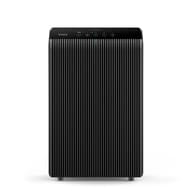
- 4. Winix 5510: Budget Smart Pick
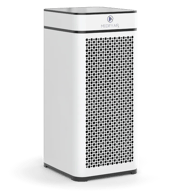
- 5. Medify MA-40: Best Compact Option
- How to Get the Most Out of Your Air Purifier for Weed Smoke
- Run It Before You Smoke
- Position It Close to the Source
- Keep It Running After
- Replace Carbon Filters on Schedule
- Supplement With Ventilation
- Air Purifier vs. Other Odor Solutions
- The Bottom Line
TL;DR
At Clean Air Critic, the best air purifier for weed smoke is the Levoit Core 600S, with a 410 CFM smoke CADR and activated carbon filtration that handles both marijuana particulates and odor for under $300. For maximum odor elimination in large spaces, the IQAir HealthPro Plus XE packs 5 lbs of granular activated carbon. Budget buyers wanting WiFi should grab the Winix 5510 around $180.
Full Comparison
| # | Product | Best For | Rating | Price | |
|---|---|---|---|---|---|
| 1 | Levoit Core 600S Top Pick Levoit | Best Overall for Weed Smoke | 4.8 | $$ | Check Price |
| 2 | IQAir HealthPro Plus XE IQAir | Best for Heavy Smokers | 4.9 | $$$$ | Check Price |
| 3 | Coway Airmega 400 Coway | Best for Large Rooms | 4.6 | $$$ | Check Price |
| 4 | Winix 5510 Winix | Budget Smart Pick | 4.5 | $$ | Check Price |
| 5 | Medify MA-40 Medify | Best Compact Option | 4.5 | $$ | Check Price |
Affiliate Disclosure: CleanAirCritic earns commissions from qualifying purchases through affiliate links on this page. This does not influence our rankings or reviews. All opinions are our own. Learn more
Marijuana smoke is a different beast than cigarette or wildfire smoke. Cannabis combustion produces heavy particulate matter, but the real challenge is the smell. Terpenes, the aromatic compounds that give each strain its distinctive scent, are volatile organic compounds (VOCs) that linger in fabrics, carpets, and drywall long after the visible smoke clears. A standard HEPA filter will catch the particles, but it will not touch the odor.
To actually eliminate weed smoke, you need an air purifier with two things: True HEPA filtration for the particulates and a thick activated carbon filter for the terpenes, VOCs, and gases. The thin carbon pre-filters on most budget purifiers are basically decorative when it comes to cannabis odor. You need real granular carbon, measured in pounds, not millimeters.
We evaluated five air purifiers specifically for their ability to handle marijuana smoke, prioritizing activated carbon weight, smoke CADR ratings, and real-world odor elimination. If you are also dealing with wildfire smoke, that guide covers models optimized for that specific scenario.
Our Top Picks at a Glance
| Purifier | Best For | CADR (Smoke) | Room Coverage | Price Range |
|---|---|---|---|---|
| Levoit Core 600S | Best Overall | 410 CFM | Up to 635 sq ft | ~$260 |
| IQAir HealthPro Plus XE | Heavy Smokers | 300+ CFM | Up to 1,125 sq ft | ~$1,199 |
| Coway Airmega 400 | Large Rooms | 328 CFM | Up to 1,560 sq ft | ~$349 |
| Winix 5510 | Budget Smart Pick | 232 CFM | Up to 372 sq ft | ~$180 |
| Medify MA-40 | Compact Option | 380 CFM | Up to 840 sq ft | ~$250 |
Why Weed Smoke Is Harder to Filter Than Regular Smoke
Cannabis smoke contains over 100 identified compounds, many of which are gaseous and pass straight through HEPA filters. The three main challenges:
Terpenes and VOCs
Myrcene, limonene, pinene, and linalool are the dominant terpenes in marijuana smoke. These are volatile organic compounds that exist as gases at room temperature, which means particle filters cannot capture them. Only activated carbon (or similar adsorbent media) removes these from the air through a chemical bonding process called adsorption.
Fine Particulate Matter
Marijuana smoke produces PM2.5 particles in the 0.1 to 2.5 micron range, similar to cigarette smoke. These particles are small enough to penetrate deep into your lungs. True HEPA filters (H13 grade) capture 99.97% of particles at 0.3 microns, making them effective for the particulate component.
Resinous Residue
Cannabis smoke carries sticky resin compounds that can coat surfaces and pre-filters faster than tobacco smoke. This means your filters may need more frequent replacement, especially the carbon stage. Plan on replacing carbon filters 30 to 50% sooner than the manufacturer's recommendation if you smoke daily.
What to Look For in a Weed Smoke Air Purifier
Before we get into the reviews, here is what actually matters when you are shopping for a cannabis smoke purifier. For a broader overview of air purifier features, our how to choose an air purifier guide covers the basics.
Activated Carbon Filter Weight
This is the single most important spec for marijuana odor. Thin carbon mesh filters (the kind you find on $50 purifiers) saturate within days of regular use. Look for purifiers with at least 2 to 3 pounds of granular activated carbon. The IQAir HealthPro Plus XE leads with 5 lbs. More carbon means more surface area for adsorption, which translates to longer-lasting odor control.
Smoke CADR Rating
The Clean Air Delivery Rate measures how quickly a purifier removes smoke particles from the air. For a room where you smoke regularly, aim for a smoke CADR that matches or exceeds your room's square footage. A 200 sq ft bedroom needs at least 200 CFM of smoke CADR for rapid clearance.
Sealed System Design
If the purifier housing has gaps, unfiltered air bypasses the carbon filter entirely. That means odor slips through no matter how much carbon is inside. Look for purifiers with gasket-sealed filter housings. IQAir and Medify are especially well-sealed.
Filter Replacement Cost
Cannabis smoke is hard on carbon filters. Before buying, calculate the annual filter cost and factor in replacing carbon filters more frequently than the manufacturer suggests. A purifier that costs $150 but burns through $80 in filters every three months is more expensive over two years than an $1,199 IQAir with filters that last a year.
Detailed Reviews
1. Levoit Core 600S: Best Overall for Weed Smoke
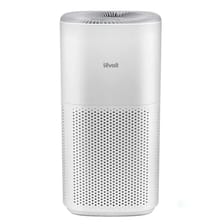
The Levoit Core 600S delivers the highest smoke CADR on this list at 410 CFM, and its three-stage filtration system with activated carbon handles both the visible haze and the lingering smell of cannabis. At around $260, it hits the sweet spot between performance and affordability.
Why it works for weed smoke: The H13 True HEPA filter captures 99.97% of smoke particles at 0.3 microns, while the activated carbon layer with a honeycomb structure provides more surface area for terpene and VOC adsorption than flat carbon sheets. The high CADR means the room clears quickly, which matters when you want smoke gone in minutes rather than hours.
Smart features matter here: The VeSync app and laser-based PM2.5 sensor let you monitor air quality in real time. You can see exactly when the air returns to baseline after a session. The auto mode ramps the fan up when it detects smoke and backs off once the air is clean.
Noise: 26 dB on low (barely audible), up to 55 dB on turbo. Sleep mode dims the display and drops to the quietest setting.
The catch: The activated carbon quantity is good but not exceptional. Daily smokers will want to replace the carbon filter every 3 to 4 months rather than the suggested 6 to 8 months. Filter replacements run about $40 to $50 each.
Annual cost estimate: ~$270 upfront + ~$120 to $160 in filters for daily smokers.
2. IQAir HealthPro Plus XE: Best for Heavy Smokers
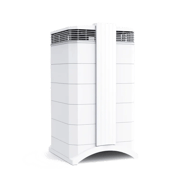
If you smoke multiple times a day and need the absolute best odor elimination, the IQAir HealthPro Plus XE is in a different league. Its V5-Cell gas and odor filter contains 5 lbs of granular activated carbon and alumina, more than double what most competitors offer. This is the purifier allergists recommend for smoke sensitivity, and it handles cannabis terpenes with the same thoroughness.
Why it works for weed smoke: The four-stage system attacks smoke from every angle. The pre-filter catches large particles and resin. The V5-Cell filter with its massive carbon bed absorbs terpenes, VOCs, and gases. The HyperHEPA filter then captures ultrafine particles down to 0.003 microns, 100 times smaller than standard HEPA. The fully sealed, medical-grade housing ensures zero air bypass.
Odor performance: This is where the IQAir separates itself. The 5 lbs of carbon means the filter lasts significantly longer under heavy smoke exposure before saturating. Where the Levoit might need a carbon replacement every 3 to 4 months for daily use, the IQAir V5-Cell typically lasts 12+ months.
Room coverage: Up to 1,125 sq ft, which is enough for an entire apartment or multiple rooms with doors open.
The catch: The price. At roughly $1,199, this is a serious investment. Filter replacements are $70 to $200 depending on the stage, though they last much longer. Smart control is limited to IQAir's AirVisual app, with no Alexa or Google Assistant support.
Annual cost estimate: ~$1,199 upfront + ~$150 to $200 in filters per year.
3. Coway Airmega 400: Best for Large Rooms
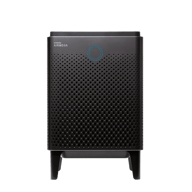
The Coway Airmega 400 covers an impressive 1,560 sq ft with dual HEPA and activated carbon filters pulling air from both sides simultaneously. If you smoke in a large living area or open floor plan and need the smell contained across the entire space, this is the pick.
Why it works for weed smoke: Dual True HEPA filters with activated carbon process air from two intake points, which means faster smoke clearance across a wide area. The real-time air quality sensor adjusts fan speed automatically when it detects smoke. The color-coded LED ring (blue for clean, red for polluted) gives you visual confirmation that the purifier is working.
Large space advantage: Most purifiers on this list are optimized for one room. The Airmega 400 can handle a combined living room and kitchen area, which is useful if smoke drifts between spaces. Its 328 CFM smoke CADR is adequate for rooms up to 500 sq ft for rapid clearance, while the 1,560 sq ft rating reflects slower air changes in larger areas.
Build quality: The filter housing is well-sealed, and the Max2 filter cartridges combine HEPA and carbon in a single unit for straightforward replacement.
The catch: The activated carbon quantity per filter is moderate. For very heavy smoking, the carbon may saturate faster than the HEPA side wears out, leaving you with odor breakthrough while the particle filtration still works fine. You can mitigate this by replacing filters on a shorter schedule.
Annual cost estimate: ~$349 upfront + ~$100 to $130 in filters (two Max2 sets at $50 to $65 each).
4. Winix 5510: Budget Smart Pick
The Winix 5510 is the most affordable smart purifier on this list that we can genuinely recommend for weed smoke. The successor to the discontinued 5500-2, its four-stage filtration adds WiFi and the Winix Smart App, with an activated carbon stage built into the replaceable Filter Q.
Why it works for weed smoke: The True HEPA filter handles particulates while the activated carbon in the Filter Q adsorbs odor compounds. The PlasmaWave technology adds a secondary layer by breaking down VOCs at a molecular level without producing harmful ozone (certified by CARB). For light to moderate smoking, this combination is effective and affordable.
Smart monitoring: WiFi connectivity with the Winix Smart App lets you watch air quality climb during a session and confirm when it clears, then adjust the fan from your phone. The washable pre-filter rinses clean to protect the HEPA stage.
Limitations for heavy use: The 232 CFM smoke CADR and 372 sq ft coverage are adequate for a bedroom or small living room, but not for large spaces. The carbon capacity is also lower than the premium models, and because the carbon lives in the replaceable Filter Q (not a washable layer), heavy daily smokers will burn through filters faster and notice odor breakthrough sooner. This purifier is best suited for occasional to moderate use.
Honest tradeoffs: This is a smart-value pick, not the cheapest unit to run; plan on roughly $80 per year in Filter Q replacements. It runs loud at full speed (~67 dB max, ~35 dB in sleep mode) and has no physical remote. Auto mode with the built-in sensor handles fan speed adjustments.
Annual cost estimate: ~$180 upfront + ~$80 per year in Filter Q replacements.
5. Medify MA-40: Best Compact Option
The Medify MA-40 packs a 380 CFM smoke CADR into a compact tower design, making it the best option if you need strong smoke performance without a large footprint. Its H13 True HEPA filter captures 99.9% of particles down to 0.1 microns, and the dual air intake speeds up purification.
Why it works for weed smoke: The high CADR relative to its size means the MA-40 clears smoke quickly in rooms up to 840 sq ft. The activated carbon layer handles odor compounds, and the dual intake design pulls smoky air from both sides of the unit. The sealed housing prevents air bypass.
Compact advantage: At just 9.9 x 10.9 x 22 inches and 15.6 lbs, the MA-40 is easy to move between rooms. Some users keep it in the smoking room during sessions and move it to the bedroom at night.
The catch: It is louder than competitors, with a minimum noise level of 46 dB. That is noticeable in a quiet room and may bother light sleepers. No smart features or WiFi. Filter replacements every 3 to 6 months add up at around $35 each.
Annual cost estimate: ~$250 upfront + ~$70 to $140 in filters depending on usage.
How to Get the Most Out of Your Air Purifier for Weed Smoke
Buying the right purifier is half the equation. How you use it determines whether your room actually smells clean.
Run It Before You Smoke
Turn the purifier on high 10 to 15 minutes before your session. This creates a baseline of clean, circulating air that helps the purifier catch smoke as it is produced rather than after it has settled into every surface.
Position It Close to the Source
Place the purifier 3 to 5 feet from where you smoke, with the intake facing the smoking area. The closer it is to the source, the more smoke it captures before it disperses. Avoid placing it across the room where smoke has to travel the full distance before reaching the intake.
Keep It Running After
Leave the purifier on high for at least 30 to 60 minutes after your last session. Smoke particles and odor compounds continue circulating even after the visible smoke clears. The lingering terpenes are what your neighbors (or your future sober self) will notice.
Replace Carbon Filters on Schedule
The number one reason people say "my air purifier stopped working" is a saturated carbon filter. If you smoke daily, set a reminder to replace or wash the carbon filter 30 to 50% sooner than the manufacturer suggests. A fresh carbon filter makes a dramatic difference in odor control.
Supplement With Ventilation
An air purifier works best in a sealed room, but a brief window opening after a session can help flush out residual odor before closing up and letting the purifier finish the job. Just do not leave the window open while the purifier runs, as you will be filtering outdoor air instead of cleaning the room.
Air Purifier vs. Other Odor Solutions
You might be wondering how air purifiers compare to other common odor control methods. Here is the honest breakdown.
Candles and incense: These mask the smell temporarily by adding a competing scent. They do not remove smoke particles or VOCs. Some actually add more particulate matter to the air. Not a real solution.
Ozium and spray deodorizers: Ozium works by releasing ozone, which oxidizes odor molecules. It is somewhat effective short-term but ozone is a respiratory irritant. We do not recommend it for regular use. Spray deodorizers mask rather than remove.
Sploofs and smoke filters: Exhaling through a sploof (like a SmokeBuddy) reduces the amount of smoke that enters the room in the first place. This is actually a solid complement to an air purifier, not a replacement. Use both for the best results.
Air purifiers: The only option that continuously removes both particles and odor compounds from the air. The upfront cost is higher, but it is the only approach that actually cleans the air rather than covering up the problem.
The Bottom Line
For most people, the Levoit Core 600S is the best balance of smoke CADR, odor removal, smart features, and price. It clears a room quickly and the app lets you verify the air is actually clean.
If you smoke heavily and want the best possible odor elimination regardless of price, the IQAir HealthPro Plus XE and its 5 lbs of activated carbon is the gold standard. It costs more upfront but the filters last longer under heavy use, partially offsetting the price difference over time.
For budget-conscious buyers who want WiFi, the Winix 5510 delivers smart monitoring and four-stage filtration around $180, providing genuine odor reduction for light to moderate smoking.
Whichever model you choose, the key is consistent use and timely filter replacements. An air purifier is only as good as its carbon filter, and a saturated filter is just an expensive fan. For more on keeping your purifier running at peak performance, check out our air purifier maintenance guide.
Frequently Asked Questions
Do air purifiers actually remove the smell of weed?
How long does it take an air purifier to clear weed smoke from a room?
Will a cheap air purifier work for marijuana smoke?
Is a HEPA filter or carbon filter more important for weed smoke?
How often should I replace the carbon filter if I smoke regularly?
Can my landlord or neighbors still smell weed if I use an air purifier?
Where should I place my air purifier when smoking?
You Might Also Like

Best Air Purifier for COPD (2026): 7 Ozone-Free Picks
The 7 best air purifiers for COPD in 2026, screened for zero ozone and costed for 24/7 use. Ozone-free HEPA picks from $56 to $290 a year to run.

Best Air Purifier for a Gas Stove (2026): 7 Carbon Picks
The 7 best air purifiers for gas stove pollution in 2026, ranked by carbon capacity. What they fix, what they cannot fix, and honest NO2 reduction numbers.
Best Air Purifier & Humidifier Combo (2026)
The best air purifier and humidifier combos in 2026. We rate the top HEPA+humidifier units and explain when a pairing of two separate devices beats any all-in-one.
Best Air Purifiers for Nail Salons (2026)
The best air purifiers for nail salons in 2026. We compare heavy-carbon units and source-capture options to clear acrylic fumes, MMA monomer, and VOCs at the nail table.