Best Air Purifier with UV-C Light (2026)
The best air purifiers with UV-C light in 2026. We rate the top ozone-free HEPA + UV-C units and explain honestly where UV-C actually helps and where it doesn't.
Based on HEPA filtration analysis, review of UV-C dwell-time and dosage limitations in consumer units, ozone-safety certifications (CARB, Zero Ozone Verified), and CADR-per-dollar comparison
Table of Contents
- Our Top Picks at a Glance
- The Honest Verdict First
- Detailed Reviews
- 1. GermGuardian AC5350B: Best Overall with UV-C
- 2. Pure Enrichment PureZone 3-in-1: Best Ozone-Free Compact
- 3. SilverOnyx 5-Speed: Best with Air Quality Sensor
- 4. GermGuardian AC4825E: Best Budget UV-C
- 5. Levoit Core 400S: Best Overall Air Purifier (No UV Needed)
- How UV-C Actually Works (and Where It Falls Short)
- The Science Is Real, but Dose Is Everything
- Consumer Purifiers Move Air Too Fast
- Where UV-C Genuinely Helps
- The Ozone Warning You Should Not Ignore
- The Bottom Line
TL;DR
At Clean Air Critic, the best air purifier with UV-C light is the GermGuardian AC5350B, a 28-inch tower that pairs True HEPA filtration with a UV-C sanitizer and is Zero Ozone Verified for spaces up to 870 sq ft. But read our honest verdict first: in consumer purifiers, the HEPA filter does almost all the real work, and UV-C is a supplemental extra. If you want the single best cleaner regardless of UV, the Levoit Core 400S outperforms every UV-C unit on this list. Whatever you choose, only buy a UV model that is certified ozone-free.
Full Comparison
| # | Product | Best For | Rating | Price | |
|---|---|---|---|---|---|
| 1 | GermGuardian AC5350B Top Pick GermGuardian | Best Overall with UV-C | 4.5 | $$ | Check Price |
| 2 | Pure Enrichment PureZone 3-in-1 Pure Enrichment | Best Ozone-Free Compact | 4.6 | $ | Check Price |
| 3 | SilverOnyx 5-Speed SilverOnyx | Best with Air Quality Sensor | 4.4 | $$ | Check Price |
| 4 | GermGuardian AC4825E GermGuardian | Best Budget UV-C | 4.3 | $ | Check Price |
| 5 | Levoit Core 400S Levoit | Best Overall Air Purifier (No UV Needed) | 4.8 | $$ | Check Price |
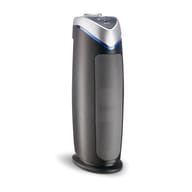
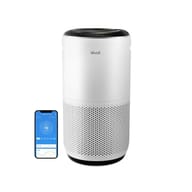
Affiliate Disclosure: CleanAirCritic earns commissions from qualifying purchases through affiliate links on this page. This does not influence our rankings or reviews. All opinions are our own. Learn more
UV-C air purifiers sell a compelling promise: a light that kills germs, viruses, and mold as the air passes through. The underlying science is legitimate. Ultraviolet germicidal irradiation at the 254-nanometer wavelength genuinely damages the DNA of microbes, and hospitals use it in controlled settings.
The problem is dose. UV-C only works when microbes get enough exposure, and inside a consumer air purifier, air rushes past a small bulb in a fraction of a second. That is nowhere near the dwell time needed to reliably inactivate most airborne pathogens. Meanwhile, the True HEPA filter sitting in the same machine physically traps 99.97% of particles at 0.3 microns, including the droplets and spores that carry germs in the first place.
So here is our position, up front: buy a UV-C purifier for its HEPA filter, and treat the UV as a supplemental extra. Do not overpay for the UV badge, and never buy a cheap "UV" unit that turns out to be an ozone-generating ionizer. Our guide to HEPA vs. ionic vs. UV air purifiers breaks down the technologies in depth, and our air purifier myths, debunked piece covers the marketing claims to ignore.
Below are the best UV-C models we recommend, all certified ozone-free, plus our honest overall pick that skips UV altogether.
Our Top Picks at a Glance
| Product | Best For | HEPA Grade | UV-C | Coverage | Ozone-Free |
|---|---|---|---|---|---|
| GermGuardian AC5350B | Overall UV-C | True HEPA | Yes | 870 sq ft | Zero Ozone Verified |
| Pure Enrichment PureZone 3-in-1 | Ozone-Free Compact | H13 True HEPA | Yes | 200 sq ft | CARB Certified |
| SilverOnyx 5-Speed | Air Quality Sensor | H13 True HEPA | Yes | 500 sq ft | CARB (ionizer off) |
| GermGuardian AC4825E | Budget UV-C | True HEPA | Yes | 743 sq ft | Zero Ozone Verified |
| Levoit Core 400S | Best Overall (No UV) | H13 True HEPA | No | 403 sq ft | No Ozone |
The Honest Verdict First
If your real goal is cleaner, healthier air, the most important number on the spec sheet is not "UV-C," it is the filter grade and CADR. A True HEPA filter captures the particles that carry germs whether or not a UV bulb is present. That is why our single best overall pick, the Levoit Core 400S, has no UV at all and still outperforms most UV units on this list.
UV-C earns its place in two situations: when it comes at little or no price premium alongside a good filter, and when you want to inhibit mold growth on the filter in a humid room. In those cases, the units below are excellent. Just make sure whatever you buy is certified ozone-free, because an ozone-emitting purifier does more harm than good.
Detailed Reviews
1. GermGuardian AC5350B: Best Overall with UV-C
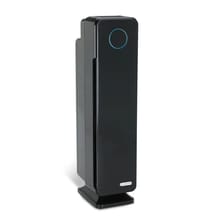
The GermGuardian AC5350B is the UV-C purifier we recommend to most people, because it gets the fundamentals right: a genuine True HEPA filter, real coverage, and, crucially, Zero Ozone Verified and CARB compliant certification.
Filtration: The 28-inch tower uses a three-layer True HEPA Pure system that captures 99.97% of dust, pollen, pet dander, and smoke, plus an activated carbon layer for odors. It cleans up to 870 sq ft over an hour and cycles the air in a 180 sq ft room nearly five times an hour, with a smoke CADR of 125.
UV-C stage: An enclosed UV-C bulb sits after the filter to help reduce airborne germs, bacteria, and mold spores, and to inhibit mold growth on the captured media. It is optional and toggled separately, so you can run the purifier with or without it. As with all consumer UV, treat it as a supplement to the HEPA filter rather than a standalone germ solution.
Safety and controls: This is the key reason it tops the list. The AC5350 is Zero Ozone Verified, CARB compliant, and ETL certified, so you get the UV feature without the ozone risk that plagues cheaper units. Five fan speeds and an 8-hour timer let you dial in everything from powerful allergen control to quiet overnight operation, and Guardian backs it with a five-year warranty.
Who this is for: Anyone who wants UV-C in a large room and refuses to compromise on ozone safety. The best all-around UV-C pick for living rooms, large bedrooms, and open basements.
2. Pure Enrichment PureZone 3-in-1: Best Ozone-Free Compact
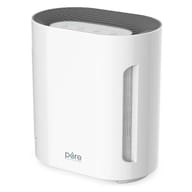
The Pure Enrichment PureZone 3-in-1 is our pick for a smaller room or a desk, and it is one of the safest UV units you can buy thanks to its H13 True HEPA filter and CARB certification.
Filtration: A four-stage system combines a pre-filter, a H13 True HEPA layer that captures 99.97% of particles at 0.3 microns, activated carbon for odors, and an enclosed UV-C stage. Coverage is rated to about 200 sq ft, ideal for a bedroom, nursery, or home office.
UV-C stage: The UV-C light is fully sealed inside the unit and targets germs, bacteria, and fungi as air moves through. Because the housing is enclosed and the unit is CARB certified, there is no ozone concern, which is exactly what you want in a bedroom or a child's room.
Simplicity and value: Three fan speeds, an optional timer, and a whisper-quiet low setting make it easy to set and forget. At around $100 with a five-year warranty and a H13 filter, it is genuinely good value, and the UV comes as a no-penalty bonus rather than an expensive upcharge.
Who this is for: Bedrooms, nurseries, offices, and anyone who wants the reassurance of a medical-grade H13 filter plus UV-C in a compact, certified ozone-free package.
3. SilverOnyx 5-Speed: Best with Air Quality Sensor
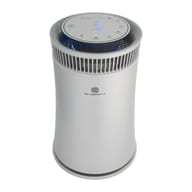
The SilverOnyx 5-Speed is the feature-loaded option, adding a real-time air quality sensor and auto mode that most UV units in this price range lack. It covers up to 500 sq ft.
Filtration: A five-stage system centers on a H13 True HEPA filter that captures 99.97% of particles at 0.3 microns, backed by a pre-filter and activated carbon. Its CADR of roughly 85 is modest for 500 sq ft, so in a large room it works best run continuously rather than in quick bursts.
Smart features: A built-in PM2.5 particle sensor and auto mode adjust fan speed to real-time air quality, and five speeds plus a timer give you fine control. The sensor is the standout: it is genuinely useful for seeing when air quality dips and letting the unit respond on its own.
A note on the ionizer: The SilverOnyx includes both a UV-C light and an optional ionizer. The UV-C is enclosed and safe. The ionizer, like most, can produce trace ozone, so we recommend running the unit with the ionizer switched off and relying on the HEPA filter and UV-C. Operated that way, it is CARB compliant and safe.
Who this is for: Buyers who want automatic, sensor-driven operation and UV-C in a mid-size room, and who are comfortable leaving the ionizer feature off.
4. GermGuardian AC4825E: Best Budget UV-C
The GermGuardian AC4825E is the budget entry point to HEPA-plus-UV-C, and at around $80 it delivers a surprising amount of purifier for the money in a slim 21-inch tower.
Filtration: A True HEPA filter captures 99.97% of particles at 0.3 microns, and a charcoal layer handles light odors. Coverage runs up to 743 sq ft over an hour for lighter filtration needs, though for rapid cleaning treat it as a small-to-mid room unit.
UV-C stage: Like its bigger sibling, it includes an enclosed UV-C bulb to help reduce germs and inhibit mold on the filter, and newer units are Zero Ozone Verified. It is the same honest deal: a solid True HEPA filter with UV as a bonus, not a miracle.
Value: There is no smart sensor or app, just three manual speeds and a simple, reliable design. For a spare bedroom, dorm, or small office where you want basic HEPA filtration plus UV-C without spending much, it is hard to beat. We also feature it as a budget option in our best air purifiers for basements guide.
Who this is for: Budget shoppers who want name-brand HEPA plus UV-C for a small or mid-size room and do not need smart features.
5. Levoit Core 400S: Best Overall Air Purifier (No UV Needed)
We are including the Levoit Core 400S precisely because it has no UV-C, to make a point: the best cleaner in this guide is the one that skips the marketing feature and nails the fundamentals.
Filtration: A three-stage H13 True HEPA system captures 99.97% of particles at 0.3 microns, with a substantial activated carbon layer for odors. Its 260 CFM CADR cycles a 400 sq ft room several times an hour, well ahead of the UV units above in raw cleaning speed.
Smart features: A real PM2.5 laser sensor drives auto mode through the VeSync app, with air quality history, filter tracking, and scheduling. On sleep mode it runs at a near-silent 24 dB. This is a genuinely smart purifier, not a basic box with a UV badge.
Why it makes the list: If your goal is the cleanest air per dollar, the Core 400S beats every UV-C unit here on filtration and airflow, and it produces no ozone. Buy a UV model if you specifically want the germicidal layer or mold-on-filter protection; buy this if you just want the best overall purifier. Our full Levoit Core 400S review covers it in depth.
Who this is for: Anyone who cares more about measurable air cleaning than the UV label, and wants the strongest smart purifier on this list.
How UV-C Actually Works (and Where It Falls Short)
Understanding the technology explains every recommendation above.
The Science Is Real, but Dose Is Everything
UV-C light at 254 nanometers damages the genetic material of bacteria, viruses, and mold spores, preventing them from reproducing. This is well established, and it is why UV germicidal systems appear in hospital HVAC and water treatment. But effectiveness depends entirely on dose, which is intensity multiplied by exposure time. Hospital systems use powerful lamps and slow, controlled airflow to hit the required dose.
Consumer Purifiers Move Air Too Fast
In a home air purifier, the fan pushes air past a small UV bulb in a fraction of a second. That brief contact delivers only a small fraction of the dose used in clinical settings, so real-world inactivation of airborne microbes is limited. This is not a knock on any specific brand; it is a physical limitation of putting a small bulb in a high-airflow box.
Where UV-C Genuinely Helps
UV-C's most reliable benefit in a consumer unit is not sterilizing the passing air, it is inhibiting mold and bacterial growth on the filter itself. In humid rooms, spores captured by the HEPA media can colonize the damp filter over time. A UV bulb aimed at the filter suppresses that growth, which extends filter freshness and prevents the unit from becoming a source of odor. That is a real, if modest, advantage, and it is why UV pairs well with purifiers destined for basements and bathrooms. For the broader picture on whether purifiers deliver, see do air purifiers really work.
The Ozone Warning You Should Not Ignore
The biggest risk with UV and ionic purifiers is ozone. Ozone is a lung irritant that can worsen asthma and respiratory conditions, and some purifiers, especially cheap ones marketed on "ionization" or "activated oxygen," generate it deliberately or as a byproduct.
Every unit in this guide is certified ozone-free, meaning CARB compliant or Zero Ozone Verified. That certification is non-negotiable. If a UV or ionizer purifier does not clearly state CARB compliance or Zero Ozone verification, do not buy it. And if a unit you own has an ionizer feature, run it with that feature switched off and let the HEPA filter and enclosed UV-C do the work.
The Bottom Line
For the best air purifier with UV-C light, the GermGuardian AC5350B is our top pick: a large-room True HEPA tower with an enclosed UV-C stage that is Zero Ozone Verified. For a compact bedroom or office, the Pure Enrichment PureZone 3-in-1 delivers a medical-grade H13 filter plus UV-C at a great price, and the GermGuardian AC4825E is the budget choice.
But keep the honest verdict in mind: in consumer units, the HEPA filter does the real work and UV-C is a supplemental bonus. If you want the single best cleaner on this list, the Levoit Core 400S outperforms every UV unit here and produces no ozone. Buy UV for the germicidal layer and mold-on-filter protection if those matter to you; buy the best filter if raw air cleaning is your goal. Either way, insist on a certified ozone-free model.
For related reading, see HEPA vs. ionic vs. UV air purifiers, our air purifier myths, debunked explainer, and the best air purifiers for mold.
Last updated: July 2026. Prices and availability are subject to change. We update this guide seasonally and whenever significant new models launch.
Frequently Asked Questions
Do UV-C air purifiers actually work?
Is UV-C light in air purifiers safe?
What is the difference between UV-C and an ionizer?
Should I pay extra for a UV-C air purifier?
Does UV-C light kill mold in air purifiers?
How often do I need to replace the UV-C bulb?
What is the best air purifier with UV-C light for a large room?
You Might Also Like
Best Air Purifier for COPD (2026): 7 Ozone-Free Picks
The 7 best air purifiers for COPD in 2026, screened for zero ozone and costed for 24/7 use. Ozone-free HEPA picks from $56 to $290 a year to run.

Best Air Purifier for a Gas Stove (2026): 7 Carbon Picks
The 7 best air purifiers for gas stove pollution in 2026, ranked by carbon capacity. What they fix, what they cannot fix, and honest NO2 reduction numbers.
Best Air Purifier & Humidifier Combo (2026)
The best air purifier and humidifier combos in 2026. We rate the top HEPA+humidifier units and explain when a pairing of two separate devices beats any all-in-one.
Best Air Purifiers for Nail Salons (2026)
The best air purifiers for nail salons in 2026. We compare heavy-carbon units and source-capture options to clear acrylic fumes, MMA monomer, and VOCs at the nail table.