
Best CO2 Monitors for Home: Track Your Indoor Air Quality (2026)
Best CO2 monitors for home in 2026, from budget NDIR sensors to premium multi-parameter devices. Accurate readings to ventilate smarter.

Table of Contents
- Our Top Picks at a Glance
- What to Look For in a CO2 Monitor
- NDIR Sensor (Non-Negotiable)
- Display and Readability
- Connectivity
- Additional Parameters
- Detailed Reviews
- 1. Aranet4 HOME: Best Overall CO2 Monitor
- 2. Airthings View Plus: Best Premium Multi-Parameter
- 3. Qingping Air Monitor Gen 2: Best Multi-Parameter Value
- 4. SwitchBot CO2 Detector: Best Budget CO2 Monitor
- 5. Temtop M2000: Budget Portable Option
- CO2 Monitoring Buying Guide
- What CO2 Levels Mean
- Common High-CO2 Scenarios
- Cost Comparison
TL;DR
The best CO2 monitor for home use is the Aranet4 HOME, with a highly accurate NDIR sensor, e-ink display, and 2-year battery life in a portable package. For budget buyers, the SwitchBot CO2 Detector delivers NDIR accuracy at $60 with Matter smart home support. If you want CO2 plus PM2.5, VOCs, and more in one device, the Qingping Air Monitor Gen 2 is the best multi-parameter value at $120.

Full Comparison
| # | Product | Best For | Rating | Price | |
|---|---|---|---|---|---|
| 1 | Aranet4 HOME Top Pick Aranet | Best Overall CO2 Monitor | 4.9 | $$ | Check Price |
| 2 | Airthings View Plus Airthings | Best Premium Multi-Parameter | 4.8 | $$$ | Check Price |
| 3 | Qingping Air Monitor Gen 2 Qingping | Best Multi-Parameter Value | 4.5 | $$ | Check Price |
| 4 | SwitchBot CO2 Detector SwitchBot | Best Budget CO2 Monitor | 4.3 | $ | Check Price |
| 5 | Temtop M2000 Temtop | Budget Portable Option | 4 | $ | Check Price |
Affiliate Disclosure: CleanAirCritic earns commissions from qualifying purchases through affiliate links on this page. This does not influence our rankings or reviews. All opinions are our own. Learn more
High CO2 levels in your home cause brain fog, headaches, poor sleep, and reduced productivity — and most people have no idea it is happening. A well-sealed, energy-efficient house can push bedroom CO2 above 2,000 ppm overnight with the door closed, more than four times the outdoor baseline. The fix is straightforward: measure CO2, then ventilate when levels climb.
The critical spec is the sensor type. Only monitors with a true NDIR (Non-Dispersive Infrared) sensor measure CO2 directly. Cheaper devices estimate CO2 from VOC readings (labeled eCO2), which is unreliable. Every monitor on this list uses a real NDIR sensor — that is the baseline for an accurate reading. Beyond that, we evaluated display quality, connectivity, battery life, and whether the monitor tracks additional parameters like PM2.5 or VOCs.
Our Top Picks at a Glance
| Monitor | Best For | Sensor | Parameters | Connectivity | Price |
|---|---|---|---|---|---|
| Aranet4 HOME | Best Overall | NDIR | CO2, temp, humidity, pressure | Bluetooth | $200 |
| Airthings View Plus | Best Premium | NDIR | CO2, PM2.5, VOC, radon, temp, humidity, pressure | WiFi | $300 |
| Qingping Air Monitor Gen 2 | Best Multi-Parameter Value | NDIR | CO2, PM2.5, PM10, tVOC, temp, humidity | WiFi (HomeKit) | $120 |
| SwitchBot CO2 Detector | Best Budget | NDIR | CO2, temp, humidity | WiFi (Matter) | $60 |
| Temtop M2000 | Budget Portable | NDIR* | CO2, PM2.5, HCHO, temp, humidity | None | $60 |
*The Temtop M2000's CO2 sensor is less accurate than dedicated NDIR sensors in the Aranet4 or SwitchBot.
What to Look For in a CO2 Monitor
NDIR Sensor (Non-Negotiable)
The single most important spec is a true NDIR CO2 sensor. NDIR works by shining infrared light through a chamber and measuring how much CO2 absorbs. It is accurate to within ±30–50 ppm on quality monitors. Avoid monitors that list "eCO2" or "estimated CO2" — these derive a CO2 guess from VOC sensor readings and can be off by hundreds of ppm.
Display and Readability
You will glance at your CO2 monitor dozens of times a day. An always-on display you can read from across the room matters more than you expect. E-ink displays (Aranet4, Airthings) are excellent in daylight and consume almost no power. LCD/LED displays (Qingping, SwitchBot) are brighter but require power. Color-coded indicators (green/yellow/red) help you assess air quality instantly without reading numbers.
Connectivity
Bluetooth-only (Aranet4): Data syncs to your phone when nearby. Good for personal monitoring, limited for automation.
WiFi (Airthings, Qingping, SwitchBot, GoveeLife): Continuous cloud reporting with history graphs, remote monitoring, and smart home automation triggers. Essential if you want to automatically turn on ventilation when CO2 rises.
Matter support (SwitchBot): Cross-platform smart home compatibility with Apple Home, Google Home, and Amazon Alexa without vendor lock-in.
Additional Parameters
A CO2-only monitor is fine if ventilation is your only concern. But if you also care about particulate matter (PM2.5 from cooking, wildfire smoke) or chemical off-gassing (VOCs from furniture, paint, cleaning products), a multi-parameter monitor saves you from buying multiple devices.
Detailed Reviews
1. Aranet4 HOME: Best Overall CO2 Monitor
The Aranet4 HOME is the gold standard for home CO2 monitoring. Its NDIR sensor is accurate to ±30 ppm, which is reference-grade for a consumer device. The e-ink display shows CO2, temperature, humidity, and atmospheric pressure at a glance, with a color-coded indicator that shifts from green to yellow to red as CO2 climbs.
Why it is the best: Accuracy and battery life set the Aranet4 apart. The NDIR sensor delivers consistent readings without drift, and the device runs for 2 years on 2 AA batteries. No charging cables, no power outlet needed. You place it where you want to monitor and forget about maintenance. The Bluetooth app stores historical data with clear graphs showing CO2 trends over days and weeks.
Portability: At 2.4 x 2.4 x 1.3 inches and 5.6 ounces, the Aranet4 is genuinely portable. Move it between rooms to test different spaces, bring it to the office, or carry it when traveling. No other monitor on this list matches its combination of accuracy and portability.
Downsides: No WiFi means no remote monitoring or smart home automation. You need to be within Bluetooth range to sync data. It measures only CO2, temperature, humidity, and pressure — no PM2.5 or VOC. At $200, it is expensive for a single-parameter focus, but the sensor quality justifies the price.
2. Airthings View Plus: Best Premium Multi-Parameter
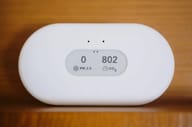
The Airthings View Plus is for people who want one device to monitor everything. It tracks CO2, PM2.5, VOCs, radon, temperature, humidity, and air pressure — seven parameters on a single e-ink display with WiFi cloud connectivity.
Why it works: The NDIR CO2 sensor is accurate and reliable. But the real value is the combination of sensors. Radon monitoring alone would cost $179+ for a dedicated device (see the Airthings Corentium Home). Adding CO2, PM2.5, and VOC measurement into the same unit at $300 makes the View Plus a strong value for comprehensive monitoring.
Smart features: WiFi connects to the Airthings dashboard, which stores long-term data with trend analysis. SmartThings and IFTTT integration lets you trigger ventilation fans or air purifiers when thresholds are exceeded. The Airthings API is available for custom integrations.
Downsides: At $300, it is a significant investment. Radon readings need 30+ days to stabilize for long-term accuracy. No audible alarm for poor air quality — you need to check the display or app. Battery-powered with optional USB-C, but battery life is shorter than the Aranet4 due to WiFi.
Use discount code clean-air-critic-10OFF for 10% off at airthings.com.
3. Qingping Air Monitor Gen 2: Best Multi-Parameter Value
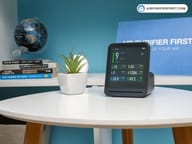
The Qingping Air Monitor Gen 2 packs an NDIR CO2 sensor, PM2.5 and PM10 laser particle sensors, and a tVOC sensor into a $120 device with a 3.1-inch IPS touchscreen. For the price, the sensor coverage and display quality are unmatched.
Why it works: Six parameters (CO2, PM2.5, PM10, tVOC, temperature, humidity) on a clear touchscreen with historical graphs. The NDIR CO2 sensor is accurate, and the dual particle sensors differentiate between fine (PM2.5) and coarse (PM10) particulates. Apple HomeKit native support makes it the best choice for Apple smart home users.
Display: The IPS touchscreen is the best display on this list. Clear readings at any angle, touch-driven historical graphs, and customizable main screens. You see everything without opening an app.
Downsides: USB-C powered only — no battery option, so placement requires a nearby outlet or USB port. HomeKit setup can be finicky on some networks. No radon measurement. If you want radon, you need the Airthings View Plus.
4. SwitchBot CO2 Detector: Best Budget CO2 Monitor
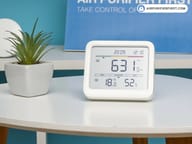
At $60, the SwitchBot CO2 Detector is the least expensive monitor on this list with a genuine NDIR sensor. That alone makes it notable — most monitors under $80 use inferior eCO2 estimation.
Why it works: The NDIR sensor delivers real CO2 measurements, not estimates. The LED display shows CO2, temperature, and humidity with alert thresholds you can customize. Matter support means it works with Apple Home, Google Home, and Alexa regardless of which ecosystem you use.
Smart home strength: Within the SwitchBot ecosystem, the CO2 detector can trigger automations — open a SwitchBot window actuator, turn on a fan, or activate a smart plug powering a ventilator when CO2 rises above your threshold. Matter compatibility extends this to other platforms.
Downsides: CO2, temperature, and humidity only — no PM2.5 or VOC. Some SwitchBot Hub features require the hub accessory. The display is adequate but not as sharp or detailed as the Qingping or Aranet4. Limited standalone functionality without the app.
5. Temtop M2000: Budget Portable Option
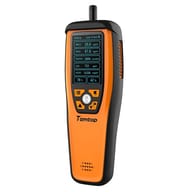
The Temtop M2000 monitors CO2, PM2.5, formaldehyde (HCHO), temperature, and humidity at a $60 price point with a built-in rechargeable battery. It measures more parameters than any other monitor under $100.
Why it works: If you want a portable, battery-powered monitor that measures CO2 and PM2.5 without spending $200+, the M2000 is the most practical option. The color LCD shows all readings simultaneously. The rechargeable battery means no outlet required — useful for spot-checking different rooms, offices, or when traveling.
Formaldehyde detection: The HCHO sensor is a unique feature at this price. Formaldehyde off-gasses from new furniture, flooring, and building materials. If you have recently renovated or moved into new construction, the M2000 can flag elevated formaldehyde levels that warrant ventilation.
Downsides: The CO2 sensor is noticeably less accurate than the NDIR sensors in the Aranet4 or SwitchBot — expect ±50–100 ppm variance rather than ±30 ppm. No WiFi, no app, no data export. You get real-time readings and nothing else. No smart home integration. For pure CO2 accuracy, the SwitchBot is a better buy at the same price.
CO2 Monitoring Buying Guide
What CO2 Levels Mean
Understanding the numbers on your monitor:
- 400–450 ppm: Outdoor baseline. You will see this with windows open.
- 450–700 ppm: Good indoor air. Adequate ventilation.
- 700–1,000 ppm: Acceptable but getting stuffy. Consider opening a window or running ventilation.
- 1,000–2,000 ppm: Poor ventilation. You will likely notice drowsiness, difficulty concentrating, and headaches with prolonged exposure.
- 2,000–5,000 ppm: Bad. Open windows immediately. Common in unventilated bedrooms overnight with the door closed.
- 5,000+ ppm: Hazardous with prolonged exposure. Requires immediate ventilation.
Common High-CO2 Scenarios
Closed bedrooms at night: Two adults sleeping in a sealed bedroom can push CO2 above 2,500 ppm by morning. Cracking a door or window, or running a ventilation fan, keeps levels under 1,000 ppm.
Home offices: A single person in a small, closed office can exceed 1,500 ppm within 2–3 hours. This directly impacts cognitive performance — a Harvard study found decision-making scores dropped 50% at 1,400 ppm compared to 550 ppm.
Classrooms and meeting rooms: If you work from a shared space, bringing a portable monitor (like the Aranet4) can reveal ventilation problems you would not otherwise notice.
Cost Comparison
| Monitor | Price | Ongoing Costs | Total 3-Year Cost |
|---|---|---|---|
| Aranet4 HOME | $200 | ~$5 (AA batteries) | ~$205 |
| Airthings View Plus | $300 | $0 (USB-C/batteries) | ~$300 |
| Qingping Air Monitor Gen 2 | $120 | $0 (USB-C powered) | ~$120 |
| SwitchBot CO2 Detector | $60 | $0 (USB-C powered) | ~$60 |
| Temtop M2000 | $60 | $0 (rechargeable) | ~$60 |
CO2 monitors have no consumable filters to replace, making them a one-time investment. The SwitchBot and Temtop offer the lowest total cost of ownership.
If you are looking for a device that also handles particulate matter from cooking, wildfire smoke, or other sources, see our guide to the best indoor air quality monitors. For a broader introduction to what these devices measure and why it matters, start with indoor air quality basics.
Last updated: March 2026. Prices and availability are subject to change.