Best Indoor Air Quality Monitors: Track What You're Breathing (2026)
Best indoor air quality monitors in 2026. Devices that measure PM2.5, CO2, VOCs, and more — see what is in your air and when to act.

Table of Contents
- Our Top Picks at a Glance
- How to Choose the Right Monitor
- Parameter Priority
- Sensor Quality vs. Price
- Detailed Reviews
- 1. Airthings View Plus: Best Overall (Most Comprehensive)
- 2. Qingping Air Monitor Gen 2: Best Value Multi-Parameter
- 3. Aranet4 HOME: Best for CO2 Accuracy
- 4. PurpleAir PA-I-Indoor: Best for PM2.5 Accuracy
- 5. Amazon Smart Air Quality Monitor: Best for Alexa Smart Home
- 6. GoveeLife Smart Air Quality Monitor: Best Budget WiFi Monitor
- Indoor Air Quality Buying Guide
- Understanding the Key Parameters
- Multi-Room Strategy
- Cost Comparison
TL;DR
The best indoor air quality monitor is the Airthings View Plus, tracking 7 parameters including radon, CO2, PM2.5, and VOCs with WiFi connectivity and a cloud dashboard. For a more affordable multi-parameter option, the Qingping Air Monitor Gen 2 covers CO2, PM2.5, and VOCs for $120 with Apple HomeKit support. Budget buyers who want Alexa integration should consider the Amazon Smart Air Quality Monitor at $70.

Full Comparison
| # | Product | Best For | Rating | Price | |
|---|---|---|---|---|---|
| 1 | Airthings View Plus Top Pick Airthings | Best Overall (Most Comprehensive) | 4.8 | $$$ | Check Price |
| 2 | Qingping Air Monitor Gen 2 Qingping | Best Value Multi-Parameter | 4.5 | $$ | Check Price |
| 3 | Aranet4 HOME Aranet | Best for CO2 Accuracy | 4.9 | $$ | Check Price |
| 4 | PurpleAir PA-I-Indoor PurpleAir | Best for PM2.5 Accuracy | 4.6 | $$ | Check Price |
| 5 | Amazon Smart Air Quality Monitor Amazon | Best for Alexa Smart Home | 4.2 | $ | Check Price |
| 6 | GoveeLife Smart Air Quality Monitor GoveeLife | Best Budget WiFi Monitor | 4.1 | $ | Check Price |
Affiliate Disclosure: CleanAirCritic earns commissions from qualifying purchases through affiliate links on this page. This does not influence our rankings or reviews. All opinions are our own. Learn more
The air inside your home is typically 2–5 times more polluted than outdoor air, according to the EPA. Cooking generates PM2.5 particles. Furniture off-gasses formaldehyde and VOCs. Closed bedrooms build up CO2 overnight. Basements accumulate radon. None of this is visible or detectable by smell until concentrations get severe.
An indoor air quality monitor puts numbers on the invisible. It tells you when to open a window, turn on an air purifier, or run the exhaust fan. The best monitors track multiple parameters simultaneously and connect to your smart home to trigger automations.
We evaluated monitors based on sensor accuracy, parameter coverage, display quality, connectivity, and value. Not every home needs a $300 seven-parameter monitor. A $70 device that measures PM2.5 and VOCs may be all you need. Here are the best options across price points.
Our Top Picks at a Glance
| Monitor | Best For | Parameters | Connectivity | Price |
|---|---|---|---|---|
| Airthings View Plus | Most Comprehensive | Radon, CO2, PM2.5, VOC, temp, humidity, pressure | WiFi | $300 |
| Qingping Air Monitor Gen 2 | Best Value Multi-Parameter | CO2, PM2.5, PM10, tVOC, temp, humidity | WiFi (HomeKit) | $120 |
| Aranet4 HOME | Best CO2 Accuracy | CO2, temp, humidity, pressure | Bluetooth | $200 |
| PurpleAir PA-I-Indoor | Best PM2.5 Accuracy | PM1.0, PM2.5, PM10 | WiFi | $200 |
| Amazon Smart AQ Monitor | Best Alexa Integration | PM2.5, VOC, CO, temp, humidity | WiFi (Alexa) | $70 |
| GoveeLife Smart AQ Monitor | Best Budget WiFi | CO2*, PM2.5, tVOC, temp, humidity | WiFi | $80 |
*GoveeLife uses an estimated CO2 algorithm, not a true NDIR sensor.
How to Choose the Right Monitor
Parameter Priority
Different concerns call for different sensors:
Ventilation and stuffiness → CO2 monitoring. If your main concern is stuffy bedrooms, brain fog in your home office, or knowing when to open windows, a CO2 monitor with an NDIR sensor is the priority. The Aranet4 HOME and Qingping Air Monitor Gen 2 excel here.
Cooking, smoke, and allergens → PM2.5 monitoring. If you cook frequently, live in a wildfire-prone area, or have allergies triggered by particulate matter, PM2.5 measurement matters most. The PurpleAir PA-I-Indoor provides research-grade PM2.5 data. The Qingping and Amazon monitors also measure PM2.5.
Chemical off-gassing → VOC monitoring. New construction, recent renovation, new furniture, or cleaning product sensitivity makes VOC detection valuable. The Airthings View Plus, Qingping, and Amazon monitors include VOC sensors.
Radon → Dedicated radon sensor. If your area has radon risk, only the Airthings View Plus includes radon detection among multi-parameter monitors. See our best radon detectors guide for dedicated options.
Sensor Quality vs. Price
This is where the market splits clearly:
- Under $100 (Amazon, GoveeLife): Adequate sensors for directional awareness. You will know when air quality is bad, but readings may be off by 20–30%. CO2 sensors at this price are typically estimated (eCO2), not NDIR.
- $100–200 (Qingping, Aranet4, PurpleAir): Good-quality sensors with genuine NDIR CO2 or research-grade PM2.5. Accurate enough to make decisions on.
- $250+ (Airthings View Plus): Premium multi-parameter with reliable sensors across the board. Worth it if you want comprehensive data you can trust.
Detailed Reviews
1. Airthings View Plus: Best Overall (Most Comprehensive)
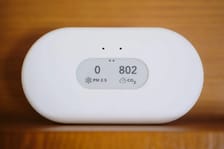
The Airthings View Plus measures seven parameters — radon, CO2, PM2.5, VOCs, temperature, humidity, and air pressure — making it the most comprehensive consumer air quality monitor available. The e-ink display shows all readings with color-coded indicators, and WiFi connectivity feeds data to a cloud dashboard with long-term trend analysis.
Why it is the best overall: No other single device covers this many parameters with decent sensor quality. The NDIR CO2 sensor is accurate. The radon sensor uses proven alpha spectrometry technology (the same sensor as their dedicated Corentium Home). PM2.5 and VOC sensors are adequate for consumer use. The WiFi dashboard provides historical data going back months, which is essential for understanding seasonal patterns.
Smart home integration: SmartThings, IFTTT, and the Airthings API enable automation triggers. Set an IFTTT rule to turn on your smart air purifier when PM2.5 exceeds 25 micrograms per cubic meter, or ventilate when CO2 tops 1,000 ppm.
Downsides: At $300, it is a significant investment. Individual sensor quality is good but not best-in-class — the Aranet4 has a better CO2 sensor, and the PurpleAir has a better PM2.5 sensor. Radon readings need 30+ days to stabilize. No audible alerts for poor air quality.
Use discount code clean-air-critic-10OFF for 10% off at airthings.com.
2. Qingping Air Monitor Gen 2: Best Value Multi-Parameter
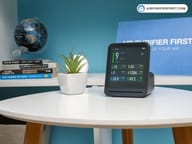
The Qingping Air Monitor Gen 2 is the best value proposition on this list. For $120, you get an NDIR CO2 sensor, dual particle sensors (PM2.5 and PM10), tVOC detection, temperature, and humidity — all displayed on a clear 3.1-inch IPS touchscreen with Apple HomeKit native support.
Why it works: The NDIR CO2 sensor is a genuine infrared sensor, not an estimated algorithm. At $120, this is the cheapest multi-parameter monitor with real CO2 measurement. The touchscreen shows all readings simultaneously with historical graphs you can scroll through without opening an app. HomeKit support makes it the default choice for Apple ecosystem users.
Display quality: The best display on this list. The IPS touchscreen is bright, clear at any viewing angle, and shows all six parameters on the home screen. Swipe to see historical graphs by hour, day, or week. No other monitor in this price range offers this level of visual data.
Smart features: Apple HomeKit support enables automations through the Apple Home app — trigger a smart plug, fan, or purifier based on air quality thresholds. The Qingping+ app provides data for non-Apple users as well.
Downsides: USB-C powered only, no battery option. HomeKit WiFi setup can require a 2.4 GHz network and patience. No radon measurement. The tVOC sensor provides a composite index rather than specific chemical identification.
3. Aranet4 HOME: Best for CO2 Accuracy
The Aranet4 HOME is a single-purpose tool that does one thing exceptionally well: measure CO2 with reference-grade accuracy. If CO2 monitoring is your primary need, nothing in the consumer market matches the Aranet4's combination of accuracy, battery life, and portability.
Why it works: The NDIR sensor is accurate to ±30 ppm, which is as close to lab-grade as consumer devices get. The e-ink display is always-on, readable in any lighting, and the device runs for 2 years on 2 AA batteries. At 5.6 ounces, you can carry it between rooms, to the office, or while traveling.
Best use case: The Aranet4 is ideal for people whose primary concern is ventilation — monitoring bedroom CO2 overnight, tracking office air quality, or verifying that HVAC systems deliver adequate fresh air. If you already have an air purifier with a PM2.5 sensor, the Aranet4 fills the CO2 gap.
Downsides: CO2, temperature, humidity, and pressure only — no PM2.5, VOC, or radon. Bluetooth-only connectivity means no smart home automation. Data syncs to the app only when your phone is nearby. At $200 for a CO2-focused device, it is expensive if you also need PM2.5 or VOC measurement.
For a deeper look at CO2 monitoring options, see our best CO2 monitors guide.
4. PurpleAir PA-I-Indoor: Best for PM2.5 Accuracy
The PurpleAir PA-I-Indoor uses dual PMS5003 laser particle counters, the same sensor technology used in government air quality monitoring networks. For PM2.5 measurement accuracy and reliability, no consumer device comes close.
Why it works: Dual laser sensors provide redundancy — each sensor takes independent readings, and the device cross-references them for accuracy. PurpleAir reports data to a community air quality map used by researchers, government agencies, and wildfire response teams. The sensor measures PM1.0, PM2.5, and PM10 with high temporal resolution (real-time readings updated every 2 seconds).
Research credibility: PurpleAir sensors are the most widely cited low-cost PM2.5 sensors in peer-reviewed air quality research. The EPA has published correction factors specifically for PurpleAir readings, a level of institutional trust that no other consumer sensor receives.
Downsides: PM only — no CO2, VOC, temperature, humidity, or radon. No standalone display; you view data through the PurpleAir web map or API. The design is industrial and utilitarian. WiFi setup requires a browser-based configuration page. This is a specialist tool for people who specifically need accurate particulate measurement.
5. Amazon Smart Air Quality Monitor: Best for Alexa Smart Home
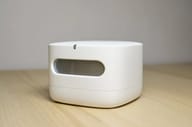
At $70, the Amazon Smart Air Quality Monitor is the most affordable way to add air quality awareness to an Alexa-based smart home. It measures PM2.5, VOCs, CO (carbon monoxide), temperature, and humidity, and integrates natively with Alexa routines.
Why it works: If you already use Echo devices and Alexa routines, this monitor plugs directly into your ecosystem. Set routines like "when PM2.5 exceeds 25, turn on the smart plug powering my air purifier" or "announce on the kitchen Echo when CO levels are elevated." The Alexa app shows current readings and 24-hour history.
CO detection: The Amazon monitor is the only device on this list that measures carbon monoxide, a potentially lethal gas from malfunctioning furnaces, stoves, or attached garages. While it should not replace a dedicated CO alarm, the monitoring adds another safety layer.
Downsides: No standalone display — you must check the Alexa app or ask Alexa for readings. Does not measure CO2 or radon. Accuracy is adequate for automation triggers but not precise enough for data analysis. Locked into the Amazon ecosystem; no HomeKit, SmartThings, or third-party integrations.
6. GoveeLife Smart Air Quality Monitor: Best Budget WiFi Monitor
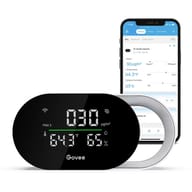
The GoveeLife Smart Air Quality Monitor offers WiFi connectivity with PM2.5, CO2, tVOC, temperature, and humidity monitoring for $80. It is the cheapest WiFi-connected monitor that measures both particulates and gas-phase pollutants.
Why it works: WiFi with the Govee Home app provides remote monitoring, push notifications for poor air quality, and historical data. Within the Govee ecosystem, it can trigger smart plugs, lights, or other Govee devices based on air quality thresholds. The LED display shows current readings without needing your phone.
Downsides: The CO2 reading uses an estimated algorithm based on the VOC sensor, not a true NDIR sensor. This means CO2 readings are directionally useful but not accurate enough for ventilation decisions. Third-party smart home integration is limited compared to Matter or HomeKit-compatible devices. Sensor accuracy across the board is adequate but clearly a step below the Qingping or Airthings.
Indoor Air Quality Buying Guide
Understanding the Key Parameters
PM2.5 (Fine Particulate Matter): Particles smaller than 2.5 microns that penetrate deep into lungs and enter the bloodstream. Sources include cooking, candles, wildfire smoke, and vehicle exhaust. Health effects include respiratory inflammation, cardiovascular stress, and increased allergy symptoms. A good indoor level is below 12 micrograms per cubic meter.
CO2 (Carbon Dioxide): A direct indicator of ventilation. Humans exhale CO2 with every breath. In a sealed room, levels rise predictably based on occupancy and room volume. High CO2 (above 1,000 ppm) causes drowsiness, headache, and impaired cognitive performance. Outdoor baseline is approximately 420 ppm.
VOCs (Volatile Organic Compounds): Gases emitted by cleaning products, paint, new furniture, building materials, and cooking. Exposure causes eye and throat irritation, headaches, and potential long-term health effects. Most monitors report a composite tVOC index rather than identifying specific chemicals.
Radon: A radioactive gas from soil that causes lung cancer. The only way to detect it is with a sensor. See our best radon detectors guide for dedicated options.
Multi-Room Strategy
The most cost-effective approach for whole-home monitoring:
- Bedroom: Your highest priority. You spend 7–9 hours here breathing the same air. A CO2 monitor (Aranet4 or SwitchBot) ensures adequate ventilation overnight.
- Kitchen/living area: PM2.5 spikes from cooking. A multi-parameter monitor (Qingping or Amazon) with automation can trigger your range hood or air purifier.
- Basement: If you are in a radon-prone area, an Airthings View Plus or Corentium Home provides continuous radon monitoring.
- Home office: A CO2 monitor helps you maintain ventilation for peak cognitive performance during work hours.
Cost Comparison
| Monitor | Price | Ongoing Costs | Key Limitation |
|---|---|---|---|
| Airthings View Plus | $300 | $0 | Premium price |
| Qingping Air Monitor Gen 2 | $120 | $0 | No radon, needs outlet |
| Aranet4 HOME | $200 | ~$5 (batteries) | CO2 only, no WiFi |
| PurpleAir PA-I-Indoor | $200 | $0 | PM only, no display |
| Amazon Smart AQ Monitor | $70 | $0 | No CO2, Alexa-only |
| GoveeLife Smart AQ Monitor | $80 | $0 | Estimated CO2, limited accuracy |
All monitors on this list are one-time purchases with no consumables or subscriptions. Choose based on which parameters matter most for your situation and budget. Once you have your monitor, our guide on how to read your air quality monitor walks you through interpreting the numbers and knowing when to take action.
Last updated: March 2026. Prices and availability are subject to change.