
Best PM2.5 Monitors for Wildfire Smoke (2026)
Best PM2.5 monitors for wildfire smoke in 2026. Track particle levels indoors and out so you know when to seal up or run your purifier.

Table of Contents
- Our Top Picks
- PurpleAir PA-I Indoor — Best Overall for Wildfire Monitoring
- Airthings View Plus — Best All-in-One with PM2.5
- Temtop M2000 — Best Portable PM2.5 Monitor
- Amazon Smart Air Quality Monitor — Best Budget Pick
- What to Look for in a Wildfire PM2.5 Monitor
- Sensor Type Matters
- Real-Time Readings Are Essential
- Alerts Save Your Health
- How to Use Your Monitor During Wildfire Season
- Next Steps
TL;DR
The best PM2.5 monitor for wildfire smoke is the PurpleAir PA-I Indoor, which provides research-grade laser particle counting and real-time data integration with the PurpleAir map network. For a budget option, the Amazon Smart Air Quality Monitor tracks PM2.5 alongside other pollutants for just $55. If you want an all-in-one device that also covers CO2 and radon, the Airthings View Plus is our premium pick at $300.
Full Comparison
| # | Product | Best For | Rating | Price | |
|---|---|---|---|---|---|
| 1 | PurpleAir PA-I Indoor Top Pick PurpleAir | Best Overall for Wildfire Monitoring | 4.8 | $$$ | Check Price |
| 2 | Airthings View Plus Airthings | Best All-in-One with PM2.5 | 4.7 | $$$ | Check Price |
| 3 | Temtop M2000 Temtop | Best Portable PM2.5 Monitor | 4.4 | $$ | Check Price |
| 4 | Amazon Smart Air Quality Monitor Amazon | Best Budget PM2.5 Monitor | 4.2 | $ | Check Price |
Wildfire smoke is the fastest-growing air quality threat in North America. The 2023 Canadian wildfire season sent PM2.5 levels to hazardous readings across the entire eastern US, and experts expect similar or worse seasons ahead.
A PM2.5 monitor is your early warning system. It tells you exactly when smoke is infiltrating your home, whether your air purifier is keeping up, and when it is safe to open windows again. Here are the best options for wildfire season.
Our Top Picks
PurpleAir PA-I Indoor — Best Overall for Wildfire Monitoring
Rating: 4.8/5 | Price: ~$230
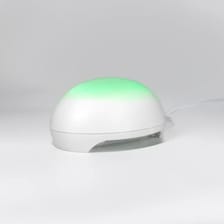
The PurpleAir PA-I Indoor uses dual laser particle counters for redundancy — if one sensor drifts, the device flags it. This matters during wildfire events when you need readings you can trust.
What makes PurpleAir stand out for wildfire monitoring is the community network. Your sensor's data joins the real-time PurpleAir map, and you can see every other PurpleAir sensor in your area. During a wildfire event, this is invaluable for tracking smoke plumes as they move across your region.
The EPA has published correction factors specifically for PurpleAir sensors during wildfire events, making these some of the most research-validated consumer PM2.5 sensors available.
Best for: Anyone who wants the most accurate PM2.5 data and wants to contribute to the community air quality network.
Limitations: WiFi only — no display on the device itself. You view readings through the PurpleAir website or app. No CO2 or radon measurement.
Airthings View Plus — Best All-in-One with PM2.5
Rating: 4.7/5 | Price: ~$300
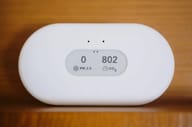
If you want PM2.5 alongside radon, CO2, VOCs, and humidity in one device, the Airthings View Plus is the premium choice. Its built-in PM2.5 sensor uses laser scattering and provides readings on the e-ink display and via the cloud dashboard.
For wildfire monitoring specifically, the PM2.5 sensor is accurate enough to tell you when levels are safe vs dangerous, though it is not as precise as the PurpleAir's dual-sensor design. The real value is seeing PM2.5 in context alongside CO2 and humidity — because during a wildfire you are often sealed up, which means CO2 can climb while you are focused on particles.
Best for: People who want comprehensive air quality monitoring year-round with solid PM2.5 tracking during wildfire season.
Limitations: PM2.5 sensor is slightly less accurate than dedicated monitors. Premium price for a device where PM2.5 is one of many features.
Temtop M2000 — Best Portable PM2.5 Monitor
Rating: 4.4/5 | Price: ~$170
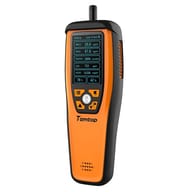
The Temtop M2000 measures PM2.5, PM10, CO2, and HCHO (formaldehyde) in a portable, battery-powered unit with a color display. The rechargeable battery lets you carry it between rooms, take it to the office, or check different areas of your home during a smoke event.
For wildfire monitoring, portability is a genuine advantage. You can quickly check every room to find which ones have the best seal against outdoor smoke, then set up your purifier there.
Best for: People who want a portable PM2.5 monitor they can carry around and who also want CO2 readings.
Limitations: No WiFi or cloud connectivity — data stays on the device. No community network. Battery life is limited (8-10 hours continuous use).
Amazon Smart Air Quality Monitor — Best Budget Pick
Rating: 4.2/5 | Price: ~$55
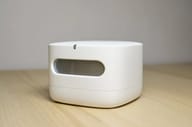
At $55, the Amazon Smart Air Quality Monitor is the most affordable way to track PM2.5 alongside temperature, humidity, CO, and VOCs. It integrates with Alexa, so you can ask "Alexa, what is the air quality?" and get a verbal response.
The PM2.5 sensor is less precise than the PurpleAir or Temtop, but it is accurate enough to tell you whether conditions are good, moderate, or dangerous. For wildfire monitoring on a budget, that distinction is what matters.
Best for: Budget buyers who want basic PM2.5 awareness and Alexa integration.
Limitations: PM2.5 accuracy is lower than laser particle counters. No display — readings are via Alexa or the app only.
What to Look for in a Wildfire PM2.5 Monitor
Sensor Type Matters
The best PM2.5 monitors use laser particle counting (also called laser scattering). A laser beam illuminates particles drawn into a chamber, and a photodetector counts them by size. PurpleAir uses PMS5003 laser counters. Temtop uses similar laser technology.
Cheaper monitors may use less accurate sensor types. Look for monitors that explicitly state laser particle counting or specify the sensor model.
Real-Time Readings Are Essential
During a wildfire event, PM2.5 changes rapidly. A monitor that updates every 1-2 minutes is much more useful than one that averages over 15-minute or hourly intervals. PurpleAir updates every 2 minutes. The Temtop M2000 updates in real time.
Alerts Save Your Health
If your monitor supports push notifications or Alexa routines, set up alerts for when PM2.5 exceeds 35 µg/m³ (unhealthy for sensitive groups). This lets you react immediately when smoke arrives rather than noticing hours later.
How to Use Your Monitor During Wildfire Season
Baseline first. Run your monitor for at least a week before fire season to know your normal indoor PM2.5. Most clean homes sit at 2-8 µg/m³.
Seal and purify. When outdoor smoke arrives, close all windows and doors. Run your HEPA air purifier on high. Watch the indoor PM2.5 reading.
Find the leaks. Carry a portable monitor around your home to find where smoke is infiltrating — leaky windows, doors, bathroom fans. Seal those gaps with towels or tape.
Monitor the recovery. After wind shifts clear the outdoor smoke, monitor indoor PM2.5 before opening windows. Residual smoke particles settle on surfaces and can take hours to clear.
Track the season. Use the PurpleAir map or AirNow.gov to monitor regional smoke. Your indoor monitor confirms whether your protection strategy is working.
Next Steps
- For a comprehensive approach that includes CO2 and radon monitoring alongside PM2.5, see our best indoor air quality monitors roundup
- If you need an air purifier to pair with your monitor, our guide to the best air purifier for smoke covers wildfire-specific picks
- Learn how monitors and purifiers work together in our guide: Air Quality Monitor vs Air Purifier