Best Air Purifiers for Asthma: Doctor-Recommended HEPA Models (2026)
6 best air purifiers for asthma in 2026. True HEPA filtration, zero ozone, and AAFA-certified picks that reduce asthma triggers at home.

Table of Contents
- Our Top Picks at a Glance
- Why Asthma Patients Need a Different Air Purifier
- Ozone Must Be Zero
- Smoke CADR Matters More Than Pollen CADR
- Continuous Operation Is Non-Negotiable
- Detailed Reviews
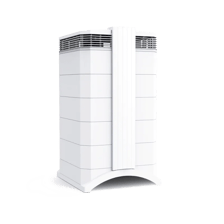
- 1. IQAir HealthPro Plus: Best Overall for Asthma
- 2. Coway Airmega AP-1512HH: Best Value, AAFA Certified
- 3. Levoit Core 400S: Best Smart Features for Asthma Management
- 4. Blueair Blue Pure 211+: Best for Large Rooms
- 5. Winix 5500-2: Best for Asthma + Chemical Sensitivity
- 6. Levoit Core 300S: Best Budget Pick
- Asthma-Specific Buying Guide
- What the AAFA Certification Means
- Particle Sizes That Trigger Asthma
- Room Placement for Asthma
- Avoiding Purifiers That Worsen Asthma
- Running Costs for 24/7 Operation
- Complementary Asthma Management Steps
TL;DR
The best air purifier for asthma is the IQAir HealthPro Plus. Its HyperHEPA filter captures particles down to 0.003 microns, it produces zero ozone, and it carries the AAFA Asthma & Allergy Friendly certification. For a more affordable option, the Coway Airmega AP-1512HH is also AAFA-certified and delivers strong True HEPA performance at around $160. Budget buyers should consider the Levoit Core 300S, which pairs quiet overnight operation with smart scheduling for under $150.
Full Comparison
| # | Product | Best For | Rating | Price | |
|---|---|---|---|---|---|
| 1 | IQAir HealthPro Plus Top Pick IQAir | Best Overall for Asthma | 4.9 | $$$$ | Check Price |
| 2 | Coway Airmega AP-1512HH Coway | Best Value, AAFA Certified | 4.7 | $$ | Check Price |
| 3 | Levoit Core 400S Levoit | Best Smart Features | 4.7 | $$ | Check Price |
| 4 | Blueair Blue Pure 211+ Blueair | Best for Large Rooms | 4.6 | $$ | Check Price |
| 5 | Winix 5500-2 Winix | Best for Asthma + Chemical Sensitivity | 4.5 | $ | Check Price |
| 6 | Levoit Core 300S Levoit | Best Budget Pick | 4.4 | $ | Check Price |
Affiliate Disclosure: CleanAirCritic earns commissions from qualifying purchases through affiliate links on this page. This does not influence our rankings or reviews. All opinions are our own. Learn more
If you have asthma, the air inside your home is working against you. Dust mites, pet dander, mold spores, and fine particulate matter circulate through your living space constantly. The American Lung Association identifies these as common asthma triggers, and indoor concentrations can be two to five times higher than outdoor levels.
A True HEPA air purifier is one of the most effective tools for reducing airborne asthma triggers. But not every purifier is safe for asthma. Ionizers and ozone-generating units can actually worsen symptoms. The Asthma and Allergy Foundation of America (AAFA) maintains a certification program that tests purifiers against rigorous standards specifically for people with asthma and allergies.
We evaluated six purifiers through the lens of asthma management: True HEPA or better filtration, zero ozone output, strong CADR ratings for fine particles, and noise levels suitable for overnight bedroom use. Here are the best options for 2026.
Our Top Picks at a Glance
| Purifier | Best For | CADR (Smoke/Dust) | Room Coverage | Price Range | AAFA Certified |
|---|---|---|---|---|---|
| IQAir HealthPro Plus | Best Overall for Asthma | 300/300 CFM | Up to 1,125 sq ft | $$$$ | Yes |
| Coway Airmega AP-1512HH | Best Value, AAFA Certified | 233/246 CFM | Up to 361 sq ft | $$ | Yes |
| Levoit Core 400S | Best Smart Features | 256/260 CFM | Up to 403 sq ft | $$ | No |
| Blueair Blue Pure 211+ | Best for Large Rooms | 350/350 CFM | Up to 550 sq ft | $$ | No |
| Winix 5500-2 | Asthma + Chemical Sensitivity | 232/243 CFM | Up to 360 sq ft | $ | No |
| Levoit Core 300S | Best Budget Pick | 141/141 CFM | Up to 219 sq ft | $ | No |
Why Asthma Patients Need a Different Air Purifier
Not every air purifier is appropriate for asthma. Standard buyer's guides focus on allergen removal and room coverage, but asthma adds three critical requirements that change the calculus.
Ozone Must Be Zero
Ozone irritates airways even at concentrations below federal safety limits. For someone with hyperreactive airways, trace ozone from an ionizer or UV-C bulb can trigger bronchospasm. The AAFA explicitly warns against ozone-producing purifiers for asthma patients. Every purifier on this list either produces zero ozone or is CARB (California Air Resources Board) certified to emit less than 0.050 ppm, well below the threshold that affects healthy adults and far below what triggers asthma symptoms in sensitive individuals.
Smoke CADR Matters More Than Pollen CADR
Most buyer's guides emphasize dust and pollen CADR. For asthma, smoke CADR is the more important metric. Smoke CADR measures filtration of the smallest test particles (0.09 to 1.0 microns), which correspond to the fine particulate matter (PM2.5) that penetrates deep into bronchial passages and triggers inflammation. Dust mite debris, combustion particles, and ultrafine mold fragments all fall in this size range.
Continuous Operation Is Non-Negotiable
Asthma triggers accumulate constantly. Opening a door, folding laundry, a pet walking through the room, cooking, or simply running the HVAC system all introduce fine particles. Turning a purifier off for even a couple of hours allows particle concentrations to climb back to baseline. The purifiers on this list are selected partly for their ability to run 24/7 efficiently: low energy consumption, quiet sleep modes, and long filter life.
Detailed Reviews
1. IQAir HealthPro Plus: Best Overall for Asthma
The IQAir HealthPro Plus is the air purifier most frequently recommended by pulmonologists and allergists for asthma patients. It holds both AAFA Asthma & Allergy Friendly certification and meets Swiss air quality standards, among the strictest in the world.
Why it works for asthma: The HyperHEPA filter captures particles down to 0.003 microns, which is 100 times finer than standard True HEPA. This is critical for asthma because many of the particles that trigger bronchospasm are smaller than 0.3 microns: combustion byproducts, ultrafine mold fragments, and the smallest allergen proteins. The three-stage system includes a microfiber pre-filter, the V5-Cell gas and odor filter (5 lbs of granular activated carbon for VOCs and chemical irritants), and the HyperHEPA final stage.
Zero ozone: The HealthPro Plus uses purely mechanical filtration. No ionizer, no UV, no plasma. It produces absolutely zero ozone, which is why it carries the AAFA certification specifically for asthma sufferers.
Performance: With a CADR of 300 CFM across all particle sizes and coverage up to 1,125 sq ft, this unit can handle large living spaces while delivering the 4-5 air changes per hour that pulmonologists recommend. Six fan speeds give you granular control from near-silent background operation to aggressive purge mode.
Noise: 29 dB on the lowest setting (quieter than a whisper), scaling to 59 dB on maximum. For overnight bedroom use, speeds 1-3 are effectively inaudible.
Downsides: The $899 price point puts it out of reach for many households. No smart features, Wi-Fi, or app. At 35 lbs, it stays where you put it. Filter replacements cost $120 per year on average, though each filter stage lasts 1-2 years. The design is functional, not decorative.
Who should buy this: Asthma patients whose symptoms are poorly controlled despite medication, anyone with severe or brittle asthma, households where a family member has asthma plus chemical sensitivities, and anyone who wants the highest-performing residential air purifier available.
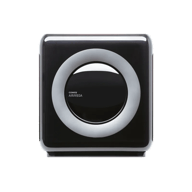
2. Coway Airmega AP-1512HH: Best Value, AAFA Certified
The Coway AP-1512HH is one of only a handful of air purifiers that carries the AAFA Asthma & Allergy Friendly certification, and it does so at roughly one-fifth the price of the IQAir. For most asthma sufferers, this is the sweet spot between medical-grade credibility and affordability.
Why it works for asthma: The four-stage filtration system (washable pre-filter, deodorization filter, True HEPA, and optional Vital Ion) removes 99.97% of particles at 0.3 microns. The AAFA certification means it has been independently tested and verified to remove at least 90% of allergens from an environmental chamber, meeting the standard specifically designed for people with asthma and allergies.
Ozone note: The Coway includes a Vital Ion feature that produces trace amounts of negative ions. While Coway states the ozone output is well below safety limits, asthma patients should turn this feature off. The button is clearly labeled, and the True HEPA filter works perfectly without it. With Vital Ion off, ozone output is zero.
Auto mode: The built-in particle sensor and color-coded air quality ring (blue, purple, red) let you see air quality at a glance. Auto mode adjusts fan speed in real time, ramping up when it detects a spike from cooking or cleaning and settling back when the air is clean. Eco mode shuts the fan off entirely during sustained clean air periods, restarting automatically when particles return.
Noise: 24 dB on low, one of the quietest purifiers at any price. On high, 53 dB is noticeable but manageable. The eco mode is completely silent when the fan shuts off.
Downsides: Coverage at 361 sq ft limits this to bedrooms and mid-sized rooms. No Wi-Fi or app. The deodorization filter is modest; if VOCs or chemical irritants are a major trigger for your asthma, you may need a purifier with a heavier activated carbon stage.
Who should buy this: Asthma patients who want AAFA-certified confidence at a reasonable price, anyone who prioritizes bedroom air quality (the most important room for nighttime asthma), and buyers who want a proven, well-reviewed unit without paying a premium.
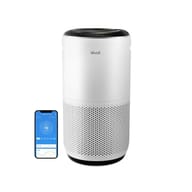
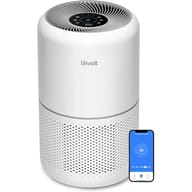
3. Levoit Core 400S: Best Smart Features for Asthma Management
The Levoit Core 400S brings real-time air quality monitoring and smart scheduling to asthma management. If you want to track your indoor air quality and automate your purifier around your daily routine, this is the best option under $200.
Why it works for asthma: The H13 True HEPA filter captures 99.97% of particles at 0.3 microns. The laser-based PM2.5 sensor is accurate and responsive, detecting particle spikes within seconds and adjusting auto mode accordingly. For asthma patients, this means the purifier ramps up automatically during cooking, cleaning, or when someone opens an exterior door, catching trigger particles before they accumulate.
Smart features for asthma: The VeSync app lets you check real-time PM2.5 readings from your phone, view air quality history over time, and set custom schedules. You can program the purifier to run on high during known trigger times (early morning when dust mites are most active, evening cooking hours) and drop to sleep mode at night. Alexa and Google Assistant integration means you can increase fan speed with a voice command when you notice symptoms starting.
Performance: Smoke CADR of 256 CFM and dust CADR of 260 CFM cover a 403 sq ft room at approximately 4 air changes per hour. Sleep mode drops to 24 dB, and the display dims completely so it will not light up your bedroom.
Downsides: The activated carbon layer is thin, so this is not ideal if chemical irritants or strong odors are primary asthma triggers. No AAFA certification. The cylindrical design takes up more floor space than tower units. Filter replacements run $30-45 every 6-8 months.
Who should buy this: Tech-comfortable asthma patients who want data-driven air quality management, anyone who benefits from scheduling purifier intensity around their daily routine, and households with smart home ecosystems already in place.
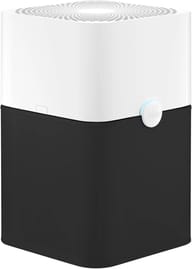
4. Blueair Blue Pure 211+: Best for Large Rooms
If your asthma symptoms are worst in a large living room or open-plan space, the Blue Pure 211+ delivers the highest CADR on this list at a mid-range price. It covers up to 550 sq ft, which means 4-5 air changes per hour in a typical 350-400 sq ft living area.
Why it works for asthma: Blueair's HEPASilent technology combines mechanical filtration with electrostatic charging, achieving 99.97% particle capture at 0.1 microns with less airflow resistance than pure mechanical HEPA. Lower resistance means more clean air delivered at lower fan speeds, which translates to less noise for a given CADR. The 350 CFM smoke CADR is the highest on this list, meaning it removes the finest asthma-triggering particles faster than any other purifier here.
Zero ozone: Despite using electrostatic assistance, the Blue Pure 211+ is CARB certified and produces zero measurable ozone. The electrostatic charge is applied to particles inside the filter housing, not broadcast into the room like a standalone ionizer.
Design: The one-button, three-speed operation is about as simple as it gets. The washable fabric pre-filter wraps around the base and comes in multiple colors. At 12.5 lbs, it is lighter than the IQAir but still best left in one spot.
Noise: 31 dB on low, 56 dB on high. The low setting is quiet enough for most bedrooms, though it is not as silent as the Coway or Levoit sleep modes. The airflow tone is a steady, even white noise without the high-pitched whine some purifiers produce.
Downsides: No auto mode, no air quality sensor, no smart features at all. You pick a speed and it runs. For asthma patients who benefit from adaptive fan speed during particle spikes, this is a real limitation. Filter replacements cost about $55 every 6 months. The cylindrical design has a 13-inch footprint.
Who should buy this: Asthma patients whose symptoms are triggered in large, open living spaces; anyone who wants maximum raw filtration performance; and buyers who prefer simple, reliable operation over smart features.
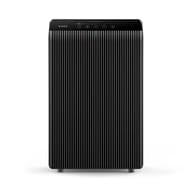
5. Winix 5500-2: Best for Asthma + Chemical Sensitivity
Many asthma patients find that their symptoms are triggered not just by particles but by chemical irritants: cleaning products, paint fumes, new furniture off-gassing, or cooking byproducts. The Winix 5500-2 addresses both particle and chemical triggers with its combination of True HEPA and washable activated carbon filtration.
Why it works for asthma: The True HEPA filter handles 99.97% of particles at 0.3 microns. The washable AOC (Advanced Odor Control) carbon filter adsorbs VOCs and chemical irritants that can trigger or worsen asthma. PlasmaWave technology breaks down allergens, bacteria, and chemical vapors at a molecular level. Importantly, PlasmaWave is CARB certified to produce safe ozone levels, and it can be turned off entirely if you prefer purely mechanical filtration.
Recommendation for asthma patients: Turn PlasmaWave off. While it is CARB certified, the trace ozone it produces (well below 0.050 ppm) is not worth the risk for sensitive airways. The True HEPA and AOC carbon filters provide excellent asthma protection on their own.
Cost advantage: The washable AOC carbon filter means you only replace the HEPA filter annually ($35-45). Over three years, the Winix 5500-2 costs roughly half as much to operate as purifiers with disposable carbon filters. For asthma patients running a purifier 24/7, operating cost matters.
Auto mode: The built-in particle sensor and auto mode adjust fan speed based on real-time air quality. An ambient light sensor dims indicator lights in dark rooms, a thoughtful feature for bedroom use.
Noise: 28 dB on low, 56 dB on turbo. Low speed is suitable for overnight bedroom operation. Turbo is best reserved for daytime purge cycles after cleaning or cooking.
Downsides: No Wi-Fi or app. The plastic build feels utilitarian. Room coverage at 360 sq ft is average. The smart sensor is adequate but not as responsive or accurate as the laser sensors in the Levoit Core 400S.
Who should buy this: Asthma patients who also react to chemical irritants, VOCs, or strong odors; anyone who wants to minimize ongoing filter costs; and buyers looking for solid all-around asthma protection under $200.
6. Levoit Core 300S: Best Budget Pick
The Levoit Core 300S delivers True HEPA filtration with smart features at the lowest price on this list. For asthma patients on a tight budget, or anyone who wants to place purifiers in multiple rooms without breaking the bank, this is the most practical option.
Why it works for asthma: The H13 True HEPA filter captures 99.97% of particles at 0.3 microns. Zero ozone; purely mechanical filtration. At 22 dB on its lowest setting, it is one of the quietest purifiers available, making it ideal for overnight bedroom use where asthma symptoms tend to be worst. The display turns off completely in sleep mode.
Smart scheduling for asthma: The VeSync app lets you create schedules that align with your asthma patterns. Program the purifier to run on high during early morning hours (when dust mite activity peaks), lower during the day, and back to medium during evening cooking. Alexa and Google Assistant voice control means you can boost the fan speed from bed if you wake up with tightness.
Multi-room strategy: At around $150 each, buying two Core 300S units for bedroom and living room is cheaper than a single premium purifier and provides better coverage for asthma management. Each unit covers 219 sq ft, which is sufficient for most bedrooms.
Noise: 22 dB on sleep mode, effectively silent. On high, 50 dB is comparable to light rainfall. The transition between speeds is smooth without sudden noise jumps that could disrupt sleep.
Downsides: CADR of 141 CFM limits it to small rooms. Inadequate for living rooms over 220 sq ft. No built-in air quality sensor (the app provides scheduling but not real-time particle monitoring). The activated carbon layer is thin; not suitable as a primary defense against chemical asthma triggers.
Who should buy this: Budget-conscious asthma patients who need bedroom air purification, anyone who wants to deploy multiple units throughout their home, and patients who value ultra-quiet nighttime operation above all else.
Asthma-Specific Buying Guide
What the AAFA Certification Means
The Asthma & Allergy Friendly certification from the Asthma and Allergy Foundation of America is the most relevant third-party validation for asthma patients. To earn this mark, a purifier must remove at least 90% of allergens from a controlled environmental chamber and meet strict standards for ozone emissions. Only two purifiers on this list carry the certification: the IQAir HealthPro Plus and the Coway Airmega AP-1512HH.
AAFA certification is not mandatory for a good asthma purifier, but it is the closest thing to a doctor's stamp of approval. If you are choosing between two otherwise similar models and one is AAFA-certified, go with the certified one.
Particle Sizes That Trigger Asthma
Understanding which particles trigger your asthma helps you prioritize the right CADR metric:
- PM2.5 and smaller (under 2.5 microns): Combustion particles, cooking fumes, smoke, ultrafine mold fragments. These penetrate deep into the bronchial tubes. Measured by smoke CADR.
- Dust mite allergens (1-10 microns): Fecal pellets and body fragments from dust mites. Measured by dust CADR.
- Pollen and large allergens (10-100 microns): Relevant for asthma patients with allergic asthma triggered by seasonal pollen. Measured by pollen CADR.
- VOCs (gaseous): Not captured by HEPA filters. Requires activated carbon. Relevant for asthma triggered by chemical irritants, cleaning products, or off-gassing.
For most asthma patients, smoke and dust CADR are the priority metrics. If your asthma has an allergic component, pollen CADR matters too.
Room Placement for Asthma
The bedroom should be your first priority. You spend 7-9 hours there breathing the same air, often surrounded by dust mite habitats (mattress, pillows, carpets). Place the purifier 3-5 feet from your bed, elevated if possible, with the air outlet directed toward you.
Second priority: the room where you spend the most waking hours (living room or home office). If budget allows, place a second purifier there.
Keep doors closed when running purifiers. An open door connects your room to the rest of the house, and the purifier cannot maintain clean air against the volume of an entire home. (For whole-house solutions, see our guide to best air purifiers for large rooms.)
Avoiding Purifiers That Worsen Asthma
Some air purifiers actively harm asthma patients:
- Ozone generators: Marketed as air "sanitizers" or "fresheners," these produce ozone deliberately. Ozone is a lung irritant that triggers bronchospasm. The EPA and AAFA both recommend against ozone generators for any indoor use.
- Standalone ionizers: Negative ion generators charge particles to make them settle on surfaces, but some produce ozone as a byproduct. The particles land on surfaces and can become airborne again when disturbed.
- UV-C purifiers without proper shielding: Some UV-C designs produce ozone when the UV light interacts with oxygen. Look for CARB certification if considering a UV-C unit.
- HEPA-type or HEPA-like filters: These are not True HEPA. They miss the fine particles that are most damaging to asthmatic airways. Insist on H13 or better.
Running Costs for 24/7 Operation
Asthma patients need to run purifiers continuously. Here is what that costs annually:
| Purifier | Purchase Price | Annual Filters | Annual Energy (est.) | Total Year-1 Cost |
|---|---|---|---|---|
| IQAir HealthPro Plus | ~$899 | ~$120 | ~$50 | ~$1,069 |
| Coway AP-1512HH | ~$160 | ~$50 | ~$18 | ~$228 |
| Levoit Core 400S | ~$190 | ~$45 | ~$10 | ~$245 |
| Blueair Blue Pure 211+ | ~$250 | ~$55 | ~$14 | ~$319 |
| Winix 5500-2 | ~$180 | ~$40 | ~$13 | ~$233 |
| Levoit Core 300S | ~$150 | ~$35 | ~$6 | ~$191 |
The Levoit Core 300S and Coway AP-1512HH offer the lowest total cost of ownership. The IQAir HealthPro Plus is expensive upfront, but its filters last longer, and the year-2 cost drops to approximately $170.
Complementary Asthma Management Steps
An air purifier works best alongside other environmental controls:
- Encase mattress and pillows in allergen-proof covers to reduce dust mite exposure.
- Wash bedding weekly in hot water (130°F / 54°C) to kill dust mites.
- Keep humidity between 30-50%. Dust mites and mold thrive above 50% humidity. Use a dehumidifier if needed.
- Vacuum with a HEPA-equipped vacuum at least twice weekly to remove settled allergens.
- Remove wall-to-wall carpeting in the bedroom if possible. Hard floors harbor fewer allergens.
- Avoid smoking indoors and minimize use of scented candles, aerosol sprays, and strong cleaning chemicals.
For a broader look at maintaining your purifier for peak performance, see our air purifier maintenance guide.
Last updated: March 2026. Prices and availability are subject to change. This article is for informational purposes only and does not constitute medical advice. Consult your doctor or pulmonologist about incorporating an air purifier into your asthma management plan.