Best Air Purifiers for Classroom Vape Smoke (2026)
The 5 best air purifiers for classroom vape smoke in 2026. Quiet, high-CADR units that remove vape aerosol from school environments.

Table of Contents
- Our Top Picks at a Glance
- Why Classroom Vape Smoke Is Different
- Ultrafine Particles Require True HEPA
- VOCs and Flavoring Compounds Linger
- Classroom Noise Constraints
- High Air Change Rates Matter
- The 5 Best Air Purifiers for Classroom Vape Smoke
- 1. Medify MA-112: Best Overall for Classrooms
- 2. IQAir HealthPro Plus: Best for Sensitive Students
- 3. Coway Airmega 400: Best for Air Quality Monitoring
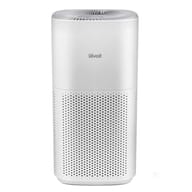
- 4. Levoit Core 600S: Best Value for Classrooms
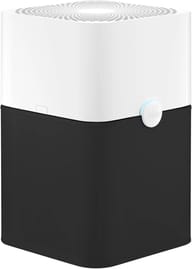
- 5. Blueair Blue Pure 211+: Best Budget Pick for Schools
- How to Choose the Right Purifier for Your School
- Match Coverage to Room Size
- Prioritize Noise Under 40 dB
- Factor in Total Cost of Ownership
- Consider Smart Features for Fleet Management
- Check Procurement Requirements
- Deployment Tips for Schools
- The Bottom Line
TL;DR
The best air purifier for classroom vape smoke is the Medify MA-112, with dual H13 HEPA filters, 450 CFM smoke CADR, and coverage up to 2,500 sq ft. It handles the ultrafine particles in vape aerosol while running quiet enough for instruction. For tighter budgets, the Levoit Core 600S delivers 410 CFM at just $240 and covers a standard 600 sq ft classroom.
Full Comparison
| # | Product | Best For | Rating | Price | |
|---|---|---|---|---|---|
| 1 | Medify MA-112 Top Pick Medify | Best Overall for Classrooms | 4.6 | $$$ | Check Price |
| 2 | IQAir HealthPro Plus IQAir | Best for Sensitive Students | 4.8 | $$$$ | Check Price |
| 3 | Coway Airmega 400 Coway | Best for Air Quality Monitoring | 4.5 | $$$ | Check Price |
| 4 | Levoit Core 600S Levoit | Best Value for Classrooms | 4.7 | $$ | Check Price |
| 5 | Blueair Blue Pure 211+ Blueair | Best Budget Pick for Schools | 4.4 | $$ | Check Price |
Affiliate Disclosure: CleanAirCritic earns commissions from qualifying purchases through affiliate links on this page. This does not influence our rankings or reviews. All opinions are our own. Learn more
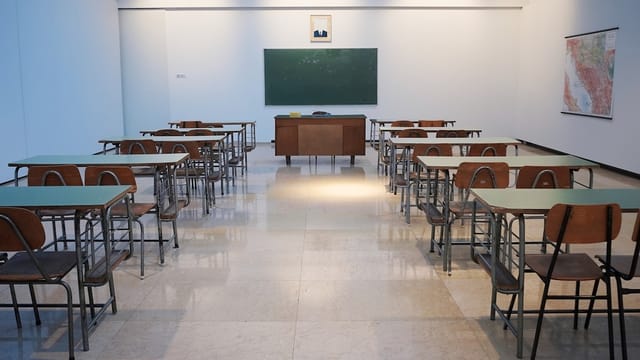
Vaping in schools is not a hypothetical problem. Over 1.6 million U.S. students reported using e-cigarettes in the most recent national survey, and administrators know the real numbers are higher. The vapor clouds drift from bathrooms into hallways and classrooms, raising PM2.5 levels to 10 to 20 times what the WHO considers safe.
The challenge for schools is different from homes. You need a purifier that covers 600 to 900 sq ft classrooms, runs quietly enough for instruction, handles the ultrafine particles in vape aerosol (0.1 to 0.3 microns), and does not blow through your maintenance budget. That narrows the field quickly.
We evaluated air purifiers specifically for classroom deployment, prioritizing CADR smoke ratings, noise levels during instruction, room coverage, and total cost of ownership. If you are dealing with vape smoke at home instead, our best air purifiers for vape smoke guide covers residential models. For a deeper look at what vaping does to indoor air, read our explainer on whether vaping affects air quality.
Our Top Picks at a Glance
| Purifier | Best For | CADR (Smoke) | Room Coverage | Noise (Low) | Price |
|---|---|---|---|---|---|
| Medify MA-112 | Best Overall | 450 CFM | Up to 2,500 sq ft | 21 dB | ~$500 |
| IQAir HealthPro Plus | Sensitive Students | 300 CFM | Up to 1,125 sq ft | 29 dB | ~$899 |
| Coway Airmega 400 | Air Quality Monitoring | 328 CFM | Up to 1,560 sq ft | 22 dB | ~$450 |
| Levoit Core 600S | Best Value | 410 CFM | Up to 635 sq ft | 26 dB | ~$240 |
| Blueair Blue Pure 211+ | Budget Pick | 350 CFM | Up to 550 sq ft | 31 dB | ~$250 |
Why Classroom Vape Smoke Is Different
If your school already has air purifiers for dust or allergens, they may not be enough for vape aerosol. The particle profile from e-cigarettes creates specific filtration challenges that matter for equipment selection.
Ultrafine Particles Require True HEPA
Vape aerosol particles concentrate in the 0.1 to 0.3 micron range, smaller than typical dust (2.5 to 10 microns) or even cigarette smoke (0.3 to 0.5 microns). Standard MERV-13 HVAC filters catch about 50% of particles in this range. An H13 True HEPA filter captures 99.97% at 0.3 microns, which is why portable HEPA air purifiers are essential supplements to school HVAC systems.
VOCs and Flavoring Compounds Linger
The sweet, fruity scents from flavored vapes come from volatile organic compounds that exist as gases at room temperature. HEPA filters cannot capture gases. You need an activated carbon stage to adsorb these compounds. Every purifier on our list includes activated carbon filtration alongside HEPA.
Classroom Noise Constraints
A purifier that hits 60 dB on medium speed might be fine in a warehouse. In a classroom, anything above 40 dB competes with a teacher's voice at normal volume. All five of our picks run below 32 dB on their lowest settings, and most offer auto modes that ramp up between classes when the room is empty.
High Air Change Rates Matter
Schools should target 3 to 6 air changes per hour (ACH) for effective particulate removal. For a 900 sq ft classroom with 9-foot ceilings, that means moving about 400 to 800 CFM of air through HEPA filtration. A single high-CADR unit or a pair of mid-range units can achieve this.
The 5 Best Air Purifiers for Classroom Vape Smoke
1. Medify MA-112: Best Overall for Classrooms
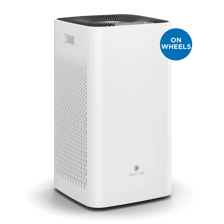
The Medify MA-112 is purpose-built for large commercial spaces, and it fits the classroom use case perfectly. Its dual H13 True HEPA filters deliver a combined CADR of 450 CFM for smoke particles, enough to cycle the air in a 900 sq ft classroom more than 4 times per hour. Coverage extends to 2,500 sq ft, which means it also handles gymnasiums, cafeterias, and auditoriums where vape aerosol tends to accumulate.
At 21 dB on its lowest setting, the MA-112 is quieter than a whisper. You will not hear it during a lecture. The glass touch panel includes a timer, child lock, and filter replacement indicator, all useful features for a school setting where multiple staff members may interact with the unit.
Why it wins for classrooms: The combination of commercial-grade CADR, dual HEPA filtration that captures particles down to 0.1 microns, and whisper-quiet operation on low makes it the best all-around choice for schools. At around $500, it costs less per square foot of coverage than most competitors.
Specs: 450 CFM smoke CADR | 2,500 sq ft coverage | 21 dB (low) | Dual H13 HEPA + Activated Carbon | 33.5 lbs | ~$500
Annual filter cost: ~$130 (dual filters)
The tradeoff: It is heavy at 33.5 lbs and takes up dedicated floor space. No WiFi or smart features, so you cannot monitor it remotely across multiple classrooms.
2. IQAir HealthPro Plus: Best for Sensitive Students
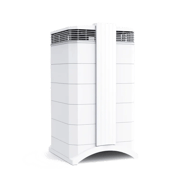
If your school has students with severe asthma, chemical sensitivities, or compromised immune systems, the IQAir HealthPro Plus offers filtration that no other residential unit can match. Its proprietary HyperHEPA technology captures particles down to 0.003 microns, which is 100 times smaller than what standard HEPA filters are rated for. That matters for vape aerosol, where a significant fraction of particles falls below the 0.3 micron HEPA test point.
The three-stage system includes a pre-filter for large particles, the HyperHEPA for ultrafine capture, and a V5-Cell gas and odor filter with 2.5 kg of activated carbon media for VOCs. This is the same technology used in hospital isolation rooms and clean labs.
Why it wins for sensitive students: Nothing else on the market captures ultrafine particles with this efficiency. The 10-year warranty reflects IQAir's confidence in the build quality. Swiss-made, medical-grade, and proven in clinical settings.
Specs: 300 CFM smoke CADR | 1,125 sq ft coverage | 29 dB (low) | HyperHEPA + V5-Cell Carbon | 35 lbs | ~$899
Annual filter cost: ~$120
The tradeoff: The $899 price tag is steep for schools buying multiple units. No smart connectivity, and the lower CADR means it clears vape clouds more slowly than the Medify. Best deployed in specific classrooms with high-risk students rather than school-wide.
3. Coway Airmega 400: Best for Air Quality Monitoring
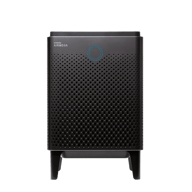
The Coway Airmega 400 brings something the other picks lack: a built-in real-time air quality sensor with a color-coded LED ring that shifts from blue (clean) to red (polluted). For school administrators, this provides visible, immediate feedback when vape aerosol enters a room. Teachers can see the indicator change without checking a phone or dashboard.
Dual-sided filtration pulls air through Max2 filters on both sides of the unit simultaneously, delivering 328 CFM smoke CADR with coverage up to 1,560 sq ft. The eco mode automatically stops the fan when air quality reads clean, saving energy during nights and weekends. At 22 dB on low, it stays below conversational level during class.
Why it wins for monitoring: The visual air quality indicator turns an invisible problem (vape aerosol) into something students and teachers can see in real time. That has educational value beyond just filtration. It also helps identify when and where vaping is happening.
Specs: 328 CFM smoke CADR | 1,560 sq ft coverage | 22 dB (low) | True HEPA + Activated Carbon (Max2) | 24.7 lbs | ~$450
Annual filter cost: ~$100
The tradeoff: Requires two Max2 filter sets per replacement, which adds to costs. The boxy design is functional but not discreet. At 328 CFM, it is better suited for standard classrooms than large open spaces.
4. Levoit Core 600S: Best Value for Classrooms
For schools that need to equip multiple classrooms without exceeding tight budgets, the Levoit Core 600S delivers the best CADR-per-dollar ratio on this list. At around $240, you get 410 CFM smoke CADR, H13 True HEPA filtration, and WiFi connectivity through the VeSync app. That means a facilities manager can monitor and adjust multiple units across the building from a single phone.
The built-in laser dust sensor provides real-time PM2.5 readings, and auto mode adjusts fan speed based on air quality. Alexa and Google Assistant integration means a teacher can voice-control the purifier without leaving the front of the room. At 26 dB on low, it is noticeably quiet.
Why it wins on value: At $240 with 410 CFM CADR, it costs roughly half what the Medify and Coway cost while delivering comparable or better raw filtration performance. The smart features add genuine utility for managing a fleet of purifiers across a school. Annual filter costs of just $60 are the lowest among our high-CADR picks.
Specs: 410 CFM smoke CADR | 635 sq ft coverage | 26 dB (low) | H13 True HEPA + Activated Carbon | 14.5 lbs | ~$240
Annual filter cost: ~$60
The tradeoff: Coverage tops out at 635 sq ft, so it will not handle a large cafeteria or gym on its own. You may need two units for classrooms over 700 sq ft. The lighter build (14.5 lbs) makes it easy to move but less durable than commercial-grade units.
5. Blueair Blue Pure 211+: Best Budget Pick for Schools
The Blueair Blue Pure 211+ strips away complexity in favor of reliability. One button. One speed dial. No app, no WiFi, no settings to misconfigure. For schools where dozens of teachers and custodial staff interact with the units, this simplicity is a feature, not a limitation.
Blueair's HEPASilent technology combines mechanical and electrostatic filtration to achieve 350 CFM smoke CADR while using just 30 to 60 watts of power. That is Energy Star certified efficiency, which matters when running 20 units across a school for 8 hours a day. The washable pre-filter fabric (available in multiple colors) extends the life of the main filter and reduces ongoing costs.
Why it wins for budgets: The combination of $250 purchase price, $55 annual filter cost, and Energy Star energy efficiency gives the Blue Pure 211+ the lowest total cost of ownership on this list. The simple one-button operation means zero training for staff.
Specs: 350 CFM smoke CADR | 550 sq ft coverage | 31 dB (low) | HEPASilent (Mechanical + Electrostatic) | 12.5 lbs | ~$250
Annual filter cost: ~$55
The tradeoff: No air quality sensor, no auto mode, no smart features. The 550 sq ft coverage is adequate for smaller classrooms but falls short for larger rooms. HEPASilent technology is effective but uses a different approach than pure H13 HEPA, which may matter for procurement specs that require medical-grade filtration.
How to Choose the Right Purifier for Your School
Match Coverage to Room Size
Measure your classroom. A standard U.S. classroom runs 600 to 900 sq ft. Match the purifier's rated coverage area to that number, and aim for at least 3 ACH. If the rated coverage assumes 2 ACH (as most AHAM ratings do), you may need to size up by 50% or use two units.
Prioritize Noise Under 40 dB
Teachers already compete with hallway noise, HVAC hum, and student conversations. A purifier above 40 dB on its operating speed adds to the problem. All our picks run well below this threshold on low, but check the medium-speed specs if you plan to run a higher setting during class.
Factor in Total Cost of Ownership
The purchase price is just the beginning. A $500 purifier with $130/year filter costs runs $1,150 over five years. A $240 purifier with $60/year filters runs $540 over the same period. Multiply that by 20 classrooms and the difference is significant.
| Purifier | Purchase | Annual Filters | 5-Year TCO (per unit) | 5-Year TCO (20 units) |
|---|---|---|---|---|
| Medify MA-112 | $500 | $130 | $1,150 | $23,000 |
| IQAir HealthPro Plus | $899 | $120 | $1,499 | $29,980 |
| Coway Airmega 400 | $450 | $100 | $950 | $19,000 |
| Levoit Core 600S | $240 | $60 | $540 | $10,800 |
| Blueair Blue Pure 211+ | $250 | $55 | $525 | $10,500 |
Consider Smart Features for Fleet Management
If your school is deploying 10 or more units, the ability to monitor and control them remotely saves custodial time. The Levoit Core 600S is the only pick with WiFi and app control, which lets a facilities manager check PM2.5 readings and filter status across the building without visiting each room.
Check Procurement Requirements
Some school districts require specific certifications (AHAM Verifide, Energy Star, CARB certified) for equipment purchases. Verify that your chosen model meets your district's procurement standards before ordering in bulk.
Deployment Tips for Schools
Place purifiers away from walls. Leave at least 12 inches of clearance on all sides for proper airflow. Corner placement restricts intake and reduces effectiveness.
Run on auto or medium during instruction. Save high-speed operation for passing periods, lunch breaks, and after school when classrooms are empty. This balances filtration with noise.
Focus on problem areas first. Bathrooms, locker rooms, and classrooms adjacent to restrooms see the most vape aerosol. Deploy your highest-CADR units there. Our cigarette smoke guide covers similar placement strategies for smoke-heavy environments.
Create a filter replacement schedule. Assign filter changes to custodial staff on a fixed calendar. Do not rely on teachers to monitor filter indicators. Budget for replacements at the start of each school year.
Pair with vape detection. Air purifiers address the air quality problem. Vape detectors address the behavioral problem. The two systems complement each other. Many schools deploy both.
The Bottom Line
For most schools, the Levoit Core 600S offers the best balance of performance, price, and manageability. At $240 per unit with smart monitoring and 410 CFM CADR, it handles standard classrooms effectively and keeps total costs low across a fleet.
Schools with larger spaces or higher budgets should look at the Medify MA-112 for its commercial-grade coverage and dual HEPA filtration. And districts with students who have respiratory conditions should consider the IQAir HealthPro Plus for those specific classrooms.
The important thing is to start somewhere. Every classroom with a HEPA air purifier has measurably better air quality than one without, and that benefits every student in the room, whether they vape or not.