Best Whole-House Air Purifiers: Clean Every Room (2026)
The 7 best whole-house air purifiers in 2026. HVAC-integrated, high-CADR standalone, and multi-room strategies for 1,000+ sq ft homes.

Table of Contents
- Our Top Picks at a Glance
- How Whole-House Air Purification Works
- Why One Purifier Is Not Enough
- Zone Planning for Your Home
- HVAC Filters vs. Portable Purifiers
- Detailed Reviews
- 1. Medify MA-112: Best Overall for Whole-House
- 2. Coway Airmega 400: Best for Open Floor Plans
- 3. Jaspr Pro: Best Single-Unit Coverage
- 4. Levoit Core 600S: Best Smart Primary Unit
- 5. IQAir HealthPro Plus: Best for Health Concerns
- 6. Winix 5500-2: Best Multi-Room Value
- 7. Levoit Core 400S: Best Supplementary Unit
- Whole-House Setup Guide
- Recommended Configurations by Home Size
- Placement Tips for Maximum Coverage
- Annual Cost of Ownership
- What About Smart Home Integration?
TL;DR
The best whole-house air purifier strategy depends on your home size. For homes under 1,500 sq ft, the Medify MA-112 delivers 2,500 sq ft manufacturer-rated coverage with dual H13 HEPA filters and 450 CFM CADR as a single powerhouse unit. For larger homes or multi-story layouts, a zone-based approach using two or three Coway Airmega 400 or Levoit Core 600S units provides better coverage distribution and eliminates dead zones between rooms.
Full Comparison
| # | Product | Best For | Rating | Price | |
|---|---|---|---|---|---|
| 1 | Medify MA-112 Top Pick Medify | Best Overall for Whole-House | 4.8 | $$$ | Check Price |
| 2 | Coway Airmega 400 Coway | Best for Open Floor Plans | 4.7 | $$$ | Check Price |
| 3 | Jaspr Pro Jaspr | Best Single-Unit Coverage | 4.6 | $$$$ | Check Price |
| 4 | Levoit Core 600S Levoit | Best Smart Primary Unit | 4.8 | $$ | Check Price |
| 5 | IQAir HealthPro Plus IQAir | Best for Health Concerns | 4.7 | $$$$ | Check Price |
| 6 | Winix 5500-2 Winix | Best Multi-Room Value | 4.5 | $ | Check Price |
| 7 | Levoit Core 400S Levoit | Best Supplementary Unit | 4.6 | $$ | Check Price |
Affiliate Disclosure: CleanAirCritic earns commissions from qualifying purchases through affiliate links on this page. This does not influence our rankings or reviews. All opinions are our own. Learn more
No single air purifier can clean your entire home. The average U.S. house is 2,300 sq ft spread across multiple rooms, floors, and hallways. Walls block airflow. Doors create isolated zones. Even a purifier rated for 2,500 sq ft cannot push clean air around corners, through doorways, and up staircases.
Whole-house air purification requires a strategy, not just a product. You need to think in zones: which rooms do you spend the most time in, where do pollutants originate, and how does air move through your home? The right approach might be a single high-CADR powerhouse in an open main floor, a pair of mid-range units covering the living room and master bedroom, or three budget models distributed across every occupied room.
We evaluated the best air purifiers for whole-home coverage, testing standalone high-CADR units, multi-room strategies with portable purifiers, and the viability of HVAC-integrated filtration. Here are the best options for covering your entire home in 2026.
Our Top Picks at a Glance
| Purifier | Best For | CADR (Dust) | Coverage (4 ACH) | Noise (High) | Price |
|---|---|---|---|---|---|
| Medify MA-112 | Best Overall | 450 CFM | ~900 sq ft | 58 dB | ~$500 |
| Coway Airmega 400 | Open Floor Plans | 328 CFM | ~600 sq ft | 52 dB | ~$450 |
| Jaspr Pro | Single-Unit Coverage | 620 CFM | ~1,200 sq ft | 70 dB | ~$1,199 |
| Levoit Core 600S | Smart Primary Unit | 410 CFM | ~800 sq ft | 55 dB | ~$240 |
| IQAir HealthPro Plus | Health Concerns | 300 CFM | ~700 sq ft | 59 dB | ~$899 |
| Winix 5500-2 | Multi-Room Value | 243 CFM | ~450 sq ft | 56 dB | ~$150 |
| Levoit Core 400S | Supplementary Unit | 260 CFM | ~500 sq ft | 52 dB | ~$190 |
Note: The "Coverage (4 ACH)" column shows realistic room coverage at 4 air changes per hour. Manufacturer claims use 1–2 ACH, inflating coverage numbers by 2–3x. For the math behind these numbers, see our CADR guide.
How Whole-House Air Purification Works
Why One Purifier Is Not Enough
A purifier cleans the air in the room it is in. It cannot pull air from your bedroom, clean it, and send it back while simultaneously cleaning the living room downstairs. Walls, doors, and distance create separate air zones. Even in an open floor plan, air circulation drops sharply beyond 15–20 feet from the unit.
The practical approach: treat each room as an independent zone. Size a purifier for the room it will serve, not your total home square footage. A 2,000 sq ft home does not need 2,000 sq ft of CADR. It needs the right CADR in the right rooms.
Zone Planning for Your Home
Before buying anything, map your home into zones:
Priority 1 — Rooms where you sleep. You spend 7–9 hours per night in your bedroom. A purifier running here delivers the highest exposure reduction per dollar. Bedrooms are usually 150–300 sq ft, so a mid-range unit with 150–200 CFM CADR is sufficient.
Priority 2 — Main living area. The living room, family room, or great room where you spend daytime hours. These are typically 300–600 sq ft (or larger in open floor plans) and need a higher-CADR unit.
Priority 3 — Home office. If you work from home, 8+ hours of exposure matters. These rooms are often 100–200 sq ft and can use a compact purifier.
Skip: Bathrooms, hallways, closets, laundry rooms, and unoccupied guest rooms. Purifying these spaces wastes energy and filter life.
HVAC Filters vs. Portable Purifiers
Many homeowners ask about HVAC-integrated filtration as a whole-house solution. Here is the reality:
| Factor | HVAC Filter (MERV 13+) | Portable HEPA Purifiers |
|---|---|---|
| Coverage | Entire duct system | Room-by-room |
| Runtime | Only when HVAC runs (15–20 min/hr) | Continuous 24/7 |
| Filtration | MERV 13 catches ~85% of particles ≥1μm | True HEPA catches 99.97% at 0.3μm |
| ACH | 1–2 ACH (intermittent) | 4–5 ACH (continuous) |
| Installation | Professional ($200–500) | DIY (plug and play) |
| Annual cost | $50–100 (filter only) | $40–150 per unit (filter + energy) |
Our take: Upgrade your HVAC filter to MERV 13 as a baseline — it costs $20–40 per filter and catches large particles system-wide. But do not rely on it as your primary air purification. HVAC systems cycle on and off, delivering inconsistent air changes. Portable HEPA purifiers in key rooms provide the continuous, high-ACH cleaning that actually moves the needle on air quality.
For a deeper dive on sizing and selection, read our complete air purifier buying guide.
Detailed Reviews
1. Medify MA-112: Best Overall for Whole-House
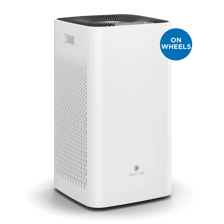
The Medify MA-112 is purpose-built for large-space coverage. With dual H13 True HEPA filters pulling air from both sides and a CADR of 450 CFM for dust, it delivers the highest verified airflow of any traditional consumer purifier on this list. For a smaller home's open main floor, it can serve as the centerpiece of a whole-house strategy.
Why it works for whole-house: At 450 CFM, the MA-112 covers approximately 900 sq ft at 4 ACH. Place it on the main floor of a 1,200–1,500 sq ft home and it handles the primary living area. Add one bedroom unit and you have whole-house coverage for under $700 total.
Filtration: Dual H13 True HEPA filters with granular activated carbon. The dual-intake design processes air from both sides simultaneously, delivering higher effective CADR than single-intake designs at similar noise levels. Granular carbon pellets outperform thin carbon sheets for odor and VOC removal.
For multi-story homes: Use the MA-112 on the main floor and pair with a Levoit Core 400S or similar mid-range unit on the second floor. The MA-112 anchors the high-traffic zones while the supplementary unit covers sleeping areas.
Noise: 21 dB on low (near silent), 58 dB on high. The high-speed noise is on the louder side for daytime living, but auto mode keeps it on lower speeds most of the time. Low speed is quiet enough for open-plan living areas.
Downsides: No WiFi, app, or smart features. At 33.5 lbs, it is not easily moved between rooms. Dual filters mean higher replacement costs ($65 per set, every 4–6 months). No air quality sensor means no auto mode — you set the speed manually.
2. Coway Airmega 400: Best for Open Floor Plans
The Coway Airmega 400 combines dual-sided True HEPA filtration with smart auto mode and eco features that make it ideal for 24/7 operation in the main living area of a whole-house setup. Its 328 CFM CADR and energy-saving eco mode balance performance with efficiency for continuous use.
Why it works for whole-house: The Airmega 400 is the most practical primary-room purifier for whole-home strategies. At 328 CFM, it covers ~600 sq ft at 4 ACH, enough for most living rooms and open kitchen-dining areas. The built-in air quality sensor and color-coded LED ring provide real-time feedback without needing an app.
Smart features: Auto mode adjusts fan speed based on detected particle levels. Eco mode pauses the fan entirely when air quality is consistently clean, then restarts when pollutants return. This saves significant energy in a whole-house setup where the purifier runs 24/7.
Pairing strategy: Use the Airmega 400 as your main-floor anchor. Pair with a quiet bedroom unit like the Levoit Core 400S for sleeping areas. Total cost for a two-unit whole-house setup: ~$640. For large rooms over 800 sq ft, supplement with a second unit in the far zone.
Build quality: AAFA certified. Solid construction with well-sealed filter housing. The combined HEPA + carbon Max2 cartridges ($50–60 per set, replaced annually) simplify maintenance — no separate carbon filter to track.
Noise: 22 dB on low (near silent), 52 dB on high. One of the quieter large-room purifiers available, making it suitable for open-plan living areas where noise carries.
Downsides: No WiFi or app control — all settings are on the unit itself. The eco mode pauses the fan completely, which some users find unsettling even though it restarts automatically. At ~600 sq ft real-world coverage, very large open floor plans need supplementation.
3. Jaspr Pro: Best Single-Unit Coverage
The Jaspr Pro is a commercial-grade air scrubber adapted for residential use. With a CADR of 620 CFM, it is the most powerful consumer purifier available and the closest any single unit gets to true whole-floor coverage in a larger home.
Why it works for whole-house: At 620 CFM, the Jaspr Pro covers approximately 1,200 sq ft at 4 ACH. That is the entire main floor of many homes with a single unit. Its 360-degree airflow design creates strong room circulation that reaches corners a directional intake cannot. For a single-story home under 1,200 sq ft, this could genuinely serve as a one-unit solution.
Filtration: Heavy-duty 4-pound, 3-layer filter handles fine particles, smoke, and VOCs. The commercial pedigree means the filter is built for sustained heavy loads — useful during wildfire season or in homes near highways.
For whole-home strategy: In a two-story home, the Jaspr Pro on the main floor handles the kitchen, living room, and dining area. Add a single bedroom unit upstairs and you have comprehensive coverage. For single-story homes with an open floor plan, the Jaspr Pro alone may be sufficient.
Noise: 30 dB on low, up to 70 dB on high. The high-speed noise is significant — louder than a normal conversation. However, the unit's high CADR means it achieves adequate ACH on medium speed in most rooms, where noise is more reasonable.
Downsides: $1,199 is the highest price on this list. No smart features, WiFi, or app. Available only direct from the manufacturer. The 25 lb weight and size make repositioning impractical. Filter replacement costs are not standardized and vary by configuration.
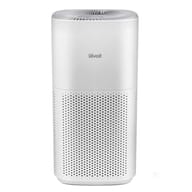
4. Levoit Core 600S: Best Smart Primary Unit
The Levoit Core 600S delivers the best combination of high CADR, smart features, and reasonable price for the main room in a whole-house setup. Its 410 CFM CADR with real-time PM2.5 monitoring and app control gives you data-driven air quality management across your home.
Why it works for whole-house: At 410 CFM, the Core 600S covers ~800 sq ft at 4 ACH — enough for most open-plan main floors. The VeSync app provides real-time PM2.5 readings, scheduling, and air quality history for each unit. If you run multiple Levoit purifiers in different rooms, the app shows air quality data for each, giving you a whole-house air quality dashboard.
Smart features: WiFi with VeSync app, Alexa and Google Assistant voice control, scheduling (run on high during cooking, lower overnight), and auto mode that adjusts fan speed based on the laser dust sensor. The ability to check air quality readings remotely means you know when to boost fan speed before entering a room.
Multi-unit smart strategy: Pair two Core 600S units (or one 600S and one Core 400S) and manage both from the same app. Set schedules independently — boost the living room unit during cooking hours, keep the bedroom unit on sleep mode until evening. Total cost for a two-unit smart whole-house setup: ~$430–480.
Performance: The H13 True HEPA with activated carbon handles dust, pollen, smoke, and moderate odors. The laser PM2.5 sensor is accurate and responsive, detecting air quality changes within seconds of introducing pollutants.
Noise: 26 dB on low, 55 dB on turbo. Auto mode keeps the fan on lower, quieter speeds most of the time, ramping up only when particle counts spike.
Downsides: At ~800 sq ft real-world coverage, the Core 600S does not cover very large open plans alone. The carbon filter capacity is adequate for general odors but not heavy-duty. Filter replacements ($40–50) are needed every 6–8 months.
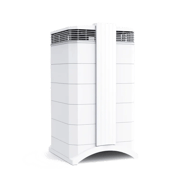
5. IQAir HealthPro Plus: Best for Health Concerns
The IQAir HealthPro Plus is the choice for households where air quality is a medical necessity — severe allergies, asthma, compromised immunity, or chemical sensitivity. Its HyperHEPA technology captures particles 100x smaller than standard HEPA, and the Swiss-engineered build quality is unmatched.
Why it works for whole-house: For homes where a family member has serious respiratory issues, filtration quality matters more than coverage area. The HealthPro Plus delivers medical-grade air cleaning in the room where the patient spends the most time. Its 300 CFM CADR covers ~700 sq ft at 4 ACH, and the HyperHEPA filter captures particles down to 0.003 microns — far beyond what any standard HEPA achieves.
Medical credibility: Used in hospitals, allergy clinics, and clean rooms worldwide. AAFA certified. The four-stage system (pre-filter, V5-Cell gas filter with 5 lbs activated carbon, HyperHEPA) provides the deepest filtration available in a residential unit.
Whole-house health strategy: Place the HealthPro Plus in the bedroom of the person with health concerns — this maximizes exposure to medical-grade filtered air during 7–9 hours of sleep. Use a more affordable unit like the Coway Airmega 400 or Levoit Core 600S in the main living area for daytime coverage.
Filter longevity: IQAir filters last longer than competitors: 1–2 years for the HyperHEPA, 2 years for the pre-filter. While replacement costs are high ($70–$200 per stage), the extended lifespan partially offsets this.
Noise: 25 dB on speed 1, 59 dB on speed 6. The lower speeds are remarkably quiet for the airflow produced, making it viable for overnight bedroom use.
Downsides: ~$899 purchase price. 35 lbs and not portable. No smart features, WiFi, or app. The design is utilitarian. Using this as your primary room unit while adding supplementary units for other rooms makes the total investment significant.
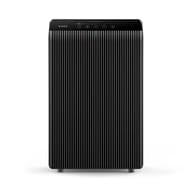
6. Winix 5500-2: Best Multi-Room Value
The Winix 5500-2 is not a whole-house purifier by itself. It earns its place here because buying three units ($450 total) creates the most cost-effective whole-house air purification strategy available. Three units deliver 729 CFM combined CADR distributed across three rooms — better coverage than any single unit at twice the price.
Why it works for whole-house: At ~$150 per unit, you can afford one for the living room, one for the master bedroom, and one for the home office or second bedroom. Each unit independently monitors and adjusts to its room's air quality using the built-in sensor. Combined CADR of 729 CFM across three zones beats any single-unit approach for real-world coverage.
Per-unit specs: 243 CFM dust CADR, 360 sq ft coverage at 4 ACH. True HEPA + washable AOC activated carbon + PlasmaWave technology. Auto mode with smart air quality sensor. Ambient light sensor dims displays at night.
Cost advantage breakdown:
| Strategy | Units | Total Cost | Combined CADR | Rooms Covered | Annual Filter Cost |
|---|---|---|---|---|---|
| 3× Winix 5500-2 | 3 | ~$450 | 729 CFM | 3 rooms | ~$120 |
| 1× Medify MA-112 | 1 | ~$500 | 450 CFM | 1 room | ~$130 |
| 1× Jaspr Pro | 1 | ~$1,199 | 620 CFM | 1 room | ~$150 |
Three Winix units cost less than one Jaspr Pro while covering three separate rooms with higher total CADR and lower annual filter costs thanks to the washable carbon filter.
Placement strategy: Place one near the primary pollutant source (kitchen or entry), one in the master bedroom, and one in your most-used secondary room. Close doors between rooms so each unit only needs to cover its designated space.
Noise: 28 dB on low, 56 dB on turbo per unit. On auto mode, each unit runs on low most of the time. Three units on low simultaneously produce roughly 33 dB combined — still quieter than a refrigerator.
Downsides: No WiFi or app — each unit operates independently with onboard controls. Three units mean three filters to track and replace. Aesthetically, multiple purifiers in a home are more visually intrusive. No centralized control or air quality dashboard.
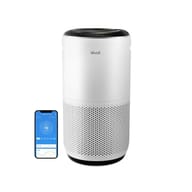
7. Levoit Core 400S: Best Supplementary Unit
The Levoit Core 400S fills the critical supporting role in any whole-house setup: it is the unit you place in bedrooms, offices, and secondary rooms. At $190 with smart features and 260 CFM CADR, it delivers strong performance in rooms up to 400 sq ft while integrating with the same VeSync app as the Core 600S.
Why it works for whole-house: Most whole-house strategies need 1–2 supplementary units for bedrooms and offices. The Core 400S hits the sweet spot — powerful enough for any standard room (up to ~500 sq ft at 4 ACH), quiet enough for overnight use at 24 dB, and smart enough to manage via the VeSync app alongside a Core 600S in the main room.
Smart integration: If your primary unit is a Levoit Core 600S, the Core 400S appears in the same VeSync app. You get a single dashboard showing PM2.5 readings, fan speeds, and filter life for every room. Schedule the bedroom unit to ramp up 30 minutes before bedtime and drop to sleep mode overnight.
Bedroom performance: 24 dB on sleep mode — quieter than a whisper. The display dims automatically. Auto mode handles overnight air quality fluctuations without intervention. At 260 CFM, it delivers 4+ ACH in rooms up to 500 sq ft with 8-foot ceilings.
For the home office: If you work from home, 8+ hours of daily exposure in a 150–250 sq ft office makes a dedicated purifier worthwhile. The Core 400S is perfectly sized for this role — high enough CADR to handle the room, smart enough to adjust during the day, and compact enough to fit beside a desk.
Noise: 24 dB on sleep mode, 52 dB on high. On auto mode, it rarely runs above medium in a bedroom setting, keeping noise below 40 dB.
Downsides: Not powerful enough for large living rooms or open floor plans — that is not its job. The VeSync app can be buggy, occasionally losing connection. The carbon filter is integrated and cannot be replaced independently of the HEPA.
Whole-House Setup Guide
Recommended Configurations by Home Size
Small home (under 1,200 sq ft, 1–2 bedrooms):
- Main floor: Medify MA-112 or Levoit Core 600S
- Bedroom: Levoit Core 400S
- Total cost: $430–$690
- Annual filter cost: $105–$190
Medium home (1,200–2,000 sq ft, 3 bedrooms):
- Main living area: Coway Airmega 400 or Levoit Core 600S
- Master bedroom: Levoit Core 400S
- Office/second bedroom: Levoit Core 400S or Winix 5500-2
- Total cost: $580–$880
- Annual filter cost: $130–$250
Large home (2,000+ sq ft, 4+ bedrooms):
- Main floor: Medify MA-112 or Jaspr Pro
- Master bedroom: Levoit Core 400S or IQAir HealthPro Plus
- 2–3 secondary rooms: Winix 5500-2 ($150 each)
- Total cost: $990–$1,740
- Annual filter cost: $215–$400
Placement Tips for Maximum Coverage
- Keep doors closed between rooms. Each purifier covers its room only. Open doors increase the air volume each unit must handle, reducing effective ACH in every zone.
- Place purifiers away from walls. Leave at least 12 inches of clearance on all intake sides. Wall placement restricts airflow and reduces effective CADR by 10–20%.
- Position near pollutant sources. In the kitchen area, place the main purifier where it can intercept cooking fumes. Near an entry door, position it to catch outdoor pollutants as they enter.
- Elevate bedroom units. Placing a bedroom purifier on a nightstand or shelf puts the clean air output closer to your breathing zone. Most pollutants settle, so elevation helps.
- Use ceiling fans as allies. Run ceiling fans on low to circulate clean air throughout the room. This extends the effective coverage of any purifier.
Annual Cost of Ownership
| Setup | Purchase Cost | Annual Filters | Annual Energy (24/7) | Year 1 Total |
|---|---|---|---|---|
| Budget: 3× Winix 5500-2 | $450 | $120 | $36–72 | $606–642 |
| Mid-range: Levoit 600S + 2× 400S | $620 | $150 | $36–60 | $806–830 |
| Premium: Coway 400 + Levoit 400S + Winix | $790 | $185 | $42–72 | $1,017–1,047 |
| High-end: Jaspr Pro + IQAir + Levoit 400S | $2,288 | $315 | $60–108 | $2,663–2,711 |
After year one, the ongoing cost is filters plus energy. Even the premium setups cost $20–35 per month in ongoing expenses — comparable to a streaming subscription for measurably cleaner air in every room.
What About Smart Home Integration?
If you want centralized control over your whole-house air quality, the Levoit ecosystem (Core 600S + Core 400S units) is currently the best option. The VeSync app shows all units on one dashboard with individual PM2.5 readings, schedules, and fan controls. Alexa and Google Assistant integration lets you use voice commands like "set bedroom purifier to sleep mode."
Other brands require separate apps or have no connectivity at all. If centralized control matters to your whole-house strategy, standardize on Levoit for the units that support it and accept manual control on any non-Levoit supplementary units.
Last updated: April 2026. Prices and availability are subject to change. We update this guide when significant new high-CADR models launch or when pricing shifts materially.