Air Purifier Myths Debunked: What Actually Works vs Marketing Hype
We separate air purifier fact from fiction. Learn which common claims are myths, what the science actually says, and how to avoid wasting money on hype.

Table of Contents
- Myth 1: Ionizers Clean the Air Just as Well as HEPA Filters
- Myth 2: Ozone Generators Are an Effective Way to Purify Indoor Air
- Myth 3: One Air Purifier Can Clean Your Entire House
- Myth 4: Air Purifiers Eliminate All Allergens
- Myth 5: More Expensive Always Means Better
- Myth 6: HEPA Filters Remove Odors and Chemicals
- Myth 7: UV-C Air Purifiers Kill All Germs and Viruses
- Myth 8: You Only Need to Run Your Air Purifier When the Air Seems Bad
- What Actually Works: A Quick Summary
- The Bottom Line
TL;DR
Most air purifier marketing exaggerates what these devices can do. HEPA purifiers genuinely reduce airborne particles by 25-50%, but ionizers are not equivalent to HEPA, ozone generators are actively harmful, one unit cannot cover your whole house, and no purifier eliminates all allergens. Stick with true HEPA filtration, size the unit to your room, and skip anything that produces ozone.
Air purifiers are a $5 billion global market, and manufacturers know that fear sells. Wildfire smoke, allergies, COVID concerns, and pollution anxiety have all driven sales, and with that growth comes a flood of marketing claims that range from slightly misleading to flat-out wrong.
We have spent years evaluating air purifiers, reading the research, and comparing manufacturer claims against independent testing data. Some of what gets repeated online is genuinely useful. A lot of it is not.
Here are the most common air purifier myths, what the evidence actually says, and what you should look for instead.
This article contains affiliate links. We may earn a commission if you purchase through our links, at no extra cost to you. See our affiliate disclosure for details.
Myth 1: Ionizers Clean the Air Just as Well as HEPA Filters
This is one of the most persistent myths in air purification, and it is simply not true.
Ionizers work by releasing charged ions into the air. These ions attach to airborne particles, giving them an electrical charge that causes them to stick to nearby surfaces like walls, furniture, and floors. The particles leave the air, technically, but they land on everything in your room. They are not captured or removed. The next time someone walks through the room or a fan kicks on, those particles go right back into the air.
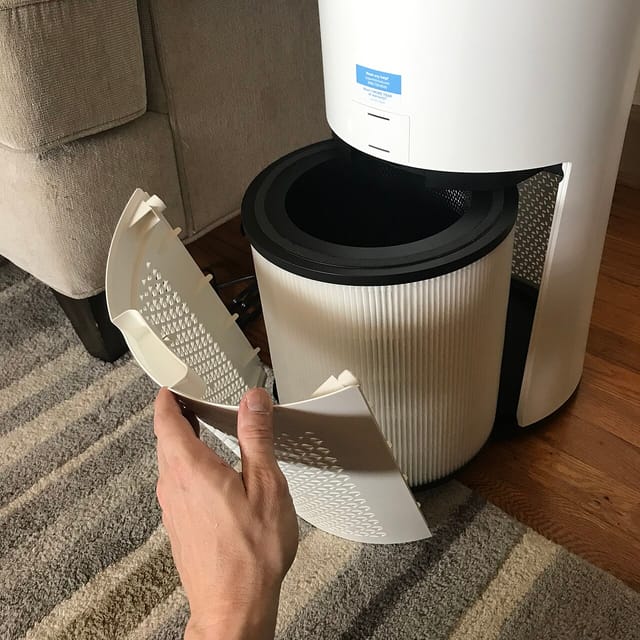
HEPA filters, by contrast, physically trap particles inside a dense fiber mat. A true HEPA filter captures 99.97% of particles at 0.3 microns in a single pass. The particles stay trapped until you replace the filter.
Consumer Reports testing found that most standalone ionizers have no measurable effect on particulate levels compared to HEPA-based purifiers. Independent research backs this up: a summary of scientific tests concluded that most air ionizers are too weak to have a meaningful impact on indoor air quality.
The performance gap is not small. It is enormous. Even the Dyson Zone, which uses electrostatic filtration in an innovative wearable design, faces scrutiny over whether its approach can match traditional HEPA performance. For a detailed breakdown of how these technologies compare, see our guide to HEPA vs ionic vs UV air purifiers.
The reality: HEPA filtration is the proven, effective standard. Ionizers are not a substitute. If your purifier relies solely on ionization, it is not doing much.
Myth 2: Ozone Generators Are an Effective Way to Purify Indoor Air
Some manufacturers sell ozone generators as air purifiers, marketing them as devices that use "activated oxygen" or "energized oxygen" to clean the air. These terms sound scientific. They are marketing language designed to obscure the fact that ozone is the same gas found in outdoor smog.
The EPA is unambiguous on this point: no federal government agency has approved ozone generators for use in occupied spaces. At concentrations that do not exceed public health standards, ozone has little effect in removing most indoor air contaminants. At concentrations high enough to be effective against pollutants, ozone causes chest pain, coughing, shortness of breath, and throat irritation. It can worsen chronic respiratory diseases like asthma and compromise the body's ability to fight respiratory infections.
It gets worse. Ozone reacts with common indoor chemicals, including fragrance compounds from cleaning products and air fresheners, to create secondary pollutants like formaldehyde and ultrafine particles. Your "air purifier" can literally make the air more toxic.
California's Air Resources Board limits indoor air cleaners sold in the state to ozone emissions of no more than 0.05 parts per million (50 ppb). The FDA mandates the same limit for any air purifier marketed with health claims. These limits exist because ozone is dangerous.
The reality: Ozone generators are not air purifiers. They are a health hazard marketed with misleading language. Avoid any device that intentionally produces ozone. If you want clean air, use a HEPA-based purifier with no ozone emissions.
Myth 3: One Air Purifier Can Clean Your Entire House
The idea that you can put a single portable air purifier in your living room and breathe clean air throughout your whole house is appealing. It is also wrong.
Portable air purifiers are designed and tested for specific room sizes. AHAM (the Association of Home Appliance Manufacturers) tests purifiers in a standard 1,008-cubic-foot room, roughly a 12x12-foot space with 8-foot ceilings. The resulting CADR (Clean Air Delivery Rate) tells you how much clean air the unit delivers in that controlled environment.
AHAM recommends that a purifier's CADR be at least two-thirds of the room's square footage. So a 200-square-foot bedroom needs a purifier with a CADR of at least 133 CFM. A 500-square-foot open living area needs a CADR of at least 333 CFM.
Here is the critical part: closed doors, hallways, and interior walls prevent meaningful air circulation between rooms. A purifier running in the living room does essentially nothing for the bedroom at the other end of the house. Air does not travel through solid walls, no matter how powerful the fan.
If you want clean air in multiple rooms, you have two options:
- Multiple portable units sized to each room. This is the most common and often most cost-effective approach.
- A whole-house system integrated into your HVAC ductwork. This filters air as it circulates through your existing heating and cooling system. See our guide to the best whole-house air purifiers for options.
For help choosing a unit sized to your space, read our how to choose an air purifier guide, which covers CADR ratings and room size calculations in detail.
The reality: One purifier covers one room. Plan your air quality strategy room by room.
Myth 4: Air Purifiers Eliminate All Allergens
If you have allergies, an air purifier can help significantly. But "significantly" is not the same as "completely," and understanding the difference saves you from unrealistic expectations.
HEPA purifiers are genuinely effective at capturing airborne allergens. Pollen, pet dander, mold spores, and dust mite debris that are floating in the air get trapped in the filter. A 2020 systematic review in The Journal of Allergy and Clinical Immunology: In Practice found that HEPA purifier use was associated with significant reductions in allergen exposure and fewer symptom days.
Here is the catch: most allergens are not floating in the air. They are embedded in your carpet, trapped in your bedding, settled on shelves, or living in upholstered furniture. Dust mite allergens are particularly stubborn. They are heavy particles that settle quickly, and they persist in fabrics for well over a year without degrading. An air purifier cannot reach dust mites living inside your mattress.
Research confirms that no single intervention eliminates allergens completely. The most effective approach combines:
- HEPA air purification for airborne particles
- Regular vacuuming with a HEPA-equipped vacuum
- Allergen-proof encasements for mattresses and pillows
- Humidity control below 50% to discourage dust mites
- Regular washing of bedding in hot water
An air purifier is one essential tool in this toolkit, not a magic bullet. For more on how purifiers work alongside other strategies, see our guide to common allergens and air purifiers.
The reality: Air purifiers reduce airborne allergens meaningfully, but they do not eliminate allergens from your home. Pair one with good cleaning habits for the best results.
Myth 5: More Expensive Always Means Better
A $700 air purifier with a sleek design and a companion app is not automatically better than a $150 unit from a less glamorous brand. What matters is measurable performance, and that is often disconnected from price.
The metrics that actually determine effectiveness are:
- CADR rating: The volume of clean air delivered per minute, independently tested by AHAM. Higher CADR means faster air cleaning for a given room size.
- Filter quality: True HEPA (99.97% at 0.3 microns) versus "HEPA-type" or "HEPA-style" filters, which can be significantly less effective and have no standardized performance requirement.
- Annual filter cost: A $100 purifier with $80 annual filters costs the same over three years as a $340 purifier with no filter costs. Factor in the total cost of ownership.
- Noise level: Measured in decibels at different fan speeds. A quieter purifier on medium may clean more air than a louder one you turn to low because it keeps you awake.
Some premium brands justify their price with genuinely better engineering, higher CADR, or lower noise. Others charge a premium for brand cachet, aesthetics, or features like air quality sensors and app connectivity that do not improve filtration performance.
A Levoit Core 300S ($100 range) and a Winix 5500-2 ($150 range) both deliver strong, AHAM-verified CADR numbers that outperform some purifiers costing three times as much. The Dyson vs Levoit comparison illustrates this price-to-performance gap clearly.
The reality: Buy based on CADR, filter type, noise, and annual costs. Not brand name or price tag.
Myth 6: HEPA Filters Remove Odors and Chemicals
This might be the most common misunderstanding about air purifiers, and it leads to real disappointment.
HEPA filters are designed to capture solid particles. They physically trap dust, pollen, smoke particles, pet dander, and other particulate matter in a dense fiber mat. They are exceptionally good at this job.
But odors and volatile organic compounds (VOCs) are not particles. They are gas-phase molecules, far too small for any mechanical filter to trap. Cooking smells, paint fumes, cleaning chemical vapors, formaldehyde off-gassing from new furniture: a HEPA filter does nothing for any of these.
To remove gases and odors, you need activated carbon filtration. Carbon filters work through adsorption, a chemical process where gas molecules bind to the porous surface of activated carbon. The more carbon in the filter (by weight), the more gas it can adsorb and the longer it lasts before saturating.
The problem: many budget purifiers include only a thin carbon mesh or carbon-coated sheet that saturates in weeks and provides minimal real-world odor removal. Meaningful carbon filtration requires 2 to 3 pounds of granular or pelletized activated carbon. For a deep dive on this, see our carbon filter vs HEPA comparison.
Carbon filters also need more frequent replacement than HEPA filters, typically every 3 to 6 months versus 6 to 12 months for HEPA. Factor this into your running costs. Our air purifier running costs guide breaks down what to expect.
The reality: HEPA handles particles. Carbon handles gases. For most homes, you want both. Make sure the carbon filter is substantial, not just a thin sheet.
Myth 7: UV-C Air Purifiers Kill All Germs and Viruses
UV-C light can inactivate bacteria, viruses, and mold spores. This is established science, and it is the basis for UV disinfection systems used in hospitals and water treatment facilities.
The problem is that consumer air purifiers are not hospital-grade UV systems. Effective UV-C disinfection requires sufficient intensity and exposure time. The pathogen needs to be exposed to the UV-C light long enough for the radiation to damage its DNA or RNA.
In most consumer air purifiers with UV-C, air moves past the UV lamp at fan speed. The exposure time is measured in fractions of a second, far less than what is needed to reliably inactivate most pathogens. The UV-C bulb in a $150 air purifier is not comparable to a $15,000 medical-grade UV system.
Some purifiers combine UV-C with HEPA filtration. In these cases, the HEPA filter does the heavy lifting by physically trapping particles (including those carrying pathogens), while the UV-C component provides marginal additional benefit. You are paying for the HEPA performance; the UV-C is largely a marketing feature in most consumer units.
There is also a hidden risk: some UV-C systems produce ozone as a byproduct, bringing us back to the problems discussed in Myth 2.
The reality: UV-C in consumer air purifiers sounds impressive but rarely delivers meaningful germicidal performance. Buy for the HEPA filter, not the UV light. For more details, see our HEPA vs ionic vs UV comparison.
Myth 8: You Only Need to Run Your Air Purifier When the Air Seems Bad
Many people treat their air purifier like a fan: turn it on when you notice a problem, turn it off when things seem fine. This approach wastes most of the purifier's potential.
Indoor air quality is not something you can reliably assess by how it looks or smells. Many harmful pollutants, including PM2.5, dust mite allergens, and most VOCs, are invisible and odorless. By the time you notice a problem, particulate levels may already be several times higher than recommended.
Air purifiers work by continuously cycling room air through the filter. When you turn the purifier off, particles immediately begin accumulating again. When you turn it back on, the unit has to work at higher speeds (louder and using more energy) to bring levels back down.
Running a HEPA purifier on auto or low 24/7 typically costs $2 to $5 per month in electricity and maintains consistently low particulate levels. The filter may last slightly less time, but the continuous protection is worth the tradeoff.
The reality: Run your purifier continuously, ideally on auto mode. The electricity cost is trivial, and you cannot always see or smell the pollutants that matter most.
What Actually Works: A Quick Summary
After stripping away the myths, here is what the evidence supports:
- True HEPA filtration is the proven standard for particle removal. Nothing else comes close for consumer use.
- Activated carbon is essential for odors and VOCs, but only if the filter contains a meaningful amount of carbon.
- Size the purifier to the room. Match CADR to room size using the two-thirds rule. One room, one purifier.
- Run it continuously. Auto mode or low speed, 24 hours a day.
- Replace filters on schedule. A clogged filter does not clean air. Budget $40 to $80 per year for replacements.
- Skip ozone generators, standalone ionizers, and UV-only devices. The science does not support them, and some actively harm air quality.
- Combine with source control. Air purifiers reduce airborne pollutants, but cleaning, ventilation, and humidity control address the sources.
For specific product recommendations backed by CADR data and real-world testing, see our best air purifiers for allergies or best HEPA purifiers under $200 guides.
The Bottom Line
Air purifiers work. HEPA air purifiers, specifically, are backed by decades of research showing measurable reductions in indoor particulate matter, allergens, and respiratory symptoms. The technology is sound and the benefits are real.
What does not work is the layer of marketing mythology that has grown up around these devices. Ionizers are not a HEPA replacement. Ozone generators are a health hazard. One purifier does not clean a whole house. No device eliminates all allergens. And a higher price tag does not guarantee better performance.
The best air purifier is a boring one: a true HEPA filter, properly sized for your room, running quietly around the clock. Skip the gimmicks, read the CADR numbers, and let the filter do the work.