Carbon Filter vs HEPA: What Each Removes and When You Need Both
Learn the difference between carbon filters and HEPA filters. Discover what each removes, replacement costs, and when you need both for clean indoor air.

Table of Contents
- How HEPA Filters Work
- What HEPA Filters Capture
- What HEPA Filters Do NOT Remove
- How Activated Carbon Filters Work
- What Carbon Filters Remove
- What Carbon Filters Do NOT Remove
- Carbon Filter vs HEPA: Side-by-Side Comparison
- Which Filter for Which Problem
- The Carbon Filter Quality Problem
- Thin Carbon Sheets vs Granular Carbon Beds
- Impregnated Carbon for Specific Pollutants
- Filter Replacement Costs and Schedules
- HEPA Filter Replacement
- Activated Carbon Filter Replacement
- Combined Filter Costs
- Common Misconceptions
- "HEPA filters remove everything"
- "Carbon filters are just for odors"
- "You only need one type of filter"
- "All carbon filters are the same"
- When You Need Both Filters
- The Bottom Line
TL;DR
HEPA filters capture particles like dust, pollen, pet dander, and PM2.5 at 99.97% efficiency. Activated carbon filters adsorb gases, odors, and VOCs that pass straight through HEPA. Neither filter type covers everything on its own. For most homes, you need both — which is why the best air purifiers combine a true HEPA filter with a substantial activated carbon layer.
HEPA filters and activated carbon filters are the two most common filter types in home air purifiers. They are often sold together in the same unit, which leads many people to assume they do the same thing. They do not.
HEPA filters trap particles. Carbon filters adsorb gases. These are two fundamentally different mechanisms targeting two different categories of air pollutants. Understanding the distinction is the single most important factor in choosing an air purifier that actually solves your air quality problem.
This guide explains exactly what each filter type removes, how the underlying technology works, what each one costs to maintain, and when you need one, the other, or both.
This article contains affiliate links. We may earn a commission if you purchase through our links, at no extra cost to you. See our affiliate disclosure for details.
How HEPA Filters Work
HEPA stands for High Efficiency Particulate Air. A true HEPA filter is a dense mat of randomly arranged fibers, typically fiberglass, that physically traps airborne particles as a fan forces air through.
The filter captures particles through three mechanisms:
- Interception: Particles following the airstream come close enough to a fiber and stick to it.
- Impaction: Larger particles cannot change direction fast enough to follow the air around fibers and collide with them directly.
- Diffusion: The smallest particles (below 0.1 microns) move erratically due to collisions with gas molecules and bump into fibers randomly.
To earn the true HEPA designation, a filter must capture 99.97% of particles at 0.3 microns — the most penetrating particle size. Particles both larger and smaller than 0.3 microns are actually caught at even higher rates.
This means HEPA filtration is effective across the full size range of common indoor pollutants. For a deeper look at HEPA technology and ratings, see our complete HEPA filter guide.
What HEPA Filters Capture
- Dust and dust mite allergens (10 to 100+ microns)
- Pollen (10 to 100 microns)
- Mold spores (2 to 20 microns)
- Pet dander (2.5 to 10 microns)
- Bacteria (0.3 to 10 microns)
- Fine particulate matter (PM2.5) from smoke, combustion, and wildfire haze
- Some viruses attached to respiratory droplets (0.1 to 5 microns)
What HEPA Filters Do NOT Remove
- Odors (gas molecules)
- Volatile organic compounds (VOCs) like formaldehyde, benzene, and cleaning chemical fumes
- Smoke chemicals — HEPA catches smoke particles, but the gaseous chemicals and smell pass through
- Carbon monoxide, nitrogen dioxide, and other gases
This is the most common misconception about HEPA: if you can smell it, HEPA is probably not filtering it. Odors and chemical fumes are gas-phase molecules far smaller than any particle a HEPA filter can trap. For more on this distinction, see our guide on VOCs explained.
How Activated Carbon Filters Work
Activated carbon filters use a completely different mechanism called adsorption (not absorption). The carbon material — usually derived from coconut shells, coal, or wood — is treated with high heat or chemicals to create millions of microscopic pores across its surface.
These pores massively increase the surface area of the carbon. A single gram of activated carbon can have a surface area of 3,000 square meters. Gas molecules are attracted to this surface through Van der Waals forces and become trapped in the pores.
Different gases adsorb at different rates depending on their molecular weight and the type of carbon treatment. This is why some premium filters use specially impregnated carbon (treated with potassium iodide or other chemicals) to target specific pollutants like formaldehyde.
What Carbon Filters Remove
- Volatile organic compounds (VOCs) — formaldehyde, benzene, toluene, xylene
- Cooking odors — grease, spices, burnt food
- Smoke odors and chemicals — the gaseous components that HEPA misses
- Pet odors
- Cleaning product fumes
- Off-gassing from furniture, paint, and building materials
- Some light industrial chemicals
What Carbon Filters Do NOT Remove
- Dust, pollen, and dander (solid particles)
- Mold spores (solid particles)
- Bacteria and viruses (solid particles or droplets)
- PM2.5 and fine particulate matter
- Carbon monoxide (too small and light for standard activated carbon)
- Humidity or moisture
Activated carbon is specifically a gas-phase solution. It has zero ability to trap solid particles floating in the air.
Carbon Filter vs HEPA: Side-by-Side Comparison
This table makes the fundamental difference clear. These two filter types have almost no overlap in what they remove.
| Factor | HEPA Filter | Activated Carbon Filter |
|---|---|---|
| Mechanism | Mechanical particle trapping | Gas molecule adsorption |
| Targets | Solid particles (dust, pollen, dander, smoke particles, bacteria) | Gases and vapors (VOCs, odors, chemical fumes) |
| Particle removal | 99.97% at 0.3 microns | None |
| Odor removal | None | Effective for most household odors |
| VOC removal | None | Effective, varies by carbon weight and type |
| Allergen removal | Excellent | None |
| Smoke handling | Removes visible smoke particles | Removes smoke odors and gaseous chemicals |
| Typical lifespan | 6 to 12 months | 3 to 6 months |
| Replacement cost | $30 to $80 | $15 to $40 |
| Annual filter cost | $40 to $80 | $30 to $120 (replaced more frequently) |
| Measured by CADR | Yes | No standard metric |
The CADR rating system only measures particle removal, which is why it applies to HEPA and not carbon filtration. There is no widely adopted equivalent standard for gas removal effectiveness in consumer air purifiers.
Which Filter for Which Problem
This is the decision table. Find your primary air quality concern and see which filter type you need.
| Your Problem | HEPA Filter | Carbon Filter | Need Both? |
|---|---|---|---|
| Seasonal allergies (pollen) | Yes | No | HEPA alone is sufficient |
| Dust buildup | Yes | No | HEPA alone is sufficient |
| Pet dander and fur | Yes | No | HEPA alone — add carbon if pet odor is also an issue |
| Pet odors | No | Yes | Both recommended |
| Cooking odors | No | Yes | Both if you also want grease particle removal |
| Cigarette or cigar smoke | Partial (particles only) | Partial (gases only) | Both required |
| Wildfire smoke | Partial (particles only) | Partial (gases only) | Both required |
| Mold spores | Yes | No | HEPA alone for spores — add carbon if musty odors persist |
| VOCs and off-gassing | No | Yes | Both recommended for general air quality |
| Asthma triggers | Yes | Helpful | Both recommended |
| New furniture or paint smell | No | Yes | Carbon is the primary need |
| General indoor air quality | Yes | Yes | Both recommended |
For most households, the answer is both. This is why the majority of quality air purifiers ship with a combined HEPA and carbon filter system. The question is whether the carbon component in your purifier is actually substantial enough to make a difference.
The Carbon Filter Quality Problem
Not all carbon filters are equal, and this is where many buyers get misled.
Thin Carbon Sheets vs Granular Carbon Beds
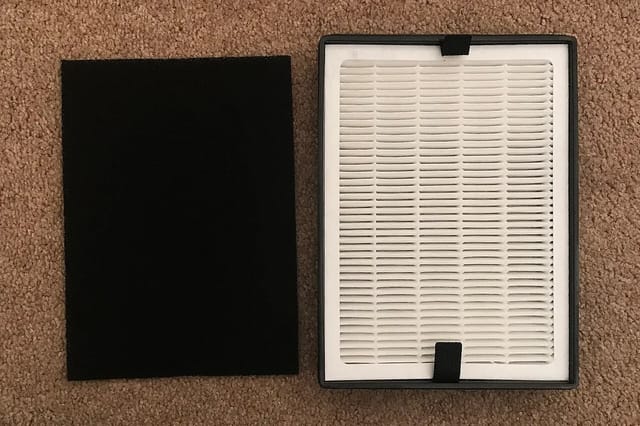
Budget air purifiers often include a thin carbon-coated mesh or a light carbon sheet as a "pre-filter." These contain a few grams of activated carbon sprayed or bonded onto a thin substrate. The gas removal capacity is minimal and the filter saturates within weeks in any environment with meaningful odor or VOC levels.
Effective carbon filtration requires a substantial amount of carbon. Premium purifiers use pelletized or granular activated carbon in a thick filter bed. The difference in performance is significant:
- Thin carbon sheet: 10 to 50 grams of carbon, saturates in 2 to 4 weeks under moderate VOC load
- Granular carbon bed: 1 to 5 pounds (450 to 2,200 grams) of carbon, lasts 3 to 6 months
If odor or VOC removal matters to you, check the carbon weight in the filter specifications. Manufacturers of premium filters usually advertise the weight. If the spec sheet does not mention carbon weight, the filter probably contains very little.
Impregnated Carbon for Specific Pollutants
Standard activated carbon adsorbs a broad range of VOCs effectively, but it is less efficient against certain low-molecular-weight gases like formaldehyde. Some manufacturers offer chemically impregnated carbon filters treated with potassium permanganate, potassium iodide, or other reagents that chemically react with and neutralize specific pollutants.
If formaldehyde from new furniture or building materials is your primary concern, look for a purifier with a formaldehyde-specific impregnated carbon filter rather than standard activated carbon. For specific product recommendations, see our best air purifiers for VOCs guide, which ranks units by carbon filter quality and gas removal effectiveness.
Filter Replacement Costs and Schedules
Long-term cost is a practical factor in choosing a purifier. Here is what to expect for each filter type.
HEPA Filter Replacement
- Frequency: Every 6 to 12 months (depends on air quality and runtime)
- Cost per filter: $30 to $80 for most consumer purifiers
- Annual cost: $40 to $80
- Signs it needs replacing: Reduced airflow, visible discoloration, musty smell from the purifier
HEPA filters degrade gradually as particles accumulate in the fibers. Most purifiers include a filter life indicator, though these are usually timer-based rather than measuring actual filter condition. For a detailed breakdown of replacement timing, see our guide on how often to replace air purifier filters.
Activated Carbon Filter Replacement
- Frequency: Every 3 to 6 months (depends on VOC/odor levels)
- Cost per filter: $15 to $40 for most consumer purifiers
- Annual cost: $30 to $120
- Signs it needs replacing: Odors no longer reduced, a chemical or stale smell from the purifier
Carbon filters fail silently. Unlike HEPA filters, which show reduced airflow as they load up, a saturated carbon filter still allows air to pass through freely — it just stops adsorbing gases. You may not notice the decline until odors return. If your home has consistent VOC sources (new furniture, a garage, cooking), err on the shorter end of the replacement schedule.
Combined Filter Costs
Most purifiers that use both HEPA and carbon come in one of two configurations:
- Integrated filter: HEPA and carbon layers bonded into a single replaceable unit. Simpler, but you replace both at once even if one still has life left. Typical cost: $40 to $80 per replacement.
- Separate filters: Independent HEPA and carbon filters replaced on different schedules. More flexible, potentially more economical over time. The washable pre-filter option can further reduce costs by handling large particles before they reach the HEPA.
Common Misconceptions
"HEPA filters remove everything"
This is the most widespread misunderstanding. HEPA filters are exceptional at particle removal, but they are physically incapable of capturing gas-phase molecules. If your problem is odors, VOCs, or chemical fumes, a HEPA-only purifier will do nothing for those issues while still running your electricity bill.
"Carbon filters are just for odors"
While odor removal is the most noticeable benefit, activated carbon also adsorbs harmful VOCs that you cannot smell at low concentrations. Formaldehyde, benzene, and toluene are present in many homes from furniture, cleaning products, and building materials. These compounds have documented health effects at chronic exposure levels. Carbon filtration provides a meaningful reduction.
"You only need one type of filter"
Unless your air quality concern is very narrowly defined (only dust allergies, or only new paint odor), a single filter type leaves significant pollutant categories unaddressed. The small additional cost of a combined HEPA and carbon system is almost always justified.
"All carbon filters are the same"
The weight, type, and treatment of the activated carbon vary enormously between purifiers. A 20-gram carbon sheet in a $50 purifier is not comparable to a 2-pound granular carbon bed in a $300 purifier. The gas removal capacity scales roughly with carbon mass.
When You Need Both Filters
For most homes, a purifier with both a true HEPA filter and a substantial activated carbon filter is the right choice. Here are the situations where dual filtration is not just helpful but essential:
- Smoke exposure — wildfire smoke, cigarette smoke, and cooking smoke all contain both particles and gases. HEPA alone removes the visible haze but leaves the chemical irritants. Carbon alone removes some odor but leaves the particulate matter.
- New home or renovation — off-gassing from paint, flooring, adhesives, and new furniture produces VOCs (carbon filter territory), while construction dust and particulate debris require HEPA.
- Urban environments — traffic exhaust contains both PM2.5 particles and gaseous pollutants like nitrogen dioxide and benzene.
- Homes with multiple concerns — allergies plus cooking odors, pet dander plus pet odors, dust plus cleaning chemical sensitivity.
When choosing an air purifier, check that the carbon filter component is substantial. A purifier with an excellent HEPA filter and a token carbon sheet is really a HEPA-only purifier with marketing language.
For a broader comparison of all major purifier technologies beyond just filter types, see our guide on HEPA vs ionic vs UV air purifiers.
The Bottom Line
HEPA captures particles. Carbon captures gases. There is almost zero overlap between what they remove. If you only care about airborne allergens and dust, HEPA alone works. If you only care about odors or chemical fumes, carbon alone works. For everything else — which covers most real-world indoor air quality situations — you need both.
When evaluating purifiers, look beyond the "HEPA + carbon" label. Check the carbon weight, verify the HEPA is true HEPA (not "HEPA-type" or "HEPA-style"), and consider the replacement cost of both filters over a year. The upfront price of the purifier is just the beginning — filter costs are the real long-term expense.