

Airthings Corentium Home vs Ecosense EcoQube: Our Pick (2026)
Winner: Airthings Corentium Home 2
The Airthings Corentium Home 2 wins for most buyers: it runs on batteries, so you can place it anywhere, its alpha spectrometry sensor is accurate over time, and its screen shows every average without an app. The EcoQube is the pick if you need WiFi alerts on your phone and a first reading in minutes.
Based on manufacturer sensor specifications, published accuracy ratings, and EPA radon guidance
Choosing a continuous radon detector comes down to two leading options: the Airthings Corentium Home 2 and the Ecosense EcoQube. Both provide ongoing radon monitoring without lab fees or disposable kits, but they take very different approaches. The Corentium is portable and battery-powered with an LCD and a Bluetooth app. The EcoQube plugs into a wall outlet and offers WiFi with app alerts. We compared their sensor types, published accuracy, time to first reading, usability, and value.

Airthings
Airthings Corentium Home 2
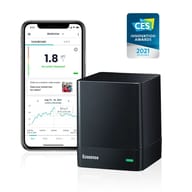
Ecosense
Ecosense EcoQube
Head-to-Head Specs
From manufacturer specs and certified ratings, not our own tests. How we research
Time to First Reading
Remote Alerts
Portability
Detailed Specs Comparison
| Spec | Airthings Corentium Home 2 | Ecosense EcoQube |
|---|---|---|
| Sensor Type | Alpha spectrometry (passive diffusion) | Pulsed ion chamber |
| Time to First Reading | First 24-hour average after 1 day | ~10 minutes |
| Display | LCD: 24h, 7d, 30d, long-term averages, temp and humidity | Color-coded LED (green/yellow/red) |
| Connectivity | Bluetooth app; WiFi via Airthings hub (SmartLink) | WiFi 2.4 GHz with EcoTracker app |
| Power | 2 AA batteries (up to 3 years) | Wall outlet (USB-C) |
| Alerts | Display and app; remote alerts need an Airthings hub | Push notifications via app |
| Data History | Up to 1 year of averages; app graphs | App with historical graphs |
| Size | Not listed by Airthings | 3.1 x 3.1 x 2.7 in |
| Weight | Not listed by Airthings | 6.6 oz |
| Radon Measurement Range | 0–250 pCi/L | 0.1–100+ pCi/L |
| Check price on Amazon | Check price on Amazon |
Where Each Excels
Airthings Corentium Home 2
- Battery powered (2 AA, up to 3 years), so you can place it anywhere
- Shows 24-hour, 7-day, 30-day and long-term radon averages on screen
- Proven alpha spectrometry sensor
- Bluetooth app for history graphs, but no app needed to read it
- No ongoing costs or subscriptions
Ecosense EcoQube
- Fast initial reading in approximately 10 minutes
- WiFi with EcoTracker app and push notifications
- Pulsed ion chamber sensor for high accuracy
- Color-coded LED for at-a-glance radon status
- Compact plug-in cube design
Which One Is Right for You?
Choose Airthings Corentium Home 2 if...
You want a reliable radon monitor that you can place anywhere without worrying about outlet access. You prefer simplicity: batteries and a clear display, with the app optional rather than required. You want to move the monitor between rooms or floors to test different areas. Buyers who want proven accuracy with no WiFi setup or subscription.
Check price on AmazonChoose Ecosense EcoQube if...
You want immediate results instead of waiting days for an initial reading. You want push notifications on your phone if radon levels spike. You have an outlet near where you want to monitor and do not need to move the device. You value historical data graphs in an app for long-term trend analysis. You want to monitor radon remotely (vacation home, rental property).
Check price on AmazonOur Verdict
Airthings no longer sells the original Corentium Home. Its replacement, the Corentium Home 2, keeps the same type of alpha spectrometry sensor and the battery-powered, display-first design, and this comparison covers the Home 2. It earns our recommendation for most homeowners on sensor design and power, not price. It runs on 2 AA batteries for up to 3 years, so it goes wherever radon collects, with no outlet needed. Its LCD shows 24-hour, 7-day, 30-day and long-term averages without an app. Bluetooth now adds the Airthings app for history graphs when you are nearby. The Ecosense EcoQube has genuine advantages. Its pulsed ion chamber sensor delivers a usable initial reading in about 10 minutes, where the Corentium needs a full day for its first 24-hour average. It has WiFi built in, so it alerts your phone if radon spikes while you are away. The Corentium can only do that when paired with an Airthings hub or View monitor. If fast results and remote alerts matter to you, the EcoQube is the better buy. For the typical homeowner who wants a reliable, set-and-forget radon monitor, the Corentium is the better fit.
Our estimated costs use published filter and energy assumptions; these totals are our calculations.
Our Estimated 5-Year Ownership Costs
| Cost | Airthings Corentium Home 2 | Ecosense EcoQube |
|---|---|---|
| Purchase Price | US$179.99 | US$149 |
| Filters (5 years) | $0 | $0 |
| Energy (5 years) | $0 | $0 |
| Total (5 years) | US$179.99 | US$149 |
Purchase prices are Amazon prices as of Nov 18, 2026, 17:00 UTC. Prices change; check the current price before you buy.