Moss Air Purifiers vs HEPA Filters: Which Actually Cleans Your Air?
We compare moss air purifiers and HEPA filters on filtration, cost, noise, room coverage, and maintenance. See which technology wins for your needs.

Table of Contents
TL;DR
HEPA filters win on every measurable air cleaning metric. They capture 99.97% of particles at 0.3 microns, deliver CADR ratings of 100 to 400+ cfm, and cover rooms up to 1,500+ square feet. Moss purifiers top out around 68 cfm (Briiv 2 Pro) and lack independent CADR testing in most cases. Moss devices are quieter, use less energy, and produce less waste, but they are supplements at best. If clean air is the priority, HEPA is the clear choice.
Moss air purifiers have exploded in popularity thanks to social media, and the appeal is easy to understand. They look beautiful, use natural materials, and promise cleaner air without disposable plastic filters. But how do they actually stack up against the HEPA technology that has been the standard in air purification for decades?
We put these two approaches side by side across five key categories: filtration effectiveness, cost, maintenance, room coverage, and noise. The results are clear, though perhaps not as one-sided as you might expect.
The Core Technology Difference
Before we compare performance, it helps to understand what each technology actually does.
HEPA filters use densely packed synthetic or fiberglass fibers to physically trap particles as air is forced through them. A True HEPA filter (H13 grade) captures 99.97% of particles at 0.3 microns, the hardest particle size to catch. This is a mechanical process with decades of independent testing behind it. For a deeper look at how this works, see our guide to HEPA filters.
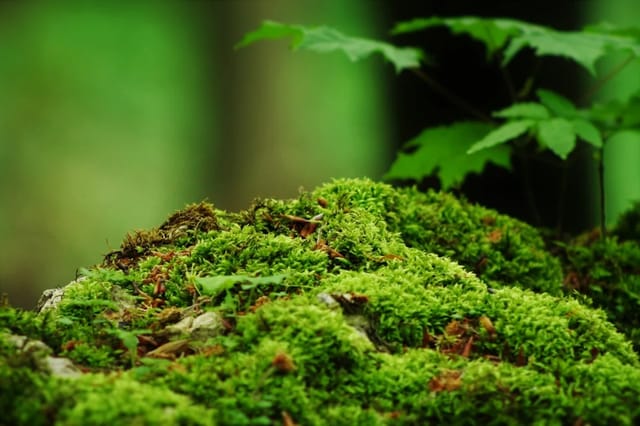
Moss purifiers use the naturally textured, high-surface-area structure of moss (typically reindeer lichen) to capture particles on contact. Research from the Technical University of Munich has shown moss can reduce PM10 particles by up to 30% in urban environments. Some moss purifiers, like the Briiv 2 Pro, combine moss with conventional filter layers for better overall performance.
The fundamental difference: HEPA is engineered for maximum particle capture. Moss is a natural material that happens to capture some particles. That distinction drives every comparison that follows.
Filtration Effectiveness
This is the category that matters most, and it is not close.
Fine Particle Removal (PM2.5)
HEPA filters capture 99.97% of particles at 0.3 microns in a single pass. This includes smoke, fine dust, bacteria, and the respiratory droplets that carry viruses. Every pass through a HEPA filter removes nearly all fine particulate matter from the air.
Moss has no meaningful impact on PM2.5. The particle sizes moss captures effectively are in the PM10 range: pollen, coarse dust, and pet dander. Fine particles pass right through or around moss fibers without sticking. The Briiv 2 Pro compensates for this with its nano matrix filter layer, but at that point, the moss is not doing the heavy lifting on fine particles.
Large Particle Removal (PM10)
This is where moss performs best. Studies have documented moss capturing pollen, coarse dust, and pet dander with moderate effectiveness. A 2024 study in Science Direct found analyzed moss species could collect up to 45,580 particles per square millimeter in urban environments.
HEPA filters also capture PM10 with near-perfect efficiency. The difference is that HEPA captures both large and small particles, while moss is limited to the larger end.
VOCs and Gases
Neither technology excels here on its own. HEPA filters do not capture gases or volatile organic compounds at all. Most quality HEPA purifiers include a separate activated carbon filter for this purpose.
Moss does absorb some VOCs naturally, which is a genuine advantage. Research has confirmed moss can take up certain volatile organic compounds and even heavy metals. However, the absorption rate in a small consumer device is modest compared to a dedicated activated carbon filter.
Winner: HEPA, decisively. There is no scenario where moss matches HEPA on overall filtration. For anyone concerned about air quality for health reasons, this category alone settles the debate.
CADR and Room Coverage
CADR (Clean Air Delivery Rate) measures how quickly a purifier can clean the air in a given space. This is where the performance gap becomes concrete. To understand why this number matters, read our CADR explainer.
| Purifier | CADR (Dust) | Recommended Room Size |
|---|---|---|
| Briiv 2 Pro (moss hybrid) | ~68 cfm | ~170 sq ft |
| MossLab Moss Air | Not rated | Desk area only |
| Levoit Core 300 (HEPA) | 140 cfm | ~219 sq ft |
| Coway Airmega AP-1512HH (HEPA) | 246 cfm | ~361 sq ft |
| Levoit Core 400S (HEPA) | 260 cfm | ~403 sq ft |
| Winix 5500-2 (HEPA) | 243 cfm | ~360 sq ft |
The Briiv 2 Pro is the only moss purifier with a published CADR figure, and it delivers roughly half the output of a $100 HEPA purifier. The MossLab Moss Air and other moss-only devices have no CADR rating at all, which tells you something about their air cleaning capability.
For rooms larger than 200 square feet, no moss purifier on the market can keep up. Even the Briiv 2 Pro is best suited for a small bedroom or office. A mid-range HEPA purifier handles a large living room with ease.
Winner: HEPA. More air cleaned, faster, in bigger spaces.
Cost Comparison
Purchase Price
Moss purifiers span a wide range. The MossLab Moss Air runs about $99, while the Briiv 2 Pro costs around $400. For context, you can buy a Levoit Core 300 for about $100 or a Coway Airmega AP-1512HH for about $150, both of which dramatically outperform any moss purifier on air cleaning.
Dollar for dollar, HEPA delivers far more air cleaning per dollar spent. The Briiv 2 Pro costs roughly 4x what a Levoit Core 300 costs, yet delivers half the CADR.
Annual Filter Costs
| Device | Annual Filter Cost |
|---|---|
| Briiv 2 Pro | ~$45 |
| Levoit Core 300 | ~$35 |
| Coway AP-1512HH | ~$45 |
| Winix 5500-2 | ~$40 |
Filter costs are surprisingly similar between the two technologies. The Briiv uses natural filters (moss and coconut fiber replaced annually, nano matrix every 3 months), and HEPA purifiers use synthetic filters replaced every 6 to 12 months. Neither has a clear cost advantage here.
Energy Costs
Moss purifiers win this one. The Briiv 2 Pro draws about 5W, costing roughly $4 per year to run continuously. Most HEPA purifiers draw 10 to 70W depending on fan speed, costing $10 to $50 annually. On low settings, the difference is small. On high, HEPA units consume significantly more power.
Winner: HEPA on value (more cleaning per dollar). Moss on energy costs (though the difference is modest).
Noise Levels
This is the one performance category where moss purifiers genuinely shine.
The Briiv 2 Pro runs under 20 dB on its lowest setting, which is functionally silent. Even on its highest setting, reviewers describe it as producing only a gentle hum. The MossLab Moss Air is similarly quiet given its tiny fan.
HEPA purifiers vary widely. On low, many modern units are quite quiet:
| Purifier | Low Setting | High Setting |
|---|---|---|
| Briiv 2 Pro | <20 dB | ~35 dB |
| Levoit Core 300 | 24 dB | 50 dB |
| Coway AP-1512HH | 24 dB | 53 dB |
| Levoit Core 400S | 23 dB | 52 dB |
On low settings, the difference between moss and HEPA is barely perceptible. On high settings, HEPA purifiers get noticeably louder because they are pushing much more air through a dense filter. This is a real tradeoff: more air cleaning means more fan noise.
If you run a purifier in your bedroom at night, both technologies work well on low settings. The Briiv 2 Pro has a slight edge for the most noise-sensitive users, but the difference on low settings is a matter of a few decibels.
Winner: Moss, with the caveat that HEPA is only louder because it is doing more work.
Maintenance
Moss Purifiers
Moss purifiers require a different kind of attention than HEPA units. The Briiv 2 Pro needs its moss and coconut filter replaced annually and its nano matrix filter swapped every 3 months. The process is straightforward but involves more touchpoints than a typical HEPA purifier.
Live moss devices like the MossLab Moss Air require more care. The moss needs adequate light and moisture to stay alive. Users have reported issues with mold growth and leaking, which means ongoing monitoring.
HEPA Purifiers
Most HEPA purifiers need a filter swap every 6 to 12 months. Some models have a washable pre-filter that should be cleaned monthly. That is about it. The process is simple: pull out the old filter, drop in the new one.
Many modern HEPA purifiers include filter life indicators. Some are timer-based, but higher-end models monitor actual airflow resistance to tell you when the filter is genuinely spent.
Winner: HEPA. Fewer maintenance touchpoints, no risk of biological issues like mold, and widely available replacement filters.
Environmental Impact
This is the strongest argument for moss purifiers, and it is legitimate.
Moss purifiers:
- Biodegradable filter materials (lichen, coconut fiber)
- Very low energy consumption (~5W)
- Smaller carbon footprint in manufacturing (less plastic)
- Briiv claims the device is 95% biodegradable
HEPA purifiers:
- Synthetic filter media (fiberglass or polypropylene) that goes to landfill
- Higher energy use (10 to 70W)
- More plastic in construction
- Filters must be replaced and discarded every 6 to 12 months
If sustainability is a top priority and you live in an area with generally good air quality, the environmental case for a moss purifier is real. Just understand that you are trading significant air cleaning performance for that eco-friendly advantage.
The Verdict
HEPA wins for anyone who needs cleaner air. The performance gap is too large to ignore. HEPA purifiers deliver 2 to 6 times more clean air output, capture particles that moss cannot touch, and cost less per unit of air cleaning. For allergies, asthma, smoke, or any health-related air quality concern, HEPA is the only responsible choice. See our guides to the best air purifiers for allergies and the best air purifiers for smoke for specific HEPA recommendations.
Moss purifiers have a narrow, valid niche. The Briiv 2 Pro is a well-designed product for buyers who prioritize sustainability and aesthetics over maximum air cleaning performance. In a small room with generally clean air, it provides modest but real filtration while looking great and consuming minimal energy. For a detailed look at the Briiv's strengths, weaknesses, and who should buy one, read our Briiv air purifier review.
The worst choice is buying a moss purifier and expecting HEPA-level results. Products like the MossLab Moss Air and DIY moss terrariums are closer to decorative humidifiers than functional air purifiers.
If you are on the fence, start with a HEPA purifier that covers your room size. Add a moss purifier later if the eco-friendly angle appeals to you. That way you get clean air first and sustainability as a bonus.
For more on how moss purifiers work and which products are worth considering, read our deep dive: Do Moss Air Purifiers Actually Work?. And for help choosing the right HEPA purifier, our complete buyer's guide walks you through the process step by step.