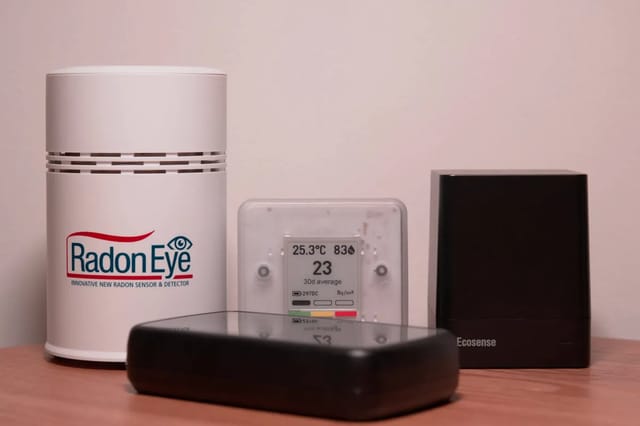
Best Radon Detectors for Home: Continuous Monitors That Protect Your Family (2026)
Best continuous radon detectors for home in 2026. Ongoing readings so you can act before radon levels become dangerous.

Table of Contents
- Our Top Picks at a Glance
- What to Look For in a Radon Detector
- Continuous vs. Single-Use Testing
- Sensor Technology
- Connectivity
- Detailed Reviews
- 1. Airthings Corentium Home: Best Overall Radon Detector
- 2. Ecosense EcoQube: Best Smart Radon Monitor
- 3. Airthings View Plus: Best Multi-Parameter (Radon + Air Quality)
- Radon Testing Guide
- How Radon Enters Your Home
- When Radon Levels Are Highest
- What to Do if Radon Is High
- Cost Comparison
TL;DR
The best radon detector for home use is the Airthings Corentium Home — a reliable, battery-powered continuous monitor that shows 1-day, 7-day, and long-term radon averages with no lab fees or subscriptions. For smart home users who want WiFi alerts and app monitoring, the Ecosense EcoQube delivers the fastest initial readings. If you also want CO2, PM2.5, and VOC monitoring in one device, the Airthings View Plus covers radon plus six other parameters.
Full Comparison
| # | Product | Best For | Rating | Price | |
|---|---|---|---|---|---|
| 1 | Airthings Corentium Home Top Pick Airthings | Best Overall Radon Detector | 4.8 | $$ | Check Price |
| 2 | Ecosense EcoQube Ecosense | Best Smart Radon Monitor | 4.6 | $$ | Check Price |
| 3 | Airthings View Plus Airthings | Best Multi-Parameter (Radon + Air Quality) | 4.8 | $$$ | Check Price |
Affiliate Disclosure: CleanAirCritic earns commissions from qualifying purchases through affiliate links on this page. This does not influence our rankings or reviews. All opinions are our own. Learn more
Radon is a radioactive gas that seeps into homes from natural uranium decay in soil and rock. It is colorless, odorless, and the second leading cause of lung cancer in the United States, responsible for an estimated 21,000 deaths per year according to the EPA. Roughly 1 in 15 American homes has radon levels at or above the EPA's action level of 4 pCi/L.
The problem with radon is that levels fluctuate constantly — hourly, daily, and seasonally — based on weather, soil moisture, barometric pressure, and how your home's HVAC system operates. A one-time charcoal test kit gives you a single snapshot that may not represent your actual long-term exposure. A continuous radon monitor tracks levels over time, showing you daily and long-term averages that reflect your real risk.
We evaluated the top continuous radon detectors for accuracy, ease of use, connectivity, and long-term reliability. Here are the best options for 2026.
Our Top Picks at a Glance
| Detector | Best For | Sensor Type | Connectivity | Power | Price |
|---|---|---|---|---|---|
| Airthings Corentium Home | Best Overall | Alpha spectrometry | None (display only) | 2 AA batteries (~2 years) | $179 |
| Ecosense EcoQube | Best Smart Monitor | Pulsed ion chamber | WiFi + app | Wall outlet | $229 |
| Airthings View Plus | Best Multi-Parameter | Alpha spectrometry | WiFi + dashboard | Battery + USB-C | $300 |
What to Look For in a Radon Detector
Continuous vs. Single-Use Testing
Single-use charcoal kits ($10–25) absorb radon over 2–7 days, then ship to a lab for analysis. They are useful for initial screening but provide only one snapshot. If your test happens during a low-radon period (dry weather, open windows), you may get a falsely reassuring result.
Continuous monitors ($150–300) measure radon around the clock and display running averages. They show you how radon fluctuates with seasons, weather, and HVAC changes. Over time, the long-term average converges on your actual exposure level. They also serve as ongoing sentinels — if you install a radon mitigation system, a continuous monitor confirms it is working.
For a one-time screening, a charcoal kit is fine. For ongoing peace of mind and accurate long-term data, a continuous monitor pays for itself.
Sensor Technology
Alpha spectrometry (Airthings): A passive diffusion chamber detects alpha particles from radon decay. Quiet, no moving parts, very low power consumption. Needs several days to accumulate enough decay events for an initial reading and 30+ days for a stable long-term average.
Pulsed ion chamber (Ecosense): An active sensing chamber ionizes air to detect radon decay products. Faster initial readings (minutes vs. days) but requires wall power. Generally considered the most accurate sensor technology at consumer price points.
Connectivity
A standalone display (Corentium Home) works well if you just want to check readings by walking up to the device. WiFi connectivity (EcoQube, View Plus) adds remote monitoring, push alerts for high radon, and historical data in a cloud dashboard — useful if the detector is in a basement you do not visit daily.
Detailed Reviews
1. Airthings Corentium Home: Best Overall Radon Detector
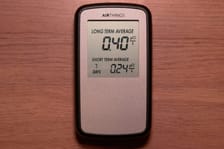
The Corentium Home is the most popular continuous radon monitor in the U.S. for good reason: it is simple, reliable, battery-powered, and requires zero maintenance. Place it in your basement, check the LCD screen when you walk by, and replace the batteries every 2 years.
Why it is the best: The alpha spectrometry sensor provides accurate long-term radon averages without ongoing costs. The LCD displays three readings — 1-day average, 7-day average, and long-term average — so you can see both recent fluctuations and your true baseline exposure. No lab fees, no subscriptions, no WiFi passwords to configure.
Simplicity: There is one button (to cycle between readings) and one display. No app, no account, no pairing process. You take it out of the box, place it where you want to monitor, and it starts measuring. This matters for less technical users who just want an answer to "is my home's radon level safe?"
Portability: Battery-powered and lightweight (4.5 oz), making it easy to test multiple rooms. Measure the basement for 30 days, then move it to a ground-floor bedroom. Keep in mind that each move resets the averaging process.
Downsides: No WiFi or app means no remote monitoring and no push alerts. If radon spikes while you are away, you will not know until you check the display. The initial reading takes several days to stabilize, and the long-term average needs 30+ days. No additional parameters — radon only.
Use discount code clean-air-critic-10OFF for 10% off at airthings.com.
2. Ecosense EcoQube: Best Smart Radon Monitor
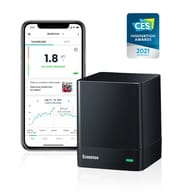
The EcoQube uses a pulsed ion chamber sensor that delivers an initial radon reading in approximately 10 minutes — dramatically faster than the days-long wait with alpha spectrometry monitors. WiFi connectivity with the EcoTracker app provides remote monitoring, push alerts, and historical data.
Why it works: The pulsed ion chamber is an active sensing technology that detects radon decay products with higher sensitivity than passive diffusion chambers. This means faster response to changing radon levels and quicker initial readings. The WiFi connection pushes data to the EcoTracker app, where you can monitor radon trends from anywhere and receive alerts when levels exceed your configured threshold.
Instant feedback: The color-coded LED on the device glows green (safe), yellow (moderate), or red (high) for at-a-glance status without reading numbers. This is useful for daily checks — you walk past the basement and see green or red.
Smart features: The app stores complete radon history with daily, weekly, and monthly trend graphs. You can set custom alert thresholds and receive push notifications on your phone. Multiple EcoQube devices report to a single dashboard if you monitor several locations.
Downsides: Requires a wall outlet — not portable and not battery-powered. At $229, it costs $50 more than the Corentium Home. It measures only radon, no other air quality parameters. The plug-in design limits placement options compared to battery-powered monitors.
Can't decide between these two? Our Airthings Corentium vs Ecosense EcoQube comparison breaks down accuracy, speed, connectivity, and total cost side by side.
3. Airthings View Plus: Best Multi-Parameter (Radon + Air Quality)
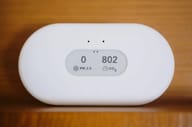
If you want radon monitoring plus a complete indoor air quality picture in one device, the Airthings View Plus is the most comprehensive consumer option. It tracks radon, CO2, PM2.5, VOCs, temperature, humidity, and air pressure — seven parameters with WiFi cloud connectivity.
Why it works: The same alpha spectrometry radon sensor as the Corentium Home, plus an NDIR CO2 sensor, laser PM2.5 counter, and VOC sensor. The e-ink display shows all parameters with color-coded indicators. WiFi connects to the Airthings dashboard for long-term data and trend analysis. SmartThings and IFTTT integration enables automation triggers.
Value proposition: A standalone Corentium Home costs $179 for radon only. A standalone CO2 monitor costs $60–200. A PM2.5 sensor costs $70–200. The View Plus at $300 replaces all three devices, making it a strong value if you want comprehensive monitoring.
Downsides: The radon sensor works identically to the Corentium Home — same 30+ day stabilization period for long-term averages. The PM2.5 and VOC sensors are adequate but not reference-grade. No audible alerts. At $300, it is the most expensive option on this list. If radon is your only concern, the Corentium Home saves $121.
Use discount code clean-air-critic-10OFF for 10% off at airthings.com.
Radon Testing Guide
How Radon Enters Your Home
Radon gas rises from soil through:
- Foundation cracks: Even hairline cracks in concrete slabs and basement walls
- Construction joints: Where walls meet floors, around pipes, and at expansion joints
- Sump pump openings: Unsealed sump pits are direct pathways
- Well water: Radon dissolved in groundwater releases into air when water is used
- Crawl spaces: Exposed soil under the home with direct soil-to-air contact
Negative air pressure inside your home (from exhaust fans, HVAC, and the stack effect) actively pulls radon from soil. This is why levels often spike during heating season when homes are sealed tight.
When Radon Levels Are Highest
Radon fluctuates based on conditions:
- Winter: Highest radon levels. Frozen ground concentrates radon under foundations. Homes are sealed and heated, increasing the pressure differential that draws radon in.
- During rain: Wet soil traps radon near the surface, pushing more through foundation cracks.
- At night: As outdoor air cools and sinks, indoor stack effect increases, pulling more soil gas.
- Closed-house conditions: Running HVAC with doors and windows closed creates negative pressure that pulls radon.
This is exactly why continuous monitoring matters. A summer test with open windows may read 2 pCi/L while the same home reads 8 pCi/L in January with windows closed.
What to Do if Radon Is High
If your long-term average exceeds 4 pCi/L (EPA action level) or 2.7 pCi/L (WHO guideline):
- Confirm with extended monitoring. Let your continuous monitor run for at least 90 days before making decisions. Short-term spikes are normal.
- Hire a certified radon mitigator. Look for NRPP or NRSB certification. Typical cost: $800–2,500 depending on home size and foundation type.
- Active soil depressurization (ASD) is the standard fix. A pipe and fan system draws radon from beneath the foundation and vents it above the roofline. Success rate is 95%+ in reducing radon to below 2 pCi/L.
- Verify with your monitor. After mitigation, your continuous detector confirms the system is working and alerts you if it fails.
Cost Comparison
| Detector | Upfront | Ongoing Costs | 3-Year Total |
|---|---|---|---|
| Airthings Corentium Home | $179 | ~$5 (batteries) | ~$184 |
| Ecosense EcoQube | $229 | ~$5 (electricity) | ~$234 |
| Airthings View Plus | $300 | ~$5 (batteries/power) | ~$305 |
| Charcoal test kit (x6) | $15 each | Lab fees $15–40 each | $180–330 |
A continuous monitor costs about the same as running periodic charcoal tests over three years but provides dramatically more data and ongoing protection.
For broader indoor air quality monitoring that includes PM2.5, CO2, and VOCs alongside radon, see our guide to the best indoor air quality monitors. To understand how particulate matter affects health, read indoor air quality basics.
Last updated: March 2026. Prices and availability are subject to change.