Best VOC Monitor for Home (2026)
The best VOC monitors of 2026 for home air quality tracking. We rank monitors by tVOC sensor quality, parameters covered, smart home integration, and value.

Table of Contents
- What a tVOC Reading Actually Tells You
- Our Top Picks at a Glance
- Detailed Reviews
- 1. Airthings View Plus: Best Overall VOC Monitor
- 2. Qingping Air Monitor Gen 2: Best Mid-Range VOC Monitor
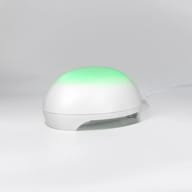
- 3. GoveeLife Smart Air Quality Monitor: Best Budget WiFi VOC Monitor
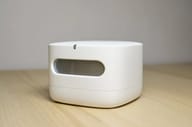
- 4. Amazon Smart Air Quality Monitor: Best for Alexa Smart Homes
- 5. PurpleAir PA-I-Indoor: Best for PM2.5 Accuracy (VOC-Adjacent Pick)
- How to Choose the Right VOC Monitor
- Match the threat to the monitor
- Price breakpoints and what they buy
- VOC monitors and CO2 monitors are not the same
- Should you pair a VOC monitor with an air purifier?
- The Bottom Line
TL;DR
At Clean Air Critic, the best VOC monitor for most homes is the Airthings View Plus, which tracks tVOC alongside radon, CO2, PM2.5, and four other parameters through a cloud dashboard that shows long-term chemical trends. For a mid-range option with a superb touchscreen display and Apple HomeKit, the Qingping Air Monitor Gen 2 covers tVOC and five other parameters for $120. Budget shoppers who want WiFi alerts should consider the GoveeLife Smart Air Quality Monitor at $80.
Full Comparison
| # | Product | Best For | Rating | Price | |
|---|---|---|---|---|---|
| 1 | Airthings View Plus Top Pick Airthings | Best Overall VOC Monitor | 4.7 | $$$ | Check Price |
| 2 | Qingping Air Monitor Gen 2 Qingping | Best Mid-Range VOC Monitor | 4.5 | $$ | Check Price |
| 3 | GoveeLife Smart Air Quality Monitor GoveeLife | Best Budget WiFi VOC Monitor | 4.1 | $ | Check Price |
| 4 | Amazon Smart Air Quality Monitor Amazon | Best for Alexa Smart Homes | 4.2 | $ | Check Price |
| 5 | PurpleAir PA-I-Indoor PurpleAir | Best for Dual-Sensor PM2.5 Accuracy | 4.6 | $$ | Check Price |
Affiliate Disclosure: CleanAirCritic earns commissions from qualifying purchases through affiliate links on this page. This does not influence our rankings or reviews. All opinions are our own. Learn more
Volatile organic compounds are the chemical category behind a lot of the air quality concerns that don't announce themselves with smoke or smell. Fresh paint, new laminate flooring, cleaning sprays, scented candles, dry-cleaning bags, even cooking at high heat all release VOCs. Some are mildly irritating at typical indoor concentrations. Some, like benzene and formaldehyde, are carcinogens at elevated long-term exposure.
A VOC monitor does not identify the specific chemical. It measures the combined chemical load in your air and shows whether that load is rising or falling. That is enough information to act on: open a window, run an air purifier with activated carbon, or clear a product out of the space.
We evaluated monitors on tVOC sensor quality, multi-parameter coverage, display and connectivity, smart home integration, and value. Here are the best options.
What a tVOC Reading Actually Tells You
Every monitor on this list uses a metal-oxide (MOX) sensor, which is the standard technology for consumer tVOC measurement. The sensor heats a semiconductor element; the resistance changes when volatile organic molecules contact it, and the firmware converts that change into a tVOC index (often in micrograms per cubic meter or in a color-coded scale).
There are two things a tVOC sensor does well: it responds quickly when VOC levels climb, and it shows clearly when ventilation brings those levels back down. A reader who runs cleaning spray in the kitchen, watches the tVOC spike, then opens a window and watches it fall in 20 minutes has learned something genuinely useful.
There is one thing it cannot do: distinguish between chemicals. A tVOC reading of 500 mcg/m3 might be coming from cleaning products, new furniture, cooking vapor, or a candle. For formaldehyde specifically, you need a dedicated electrochemical HCHO sensor, which we cover separately in our best formaldehyde monitors guide.
Our Top Picks at a Glance
| Monitor | Best For | VOC Sensor | Other Parameters | Price |
|---|---|---|---|---|
| Airthings View Plus | Best Overall | tVOC (MOX) | Radon, CO2, PM2.5, temp, humidity, pressure | $300 |
| Qingping Air Monitor Gen 2 | Best Mid-Range | tVOC (MOX) | CO2 (NDIR), PM2.5, PM10, temp, humidity | $120 |
| GoveeLife Smart AQ Monitor | Budget WiFi | tVOC (MOX) | CO2*, PM2.5, temp, humidity | $80 |
| Amazon Smart AQ Monitor | Alexa Homes | VOC (MOX) | PM2.5, CO, temp, humidity | $70 |
| PurpleAir PA-I-Indoor | PM2.5 Accuracy | None (PM-focused) | PM1.0, PM2.5, PM10 | $200 |
*GoveeLife uses an estimated CO2 algorithm rather than a true NDIR sensor.
Detailed Reviews
1. Airthings View Plus: Best Overall VOC Monitor
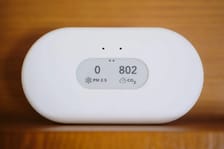
The Airthings View Plus is the best VOC monitor for most homes because it puts tVOC tracking inside the most comprehensive consumer air quality sensor available. For $300, it measures tVOC alongside radon, CO2, PM2.5, temperature, humidity, and air pressure, and logs all seven parameters to a cloud dashboard with months of history.
Why the View Plus wins for VOC tracking: Most VOC concerns are about trends over time, not instant spot readings. The View Plus dashboard shows you chemical air quality week by week, making it easy to see whether that new couch is still off-gassing after a month, whether cleaning day consistently spikes VOCs, or whether summer heat pushes VOC levels up from flooring. No other consumer device gives you that historical view across so many parameters simultaneously.
The cloud dashboard advantage: The Airthings app stores data in the cloud rather than on the device, so you can look back and correlate spikes with activities. The View Plus also supports IFTTT, SmartThings, and the Airthings API, enabling automations like triggering a smart air purifier when tVOC exceeds a threshold.
Smart home integration: Connect via IFTTT to turn on a VOC-capable air purifier automatically when chemical levels rise. SmartThings users can build routines around any of the seven parameters. For Apple HomeKit or Google Home you will need an IFTTT bridge, since native Matter support is not included.
Downsides: At $300 it is the most expensive option here. The tVOC sensor is a composite index and cannot isolate specific chemicals. Radon readings take 30 or more days to stabilize. If your only concern is VOC tracking and budget matters, a tVOC reading is all you need, and you can get that for $80 to $120.
For a full breakdown of everything the View Plus does, see our best indoor air quality monitors guide.
Use discount code clean-air-critic-10OFF for 10% off at airthings.com.
2. Qingping Air Monitor Gen 2: Best Mid-Range VOC Monitor
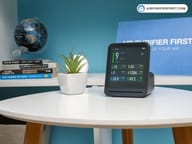
The Qingping Air Monitor Gen 2 covers tVOC, an accurate NDIR CO2 reading, PM2.5, PM10, temperature, and humidity for $120 on a 3.1-inch IPS touchscreen with Apple HomeKit built in. It is the best combination of sensor quality, display, and price for buyers who want chemical awareness alongside solid CO2 tracking.
Why it works: The touchscreen is the best in this price range. All six parameters are visible at once, and you can swipe through hourly, daily, or weekly historical graphs without opening an app. The NDIR CO2 sensor is the real article, not an estimated algorithm, so the CO2 data is trustworthy. Apple HomeKit support lets you build automations directly in the Home app: when tVOC rises, trigger a HomePod announcement or turn on an air purifier smart plug.
VOC performance: The Qingping's MOX tVOC sensor is as good as any consumer device in this class. It responds within seconds to a VOC spike (spray a cleaning product nearby and watch it react) and recovers as VOCs clear. The combined chemical index is all you get, but that is true of every tVOC monitor here.
Downsides: USB-C powered only, no battery option, so it stays put. HomeKit WiFi setup can be finicky on 2.4 GHz networks. No radon measurement. If you need the Alexa ecosystem or more than six parameters, look elsewhere.
3. GoveeLife Smart Air Quality Monitor: Best Budget WiFi VOC Monitor
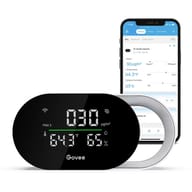
The GoveeLife is the cheapest way to get WiFi-based tVOC alerts, and it covers PM2.5, an estimated CO2, temperature, and humidity alongside VOCs for $80. If your goal is a notification when chemical air quality worsens in a specific room — a nursery, a newly renovated bedroom, a basement — this is a practical choice.
Why it works: The Govee Home app supports push notifications triggered by VOC thresholds. When the tVOC climbs above a level you set, you get a phone alert. The app also integrates with Govee smart devices, so a Govee-compatible air purifier or fan can switch on automatically. Compact and unobtrusive, it fits anywhere without dominating the room.
The CO2 caveat: The CO2 reading uses an estimated algorithm, not an NDIR sensor. It is directionally useful for very rough ventilation awareness but not reliable for precise measurements. If CO2 accuracy matters to you, step up to the Qingping.
Downsides: Limited third-party smart home support beyond the Govee ecosystem. Accuracy is adequate, not reference-grade. The tVOC index can react to alcohol and other solvents in ways that create misleading spikes.
4. Amazon Smart Air Quality Monitor: Best for Alexa Smart Homes
For $70, the Amazon Smart Air Quality Monitor integrates directly with Alexa to announce air quality and trigger routines. It measures a composite VOC index, PM2.5, carbon monoxide, temperature, and humidity. The unique addition here is the CO sensor, a genuine safety extra none of the other monitors on this list include.
Why it works: If your home already runs on Alexa, this is the simplest addition. You can say "Alexa, what is my air quality?" or build a routine that turns on an air purifier smart plug when VOCs rise. The monitor requires no display of its own because Echo devices become its interface, which keeps it compact and out of sight.
Carbon monoxide bonus: No other monitor on this list includes CO detection. At typical concentrations CO is odorless and lethal; a monitor that catches an early rise from a faulty furnace or attached garage is a meaningful safety layer. This sensor is not a replacement for a dedicated CO detector but it does add coverage.
Downsides: No standalone display. No CO2 sensor. Locked into Amazon's ecosystem. VOC accuracy is adequate but not reference-grade, and the tVOC index is opaque, offering no breakdown of what chemicals are contributing to the reading.
5. PurpleAir PA-I-Indoor: Best for PM2.5 Accuracy (VOC-Adjacent Pick)
The PurpleAir PA-I-Indoor does not measure VOCs at all. It earns a place here because it is the best choice for buyers whose primary concern is particulate-form chemical pollution: VOC-carrying particles, wildfire smoke aerosols, cooking particle spikes. Dual PMS5003 laser sensors provide research-grade PM2.5 accuracy, and PurpleAir feeds its data to a publicly visible map used by environmental researchers.
Why it is relevant to VOC shoppers: Many people reach for a "VOC monitor" when the actual threat they face is PM2.5. Cooking at high heat generates particles. Wildfire smoke carries both particles and gaseous VOCs. Candles produce ultra-fine particles alongside their chemical vapor. If particulate exposure is the bigger concern in your home, the PurpleAir's dual-sensor PM2.5 accuracy makes a stronger case than a budget MOX tVOC device.
Pairing recommendation: For the most complete chemical picture, pair the PurpleAir (PM2.5) with the Qingping Air Monitor Gen 2 (tVOC + CO2). You cover the particle and gas sides independently with the best sensor in each class.
Downsides: No VOC, CO2, or radon measurement. At $200 it is expensive for a PM-only device. No standalone display; data lives in the PurpleAir app and web map.
How to Choose the Right VOC Monitor
Match the threat to the monitor
Different VOC concerns call for different devices:
New furniture or renovation (formaldehyde concern): A general tVOC monitor will react to off-gassing but cannot give you a formaldehyde-specific reading. For that, see the best formaldehyde monitors, which cover devices with dedicated electrochemical HCHO sensors.
Long-term chemical trend tracking: The Airthings View Plus is the best choice. Its cloud dashboard shows chemical air quality over months, not just the current moment.
Cleaning product alerts or quick room-to-room checks: A portable MOX tVOC device works well for this. Any monitor on this list will react visibly within seconds of a VOC spike.
Alexa smart home automation: The Amazon Smart Air Quality Monitor is purpose-built for this use case and adds CO detection.
VOC plus CO2 plus Apple HomeKit: The Qingping Air Monitor Gen 2 hits all three at $120.
Price breakpoints and what they buy
- Under $100 (Amazon, GoveeLife): WiFi-connected VOC alerts, adequate tVOC tracking, adequate PM2.5. CO2 is estimated, not NDIR. Fine for awareness and smart-home triggers.
- $100-200 (Qingping): Good tVOC alongside genuine NDIR CO2. Better historical data and display quality. Suitable for more serious monitoring.
- $250+ (Airthings View Plus): Comprehensive multi-parameter monitoring with a cloud history database. Add radon to the mix. Worth it for whole-home awareness rather than a single room.
VOC monitors and CO2 monitors are not the same
A tVOC monitor will not tell you whether your home office is well-ventilated. CO2 is the reliable proxy for that: when CO2 rises above 1,000 ppm, fresh air exchange is inadequate. Many of the monitors here include CO2, but only the Qingping uses a genuine NDIR sensor that delivers trustworthy CO2 data in the sub-$150 range. For a full look at CO2 monitoring options, see our best CO2 monitors guide.
Should you pair a VOC monitor with an air purifier?
A monitor is most useful alongside a VOC-capable air purifier. The monitor tells you when levels are elevated; the purifier with an activated-carbon filter begins adsorbing chemical vapors. Watching the tVOC reading trend downward after starting the purifier gives you a real feedback loop rather than running the purifier on a timer and guessing. Smart home integrations on the Airthings, Qingping, and Amazon monitors can automate this entirely.
The Bottom Line
For most homes, the Qingping Air Monitor Gen 2 is the sweet spot: six parameters, an honest NDIR CO2 sensor, a beautiful touchscreen, Apple HomeKit, and fair pricing at $120. It does everything a focused VOC monitor should, plus CO2 and particulate tracking.
If budget is the constraint, the GoveeLife at $80 provides WiFi tVOC alerts for the price of a dinner out. If you want the most comprehensive picture of your home's chemical air quality over time, with radon and PM2.5 alongside tVOC, the Airthings View Plus is worth the $300. And if Alexa is your ecosystem and CO detection matters to you, the Amazon Smart Air Quality Monitor is the obvious pick at $70.
Whatever you choose, remember that a monitor is only half the system. See our guide to the best air purifiers for VOCs for the other half.
Frequently Asked Questions
What does a VOC monitor actually measure?
What tVOC level is safe indoors?
What are the biggest sources of VOCs indoors?
Can a VOC monitor tell me which specific chemical is in the air?
Do air purifiers remove VOCs?
How is a VOC monitor different from a formaldehyde monitor?
You Might Also Like
Best Formaldehyde Monitor for Home (2026)
The best formaldehyde monitors of 2026 for new furniture and renovations. We explain HCHO sensors vs. tVOC, and rank monitors by accuracy and value.

How to Use an Air Quality Monitor with Your HEPA Purifier
Pair your air quality monitor with a HEPA purifier for smarter, data-driven air cleaning. Optimal placement, setup steps, and how to read the numbers.

Air Quality Monitor vs Air Purifier: What You Actually Need
Air quality monitors and air purifiers solve different problems. We explain which you need first, when you need both, and how to use them together effectively.
Best Radon Detectors for Home (2026)
The best radon detectors for home use in 2026. Continuous monitors with accurate, real-time readings so you can act before radon becomes a health risk.