Best Air Purifier Under $50 (2026)
The 4 best air purifiers under $50 in 2026. Honest picks with True HEPA filtration, plus what to skip and which $60 upgrade is worth the extra money.

Table of Contents
- Under-$50 Air Purifiers Compared
- What You Actually Get Per Dollar
- What to Look for at This Price Point
- Best Air Purifiers Under $50
- Levoit Core Mini: Best Overall Under $50
- Pure Enrichment PureZone Mini: Best USB-Powered Pick
- Levoit Sprout: Best for Nurseries on a Budget
- GermGuardian AC4825: Best Around-$60 Upgrade
- What It Costs to Own
- When to Skip the Sub-$50 Tier
- Budget Traps to Avoid
- Frequently Asked Questions
TL;DR
At Clean Air Critic, under $50 is a tight budget for a True HEPA air purifier, but the Levoit Core Mini lands there during sales and is the right pick for desks and small bedrooms. The Pure Enrichment PureZone Mini is a reliable USB-powered alternative for cars and small spaces. The honest answer is that most sub-$50 purifiers are undersized for any room over 100 sq ft. If your room is bigger than that, save up another $40 and buy the Levoit Core 300 instead.
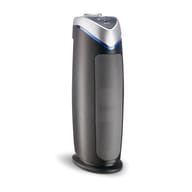
Full Comparison
| # | Product | Best For | Rating | Price | |
|---|---|---|---|---|---|
| 1 | Levoit Core Mini Top Pick Levoit | Best Overall Under $50 | 4.3 | $ | Check Price |
| 2 | Pure Enrichment PureZone Mini Pure Enrichment | Best USB-Powered Pick | 4.4 | $ | Check Price |
| 3 | Levoit Sprout Levoit | Best for Nurseries on a Budget | 4.5 | $ | Check Price |
| 4 | GermGuardian AC4825 GermGuardian | Best Around-$60 Upgrade | 4.5 | $ | Check Price |
Affiliate Disclosure: CleanAirCritic earns commissions from qualifying purchases through affiliate links on this page. This does not influence our rankings or reviews. All opinions are our own. Learn more
Under $50 is the toughest part of the air purifier market to shop honestly. Below that price point, most listings on Amazon and big-box sites are HEPA-type filters that capture a fraction of what True HEPA does, ionizers that produce trace ozone, or perfectly fine compact units sold for rooms three times the size they can actually handle. The good news is there are a few genuine True HEPA picks that land under $50 either consistently or during sales. The bad news is that most rooms in your house are too big for them.
This guide is honest about both. We list the four picks worth considering at this price, and we name the moment when stepping up to a $90 unit is the better call.
Under-$50 Air Purifiers Compared
Here is how the four picks stack up on the specs that actually matter at this price: AHAM-verified CADR, realistic coverage, sleep-mode noise, and street price. Notice how narrow the CADR range is. Nothing genuine under $50 pushes past the low 50s on dust CADR, which is the honest ceiling of the tier.
| Purifier | Best For | Dust CADR | Coverage | Noise (Low) | Price |
|---|---|---|---|---|---|
| Levoit Core Mini | Best Overall | 46 CFM | 178 sq ft | 27 dB | ~$40–$50 |
| Pure Enrichment PureZone Mini | Best USB-Powered | 13–16 CFM | 54 sq ft | 30 dB | ~$30–$40 |
| Levoit Sprout | Best for Nurseries | 46 CFM | 178 sq ft | 27 dB | ~$45–$60 |
| GermGuardian AC4825 | Best ~$60 Upgrade | 100–118 CFM | 167 sq ft | 40 dB | ~$50–$70 |
Coverage figures reflect the manufacturer rating; our sizing rule (CADR at least two-thirds of room square footage) puts the realistic sweet spot lower, closer to 100 sq ft for the Core Mini and 60 sq ft for the PureZone Mini.
What You Actually Get Per Dollar
We compared dust CADR-per-dollar across the genuine True HEPA units that reliably sell under $50, using each unit's typical street price rather than list. It is the fastest way to see why the Core Mini dominates the tier and why USB units are a form-factor purchase, not a value one.
| Purifier | Dust CADR | Typical Price | CADR per $10 |
|---|---|---|---|
| Levoit Core Mini | 46 CFM | ~$45 | 10.2 CFM |
| Levoit Sprout | 46 CFM | ~$50 | 9.2 CFM |
| GermGuardian AC4825 | 108 CFM | ~$60 | 18.0 CFM |
| Pure Enrichment PureZone Mini | 15 CFM | ~$38 | 3.9 CFM |
The takeaway is blunt. The AC4825, even though it lists a few dollars above $50, delivers nearly twice the clean-air-per-dollar of anything that fits strictly under the line. If your only constraint is the price ceiling, the Core Mini is the pick. If your constraint is the room, the small step up to the AC4825 is the better math almost every time.
What to Look for at This Price Point
Genuine True HEPA, not HEPA-type. This is the single most important filter. Look for H13 or H12 on the spec sheet. Anything labeled HEPA-type, HEPA-style, HEPA-like, or 99% HEPA is a different product with no standardized performance requirement. Every pick on this list uses genuine True HEPA media.
No ionizer, no PCO, no ozone. Many cheap purifiers stack an ionizer on top of the HEPA filter to claim higher numbers. Ionizers produce small amounts of ozone, which is a lung irritant. California regulates them for this reason. Pure mechanical HEPA plus carbon is what you want.
Realistic coverage area. Manufacturer coverage claims at this price are often based on a single air change per hour, which is not enough to make a noticeable difference. The honest rule is that CADR should be at least two-thirds of the room square footage. A 40 CFM purifier handles roughly 60 sq ft well, 100 sq ft adequately, and anything larger marginally.
Replaceable filter, not built-in. Avoid units that throw the whole purifier away when the filter saturates. Every pick on this list takes a replaceable filter cartridge.
Best Air Purifiers Under $50
Levoit Core Mini: Best Overall Under $50
The Core Mini is the answer for most people shopping under $50. It lists at $50 most of the year and dips to $40 during Levoit sales, Prime Day, and back-to-school events. The filter is genuine H13 True HEPA with an activated carbon pre-filter. CADR is AHAM verified at 46 CFM. The unit is 6.5 inches square, 10.4 inches tall, and weighs 2.2 lbs.
What makes the Core Mini work at this price is that Levoit did not cut corners on the parts that matter. The HEPA media is real, the seal around the filter is real, and the fan is properly sized for the airflow it claims. The trade-offs show up in the carbon layer, which is thinner than what you get in a $90 unit, and in coverage, which is limited to 178 sq ft and works best in 100 sq ft or less.
Use it in a single dorm, a small home office, a baby's room, or as a supplement near a bed in a larger room. Filter replacements run about $15 and last 6 to 8 months.
Pure Enrichment PureZone Mini: Best USB-Powered Pick
The PureZone Mini is the only purifier on this list that runs off USB power. Plug it into a laptop, a car cigarette adapter with USB output, or a wall brick. The H13 True HEPA filter handles small particles and the thin carbon layer takes some odor edge off.
Coverage is rated for 54 sq ft, which is the smallest on this list. CADR is in the 13 to 16 CFM range. This is a personal-space purifier, not a room purifier. It works on a desk, a nightstand, a car cup holder, or a nursery changing table. Trying to use it as the primary purifier for a bedroom will disappoint.
The price stays consistent around $40 with occasional dips to $30. Filter replacements are $12 to $15 and last 4 to 6 months in normal use. Build quality is acceptable for the price, not premium. The USB form factor is what you are paying for, not the filtration capacity.
Levoit Sprout: Best for Nurseries on a Budget
The Sprout is Levoit's nursery-targeted Core Mini variant. Same filter class, similar CADR, with a colored translucent housing and a small night light built into the base. It typically lists at $50 to $60 and discounts to the high $40s.
For a nursery, the Sprout's selling point over the Core Mini is the integrated night light, which doubles as a soft glow that is not bright enough to disrupt infant sleep. Filtration is identical to the Core Mini. The CADR of 46 CFM cycles a standard 100 sq ft nursery roughly six times per hour, which is plenty.
If you do not care about the night light, the regular Core Mini is the same purifier for typically less money. If you want the night light and the look, the Sprout is worth the small premium.
GermGuardian AC4825: Best Around-$60 Upgrade
The AC4825 sits just above the $50 line, typically $50 to $70 with frequent sales into the $50s. We include it here because it is the next step up in capacity if you find that any of the picks above is undersized for your space.
The AC4825 is a 22-inch tower with H13 HEPA, an activated carbon pre-filter, and an optional UV-C bulb. CADR is in the 100 to 118 range across dust, smoke, and pollen, which roughly triples what the Core Mini delivers. Coverage is rated for 167 sq ft. The UV-C feature does produce trace ozone, so toggle it off in the settings.
Annual cost is around $35 to $40 for filter and electricity combined. If a Core Mini is too small for your room but a $100 unit is out of budget, the AC4825 at its sale price is the bridge purifier worth knowing about.
What It Costs to Own
The sticker price is only part of the story. Filters and electricity add up, and on a budget unit the filter is often a larger share of lifetime cost than the purifier itself. Here is the three-year total for each pick, assuming continuous use on low to medium.
| Purifier | Purchase | Annual Filters | Annual Energy | 3-Year Total |
|---|---|---|---|---|
| Levoit Core Mini | ~$45 | ~$20 | ~$2 | ~$111 |
| Pure Enrichment PureZone Mini | ~$38 | ~$14 | ~$1 | ~$83 |
| Levoit Sprout | ~$50 | ~$20 | ~$2 | ~$116 |
| GermGuardian AC4825 | ~$60 | ~$40 | ~$10 | ~$210 |
Two things stand out. First, the PureZone Mini is the cheapest to own but also the least capable, so the low total reflects a small filter, not a bargain. Second, the AC4825's higher filter and energy cost is the price of real capacity. Over three years it still lands near a single mid-range unit, which is why we treat it as the sensible bridge rather than a splurge.
When to Skip the Sub-$50 Tier
There is a temptation to fix a 300 sq ft living room with a $40 purifier. Do not. The math does not work, and the result is a unit that you can hear running but cannot measure the effect of.
The honest threshold:
- Room under 130 sq ft, single person, no smoke or heavy pet load: A sub-$50 pick from this list works.
- Room 130 to 220 sq ft: Spend up to the Levoit Core 300 at around $90. Triple the CADR, real activated carbon, and meaningful effect on the air.
- Room over 220 sq ft or wildfire smoke / VOC exposure: Spend up to the Levoit Core 400S or Core 600S at $200 to $300. Anything cheaper than that for a room that big is a placebo.
The sub-$50 tier is real and useful inside its constraints. The mistake to avoid is buying outside them.
Budget Traps to Avoid
The sub-$50 shelf is where the least honest products in the category live. Three patterns account for most of the wasted money.
"99.9% HEPA" that is not True HEPA. A listing that says HEPA-type, HEPA-style, or "99.9% filtration" without an H12 or H13 grade is telling you it does not meet the True HEPA standard. These filters typically capture 85 to 90 percent of particles and let the finest smoke and allergen particles through. If the spec sheet will not commit to an H-grade, assume it is HEPA-type.
Ionizers sold as a feature. A cheap unit that advertises an ionizer or "negative ions" is padding its marketing numbers with a technology that can emit trace ozone. Ozone is a lung irritant and an asthma trigger. If you or anyone in the home has asthma, this matters even more; our best air purifier for asthma guide covers ozone-free picks in detail.
Coverage claims based on one air change. A $35 tower claiming "up to 300 sq ft" is almost always rating that number at a single air change per hour, which does nothing meaningful for smoke, dust, or allergens. Real relief needs four to five air changes per hour, which is why our two-thirds sizing rule exists. When a price looks too good for the coverage claimed, the coverage claim is the lie.
If you want the full framework for matching a purifier to your room, our how to choose an air purifier guide walks through CADR, room sizing, and filter types step by step.
Frequently Asked Questions
For broader budget guidance, our best air purifier under $100 and best air purifier under $200 roundups cover the next two price tiers in detail. For background on what HEPA actually does, see our understanding HEPA filters explainer.
If you are shopping for a specific use case, our best air purifier for dorm room and best air purifier for office guides match small-space picks to the rooms they actually fit.
Frequently Asked Questions
Can you really get a True HEPA air purifier for under $50?
What is the difference between True HEPA and HEPA-type filters?
Are cheap air purifiers a waste of money?
What CADR should I expect from an under-$50 air purifier?
Should I avoid ionizers in cheap air purifiers?
When is it worth spending more than $50?
How long do filters last in budget air purifiers?
You Might Also Like

Best Air Purifier for COPD (2026): 7 Ozone-Free Picks
The 7 best air purifiers for COPD in 2026, screened for zero ozone and costed for 24/7 use. Ozone-free HEPA picks from $56 to $290 a year to run.

Best Air Purifier for a Gas Stove (2026): 7 Carbon Picks
The 7 best air purifiers for gas stove pollution in 2026, ranked by carbon capacity. What they fix, what they cannot fix, and honest NO2 reduction numbers.
Best Air Purifier & Humidifier Combo (2026)
The best air purifier and humidifier combos in 2026. We rate the top HEPA+humidifier units and explain when a pairing of two separate devices beats any all-in-one.
Best Air Purifiers for Nail Salons (2026)
The best air purifiers for nail salons in 2026. We compare heavy-carbon units and source-capture options to clear acrylic fumes, MMA monomer, and VOCs at the nail table.