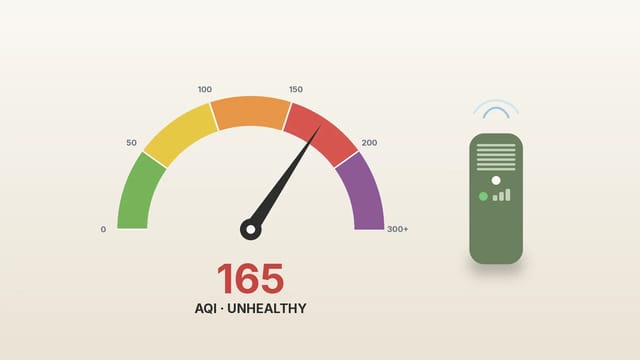
AQI Over 150: When to Run Your Air Purifier and How
AQI over 150 means the air is unhealthy for everyone. Here is exactly when to run your air purifier, what fan speed to use, and how to keep indoor air safe.

Table of Contents
- What AQI 150 Actually Means
- The Golden Rule: Start Before You Hit 150
- What to Do at Each Threshold
- AQI 51 to 100 (Moderate): Start Filtering
- AQI 101 to 150 (Unhealthy for Sensitive Groups): Sensitive People Take Cover
- AQI 151 to 200 (Unhealthy): Everyone Acts
- AQI 201 and Above (Very Unhealthy to Hazardous): Maximum Protection
- How to Run the Purifier Correctly Above 150
- Who Is Most at Risk Above AQI 150
- Symptoms That Mean You Need Cleaner Air Now
- Measure, Do Not Guess
- The Bottom Line
TL;DR
AQI over 150 is 'unhealthy' for everyone, not just sensitive groups. Run your air purifier on high, keep windows and doors closed, and stay in a sealed room where a PM2.5 monitor reads under 12 µg/m³. Do not wait for AQI 150 to start: turn the purifier on at AQI 51, and by 150 it should already be on high. Above AQI 200, run continuously and minimize going outside.
Affiliate Disclosure: CleanAirCritic earns commissions from qualifying purchases through affiliate links on this page. This does not influence our rankings or reviews. All opinions are our own. Learn more
When the air quality index climbs past 150, the air is officially unhealthy for everyone, not just sensitive groups. During wildfire season, AQI can rocket from moderate to hazardous in under an hour as the wind shifts. Knowing exactly what to do at each threshold, and doing it before the air gets bad rather than after, is what keeps your indoor air breathable.
This guide gives you a clear, action-by-action plan tied to the AQI scale, with a focus on the unhealthy range above 150. If the AQI scale itself is new to you, start with our understanding AQI explainer, then come back here for what to actually do.
What AQI 150 Actually Means
The AQI is a 0 to 500 scale that translates pollutant concentrations into a color-coded health category. For wildfire smoke, the pollutant that matters is PM2.5, the fine particles that lodge deep in your lungs and cross into your bloodstream.
| AQI | Category | PM2.5 (approx.) | What it means |
|---|---|---|---|
| 0-50 | Good | 0-12 µg/m³ | Air is clean. No action needed. |
| 51-100 | Moderate | 12-35 µg/m³ | Acceptable, but sensitive people may notice effects. |
| 101-150 | Unhealthy for Sensitive Groups | 35-55 µg/m³ | Kids, older adults, and people with conditions should act. |
| 151-200 | Unhealthy | 55-150 µg/m³ | Everyone may feel effects. Take protective action. |
| 201-300 | Very Unhealthy | 150-250 µg/m³ | Serious effects likely. Stay indoors, filtered. |
| 301+ | Hazardous | 250+ µg/m³ | Emergency conditions. Avoid all outdoor exposure. |
The key line is 150. Below it, the warnings are aimed mostly at sensitive groups. At and above it, the air is unhealthy for the general public. That is the point at which everyone in the household should be indoors with a purifier running.
The Golden Rule: Start Before You Hit 150
The single most important thing to understand is that you should not wait until AQI 150 to act. Smoke infiltrates your home continuously, and once indoor levels spike, it takes hours of filtration to bring them back down. It is far easier to keep clean air clean than to recover dirty air.
Turn your purifier on at AQI 51. Close your windows at the same time. By the time outdoor AQI reaches 150, your purifier should already be running on high in a sealed room and your indoor air should still be clean. Starting early is the difference between riding out a smoke event in comfort and chasing a problem you let get ahead of you.
What to Do at Each Threshold
AQI 51 to 100 (Moderate): Start Filtering
Turn the purifier on, on a low or medium setting, and close your windows. This is the easy, low-effort stage where you lock in clean indoor air before smoke builds. Sensitive individuals should begin limiting prolonged outdoor exertion.
AQI 101 to 150 (Unhealthy for Sensitive Groups): Sensitive People Take Cover
Children, older adults, pregnant people, and anyone with asthma, COPD, or heart disease should move into a sealed room with the purifier running on medium or high. Everyone else should close up the house and keep the purifier going. Limit outdoor activity.
AQI 151 to 200 (Unhealthy): Everyone Acts
Now the air is unhealthy for the whole household. Run the purifier on high. Keep all windows and exterior doors closed, and use a sealed clean room as your base. Verify the room is working with a PM2.5 monitor: your indoor reading should stay under 12 µg/m³. If it does not, improve your sealing or add a second purifier. Minimize trips outside, and wear an N95 if you must go out.
AQI 201 and Above (Very Unhealthy to Hazardous): Maximum Protection
Run the purifier continuously on the highest setting and treat your clean room as your living space. Only go outside when necessary, and mask with a fitted N95 when you do. Re-enter through the room furthest from your clean room and close doors behind you so you do not drag smoke in. Keep checking a real-time AQI source, because hazardous conditions can persist or worsen for days.
How to Run the Purifier Correctly Above 150
Getting the setting right matters as much as turning it on.
- Override auto mode. Auto mode adjusts fan speed based on the unit's intake sensor, which can read locally clean air and cycle down even while the room is still polluted. Above AQI 150, lock it on high.
- Size it for smoke. During a serious event you want a smoke CADR of at least 1.5 times your room's square footage. If your unit is undersized, add a second one. Our best air purifiers for wildfire smoke roundup covers picks by room size.
- Seal the room. A purifier cannot win against a wide-open door. Build a proper clean room using our step-by-step clean air room guide.
- Use both filter types. Make sure your purifier has activated carbon as well as HEPA, so it removes the smoke gases and smell, not just the particles.
Who Is Most at Risk Above AQI 150
The "unhealthy for everyone" label at AQI 151 is not a formality. Above this threshold, even healthy adults can develop symptoms with enough exposure. But some groups feel the effects sooner and more severely, and they should act at the lower 101 to 150 band rather than waiting for 150.
- Children. Their lungs are still developing, they breathe more air per pound of body weight than adults, and they are often more active outdoors.
- Older adults. Age-related decline in lung and heart function makes PM2.5 exposure riskier.
- People with asthma or COPD. Fine particles trigger inflammation and can set off attacks. Keep rescue medication accessible during smoke events.
- People with heart disease. PM2.5 is linked to heart attacks and strokes during high-pollution episodes, not just respiratory symptoms.
- Pregnant people. Smoke exposure during pregnancy is associated with adverse outcomes, so the clean room matters here too.
If anyone in these groups lives with you, treat AQI 101 as your action point, not 150.
Symptoms That Mean You Need Cleaner Air Now
Your body is a sensor too. If you notice any of these while indoors during a smoke event, your indoor air is not clean enough and you should escalate, by moving to your clean room, raising the fan speed, or improving your sealing:
- Scratchy or sore throat and a persistent cough
- Stinging or watering eyes
- Headache or unusual fatigue
- Tightness in the chest or shortness of breath
- A noticeable smoky smell indoors, which means gases are getting through
A smoky smell is an especially useful early warning. If you can smell smoke inside, particles are coming in with it, and your purifier needs more carbon capacity, a higher setting, or better room sealing.
Measure, Do Not Guess
Outdoor AQI from a station miles away is a useful signal, but it is not your indoor air. The only way to know whether your purifier and sealing are actually protecting you is to measure indoor PM2.5 directly. A good monitor shows you in real time whether your clean room is holding the line under 12 µg/m³ or whether smoke is winning.
A PM2.5 monitor also catches the fast swings that define wildfire smoke. Levels can jump from 30 to 200 µg/m³ in under an hour when the wind turns, and a spot check from a weather app will miss it. For monitor recommendations tuned to fire season, see our best PM2.5 monitors for wildfire smoke guide, and to learn how a monitor and purifier work as a team, read air quality monitor vs air purifier.
The Bottom Line
AQI over 150 is the threshold where outdoor air becomes unhealthy for everyone, but your response should begin long before you reach it. Start the purifier at AQI 51, close the windows, and by 150 you should already be running on high in a sealed room with indoor PM2.5 verified under 12 µg/m³. Override auto mode, size your purifier for smoke, and lean on a monitor rather than a guess. Do that and the number on the outdoor AQI map stops dictating the air you actually breathe.
For the full season-long plan, see our wildfire smoke prep guide, and when you are ready to pick a unit, start with our best air purifiers for wildfire smoke roundup.
Last updated: June 2026, ahead of peak fire season. We refresh this guide each wildfire season.
Frequently Asked Questions
Is AQI 150 dangerous?
What PM2.5 level does AQI 150 correspond to?
Should I run my air purifier on high when AQI is over 150?
When should I turn my air purifier on during a smoke event?
How do I know what the AQI is right now?
Can I open my windows if AQI drops below 150 at night?
Do I still need to run the purifier if I am wearing a mask?
You Might Also Like
IQAir HealthPro Plus Review: Is It Worth $1,199?
IQAir HealthPro Plus XE review: does the $1,199 Swiss HyperHEPA purifier justify its price? We break down 0.003-micron filtration, coverage, and value.

Winix 5510 Review: The 5500-2 Successor, Tested
Our Winix 5510 review covers 252 CADR, WiFi and the Smart App, PlasmaWave, noise levels, Filter Q costs, and how it compares to the 5500-2 it replaces.
Best Air Quality Apps for Wildfire Season (2026)
The best air quality apps for wildfire smoke monitoring. Compare AirNow, PurpleAir, IQAir, and built-in weather AQI to build your smoke alert setup.

Wildfire Smoke and Pets: How to Protect Your Dogs and Cats
Learn how wildfire smoke affects pets, recognize warning signs in dogs and cats, and take practical steps to protect your animals during fire season.