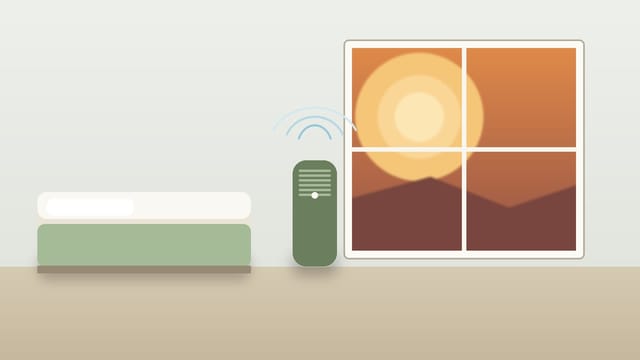
How to Create a Clean Air Room During Wildfire Season
A step-by-step guide to building a clean air room during wildfire season: seal the space, size your purifier, set AQI triggers, and keep one room breathable.

TL;DR
When wildfire smoke hits, you cannot keep your whole house clean, so concentrate on one sealed room. Pick the bedroom, seal the door and window gaps, and run a purifier sized to at least 1.5x the room's square footage in smoke CADR. Move into the clean room when AQI crosses 150, keep the door shut, and verify it is working with a PM2.5 monitor reading under 12 µg/m³. Our top purifier pick for this job is the Levoit Core 600S.
Affiliate Disclosure: CleanAirCritic earns commissions from qualifying purchases through affiliate links on this page. This does not influence our rankings or reviews. All opinions are our own. Learn more
When wildfire smoke settles over your area, the instinct is to clean the air in your whole house. That instinct will exhaust you and your filters. During a dense, multi-week smoke event, smoke leaks in through every window seal, door gap, and HVAC return faster than a few purifiers can keep up with across an entire home.
The strategy that actually works is the one public health agencies recommend: build a single clean air room. You seal one room well, run a properly sized purifier in it, and treat that room as your breathable retreat when the air outside is dangerous. This guide walks through exactly how to do it.
Why One Room Beats the Whole House
Air purifiers work by cycling a room's air through a filter several times per hour. The more air changes per hour you achieve, the cleaner the air stays. A single purifier that struggles to manage a 1,500 sq ft open floor plan can easily dominate a 200 sq ft bedroom, hitting four or five air changes per hour and holding PM2.5 far below outdoor levels.
Sealing matters just as much as filtration. Every gap you close slows the rate at which smoky outdoor air replaces the clean air your purifier just produced. A small, well-sealed room reaches a stable, low PM2.5 level and stays there. A large, leaky space never catches up because fresh smoke keeps pouring in.
There is also a practical reason. During the worst days of a smoke event, you do not need every room clean. You need the room where you sleep, work, and ride out the bad air to be reliably breathable. Concentrating your effort there is simply the highest-return move.
Step 1: Choose the Right Room
Pick the smallest room where you spend the most time. For nearly everyone, that is the bedroom. You spend seven to nine hours there sleeping, and a smaller footprint is far easier to seal and filter.
Favor a room with:
- Few windows and no exterior doors
- No fireplace or wood stove
- An interior location if possible, away from the side of the house facing the smoke
- Enough space to place the purifier away from walls
Avoid rooms with large window banks, sliding patio doors, or direct outdoor access. Those are leak magnets and will fight your purifier the entire time.
Step 2: Seal the Gaps
Sealing is the unglamorous step that makes the biggest difference. Your goal is not a hermetic chamber. It is to slow infiltration enough that your purifier stays ahead of the smoke.
Work through this checklist:
- Windows: Close them fully and lock them, which pulls the sash tight against the seal. For older or leaky frames, run painter's tape along the gaps.
- The door: Place a rolled towel or a draft stopper along the bottom. This single gap is often the largest leak in the room.
- Vents and registers: If the room has supply or return vents tied to a central system that pulls outdoor air, cover them temporarily. If your HVAC recirculates indoor air through a MERV 13 filter, you can leave them open as a supplement.
- Fireplaces and flues: Close the damper and, if needed, block the opening. Chimneys are a direct path for outdoor smoke.
- Outlets and small gaps: In extreme events, you can cover unused outlets on exterior walls, though this is a refinement, not a requirement.
Do not seal the room so tightly that you trap stale air with no fresh exchange at all. A normal bedroom with a closed door and these basic seals still exchanges enough air to be safe to occupy. You are slowing infiltration, not eliminating ventilation.
Step 3: Size and Place Your Purifier
This is where most people undersize. The everyday rule of thumb, a smoke CADR equal to two-thirds of your room's square footage, assumes normal air quality. Wildfire smoke is dense and relentless, so size up.
Use this formula: room square footage × 1.5 = minimum smoke CADR.
| Room size | Minimum smoke CADR | Suitable purifier |
|---|---|---|
| 150 sq ft | 225 CFM | Winix 5510 or Medify MA-40 |
| 200 sq ft | 300 CFM | Medify MA-40 or Levoit Core 600S |
| 300 sq ft | 450 CFM | Levoit Core 600S |
| 400+ sq ft | 600+ CFM | Two purifiers, or step up to a whole-room unit |
For a clean air room you need both filtration types: True HEPA for the fine particles and activated carbon for the gases and smell. A purifier with a thin or absent carbon stage will clear the haze but leave the acrid smell and the irritating VOCs behind. For the science on why, see our explainer on carbon filter vs. HEPA, and if CADR ratings are new to you, start with what is CADR.
Our top all-around pick for a bedroom clean air room is the Levoit Core 600S, which pairs a 410 CFM smoke CADR with a built-in PM2.5 sensor so you can watch your indoor air quality respond. For the full ranked list across budgets and room sizes, see our best air purifiers for wildfire smoke roundup.
Placement matters too. Set the purifier a foot or two away from walls and out of corners so it can pull and push air freely. Putting it near where you sit or sleep gives you the cleanest air right where you breathe.
Step 4: Set Your AQI Triggers
A clean air room only helps if you use it at the right time. Tie your behavior to the Air Quality Index. If AQI is unfamiliar, our understanding AQI guide breaks down what each level means.
- AQI 51 to 100 (moderate): Start running the purifier. Keep windows closed.
- AQI 101 to 150 (unhealthy for sensitive groups): Move into the clean room. Run the purifier on medium or high. Keep the door closed.
- AQI 151 to 200 (unhealthy): Treat the clean room as your base. Run on high, minimize trips out, and close the door each time you pass through.
- AQI 201+ (very unhealthy and beyond): Stay in the clean room. Run continuously on the highest setting. Only leave when necessary, entering from the room furthest away to avoid dragging smoke in.
For practical guidance on what to do once readings climb past the unhealthy threshold, see our companion guide, AQI Over 150: When to Run Your Air Purifier and How.
Step 5: Verify It Is Actually Working
Sealing and sizing are inputs. The output you care about is your indoor PM2.5 level, and the only way to know it is to measure it. A PM2.5 monitor turns your clean room from a hopeful guess into a verified result.
With the room sealed and the purifier running, your indoor PM2.5 should hold under 12 µg/m³ even when outdoor levels are in the hundreds. If your reading climbs, troubleshoot in this order: check for a sealing leak (usually the door), confirm the purifier is on a high enough setting, and reduce how often you open the door. If it still will not drop, the room is too big for the purifier and you should add a second unit.
For monitor recommendations tuned to fire season, see our best PM2.5 monitors for wildfire smoke guide.
Maintain the Room Through the Event
Wildfire smoke chews through filters two to four times faster than normal use. A filter rated for six months may be spent in six to eight weeks of continuous smoke. Check the filter every couple of weeks. If it is visibly gray or brown, or the purifier stops knocking down the smell, replace it. Keep at least one spare filter set on hand before fire season starts, because they sell out fast once a major fire is burning.
Common Clean Room Mistakes
A few errors come up again and again and quietly undermine an otherwise good setup:
- Picking too large a room. A 600 sq ft great room is far harder to seal and filter than a 150 sq ft bedroom. Smaller is better.
- Trusting auto mode during a severe event. Auto can cycle the fan down when the intake reads locally clean air. Lock it on high above AQI 150.
- Opening the door constantly. Every trip in and out resets your indoor air. Batch your trips and close the door each time.
- Forgetting carbon. A HEPA-only purifier clears the haze but leaves the smell and gases. Use a unit with activated carbon.
- Never measuring. Without a PM2.5 monitor you are guessing. A $50 to $100 monitor turns the whole setup into something you can verify.
The Bottom Line
You cannot out-purify an entire smoky house, but you can absolutely keep one room clean. Choose the bedroom, seal the gaps, run a purifier sized to 1.5 times the room's square footage in smoke CADR, and verify the result with a PM2.5 monitor. Do that and you will have a reliable, breathable retreat no matter how bad the air gets outside.
For the broader season-long checklist, including when to buy and how to stock filters, read our wildfire smoke prep guide. When you are ready to choose a unit, our best air purifiers for wildfire smoke roundup covers picks for every room size and budget.
Last updated: June 2026, ahead of peak fire season. We update this guide each spring before western US wildfire season begins.
Frequently Asked Questions
What is a clean air room?
Which room should I use for my clean air room?
How do I size an air purifier for a clean air room?
When should I move into my clean air room?
Do I need a carbon filter for a clean air room?
How do I know my clean air room is actually working?
Can I use my HVAC system instead of a clean air room?
You Might Also Like
IQAir HealthPro Plus Review: Is It Worth $1,199?
IQAir HealthPro Plus XE review: does the $1,199 Swiss HyperHEPA purifier justify its price? We break down 0.003-micron filtration, coverage, and value.

Winix 5510 Review: The 5500-2 Successor, Tested
Our Winix 5510 review covers 252 CADR, WiFi and the Smart App, PlasmaWave, noise levels, Filter Q costs, and how it compares to the 5500-2 it replaces.
Best Air Quality Apps for Wildfire Season (2026)
The best air quality apps for wildfire smoke monitoring. Compare AirNow, PurpleAir, IQAir, and built-in weather AQI to build your smoke alert setup.
Wildfire Smoke and Pets: How to Protect Your Dogs and Cats
Learn how wildfire smoke affects pets, recognize warning signs in dogs and cats, and take practical steps to protect your animals during fire season.